

These are some of the important discoveries made in Oplontis-Torre Annunziata at the excavation and restoration site of the Villa di Poppea, which influences the famous hall of the Mask and the Peacock, decorated in the 2nd style. The excavation reveals the first new glimpses of refined frescoes, including vivid figures of peacocks and masks.
The intervention is an important opportunity to strengthen the archaeological and urban context. Thanks to the ongoing excavations, a connection will even be created with the neighboring Spolettificio Borbonico, which will house museum exhibition spaces, warehouses and other services in the coming years. The director of the park, Gabriel Zuchtriegel, emphasizes how despite the traces present and the interpretive efforts made at the time of the first excavations, the real trend of this environment and the nearby environment still contains many uncertainties that the current excavation intervention will be able to clarify. “as well as highlighting new areas decorated with extraordinary details and colors, of which we can already admire some previews”.
Oplontis excavation site | Courtesy of the Archaeological Park of Pompeii
Thanks to the casting technique, the excavation revealed the prints of trees that adorned the garden. The original position, within a precise ornamental scheme, is reminiscent of patterns documented in the Pompeian domus and at the Oplontis site itself. Four new rooms have also been identified, in addition to the 99 already known, including an apse room that is probably part of the spa sector. An ancient section of the bottom of a seasonal stream was also discovered, flowing exactly in accordance with the route of the Via dei Sepolcri, probably formed after the eruption of 1631.
“These first results – assures the director – offer new and promising research perspectives for the knowledge of the villa plan and for the study of the interactions between human habitation and natural environment in the long term.” At the same time, work is also underway to restore the decorative elements of two cubes, small rooms originally intended as a rest area, overlooking the southwestern part of the Villa. These rooms are a triumph of stuccowork, frescoed walls, painted vaults and floor mosaics that indicate the high technical skills of the executors of the will. Egyptian blue also stands out in the pigment palette.
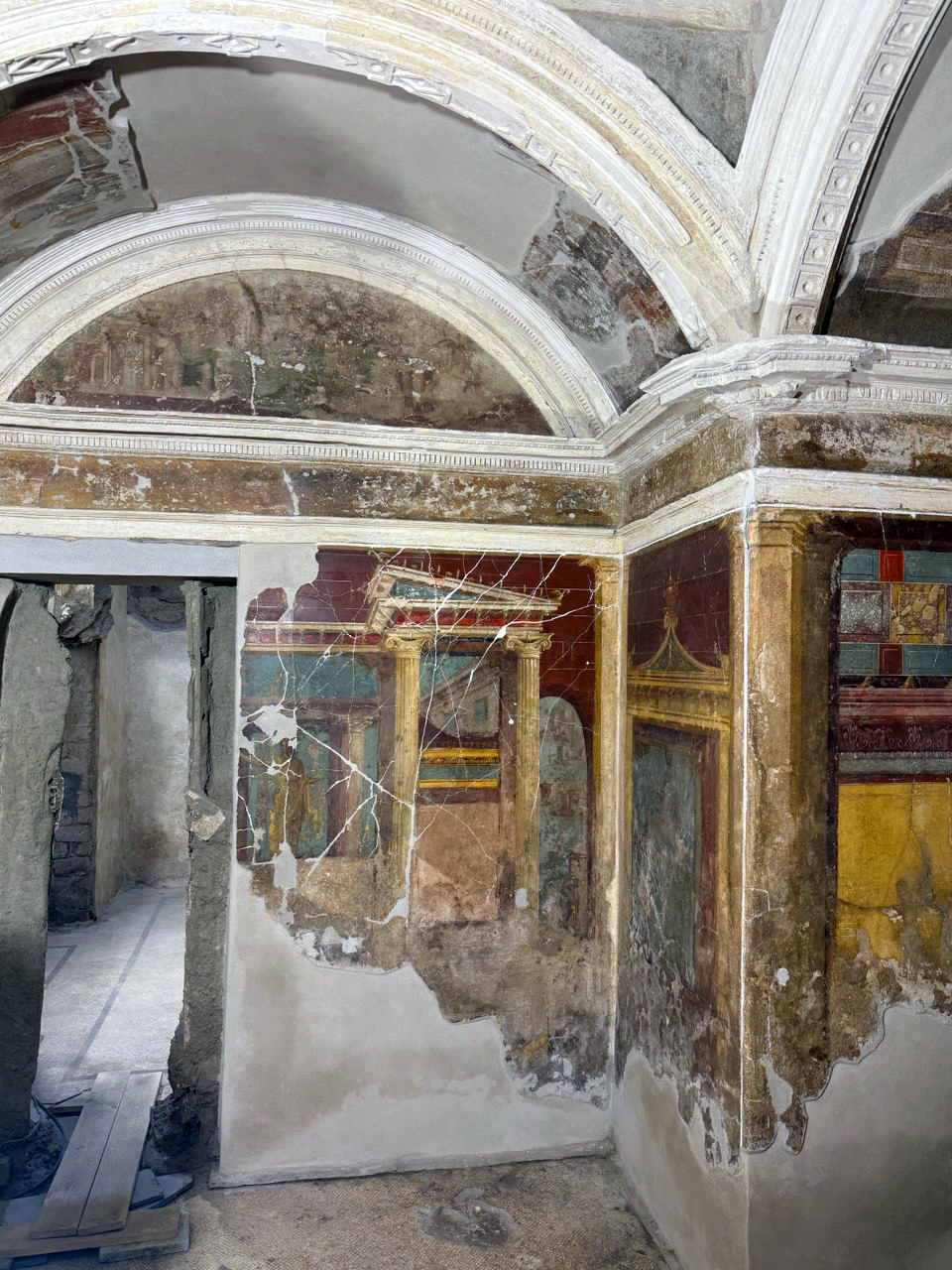
Excavation site Oplontis, cell | Courtesy of the Archaeological Park of Pompeii
The intervention aims to restore the full legibility of the painted decoration and mosaics, modified by time and the materials used in previous restoration interventions. The first room is decorated with 2nd style frescoes representing faux marble and fantastic architecture. Looking up, you can admire the vaults decorated with a coffered motif and the lunettes representing landscapes. Only part of the mosaic floor has been preserved, with black and white tiles with geometric patterns. A passage leads to a second room, decorated in the third style with monochrome backgrounds and floral motifs and in which various construction phases can be recognized, some of which are not yet completed as it must have been in a state of renovation at the time of the eruption.
The restoration work, almost complete after about a year of work, has returned the frescoes and floors to their original splendor, revealing colors and details that were previously invisible.
#Masks #peacocks #emerge #excavation #site #Villa #Poppea #Oplontis #Naples #Arte.it