

“RIP SaaS, hello AI” has become a popular refrain online, implying that AI will replace SaaS. However, that framework ignores how martech stacks actually work.
The debate between SaaS and AI has led to endless speculation: will one overtake the other? Will software vendors disappear as AI matures? These questions sound bold, but they miss the real issue.
A future-proof stack is not defined by which category of software you use, but by how effectively you manage its output, regardless of the underlying technology.
AI does not replace SaaS. Both belong to the same continuum of how companies build technological capabilities to execute and adapt.
The real change leaders need to make is simple but profound: stop seeing the stack as a collection of tools and start managing it as a portfolio of capabilities.
What is new and unique about AI?
AI agents introduce a new class of technology based on large language models instead of traditional code-and-database architectures. The challenge lies in producing predictable results.
Because AI is adaptive and probabilistic, its power lies in augmentation – improving human and system performance – rather than complete replacement.
AI agents are most effective when they are designed for a specific, well-defined task. Their targeted scope allows them to deliver reliable results within clear boundaries.
Platforms such as n8n, relay.app or gumloop offer a range of agent templates that handle very detailed tasks such as:
- Automation of newsletters (personalized sending times, repurposing of content).
- Cleaning and enriching leads (checking the validity of emails, adding missing firmographic data).
- Outreach sequencing (AI personalized follow-ups triggered by behavioral signals, social monitoring, lead qualification).
Dig deeper: 7 tips to get started with AI agents and automations
Is SaaS very different from AI?
Yes and no. SaaS, by its nature, operates through rules-based systems that deliver predictable results. You know what you’re getting and it scales reliably. In that sense it behaves differently from AI.
Yet SaaS – like AI – was never really about the tools themselves. For years, analysts evaluated best-in-class software, but rarely examined how brands actually used these tools. The prevailing assumption was that the technology would underperform if every feature was not used.
In most SaaS products about 12% According to Pendo research, most features account for the majority of usage. Gartner reports that only about a third of available tools are used at all. Seen through the lens of Pendo, that level of adoption is surprisingly strong.
Our own research at MartechTribe reinforces this pattern: the value of SaaS lies less in the tool as a whole and more in the selected features that teams rely on most.
Composability works much like Lego blocks: individual, interchangeable components that connect together to form what is needed. Shadow IT and point solutions often filled the missing pieces, driving experimentation and innovation.
This dynamic has long shaped the martech SaaS landscape, which has evolved into a long tail of specialized apps – with countless smaller apps running around a smaller number of core platforms. That trend is accelerating as AI models are integrated into more and more niche solutions.
When do you choose AI or SaaS?
Both AI and SaaS now operate in increasingly atomized ways, making composability the everyday reality of stack management. It’s tempting to think of them as competitors, but that mentality doesn’t reflect how they actually function together.
Both operate according to the same logic, but their strengths differ.
- SaaS offers reliability and predictability: the solid foundation you can rely on.
- AI offers flexibility and adaptability, adding a layer of creativity and responsiveness that SaaS alone cannot provide.
The two do not cancel each other out. They work together.
Jason Lemkin described this contrast through the idea of vibe coding.
- SaaS is stable, reliable and forms the backbone on which you build.
- AI, on the other hand, is probabilistic. It can surprise you, sometimes brilliant, sometimes frustrating. That makes it less suitable for replacement, but exceptionally useful for augmentation.
Scott Brinker expanded on Lemkin’s concept with a scale that illustrates how AI and SaaS come together in a fluid set of possibilities. Within this fabric, SaaS platforms, AI agents, use cases, workflows, datasets, and human skills are woven around customer journeys.
The bottom line: Capacity management has become the de facto currency of the stack – the smallest unit that determines how effectively your ecosystem performs.
Dig Deeper: Why Marketers Need to Master Capability Assessment and Tool Purchasing
What exactly are capabilities?
A skill is simply the ability to accomplish a task or task. It doesn’t matter whether that task is enabled by a SaaS feature, an AI agent, a workflow, a data set, or a human skill. What matters is that the capability exists, that it can be relied upon, and that it can be integrated into the larger system.
This is where leaders need a change in perspective. For too long, piles looked like shopping lists of apps: CRM here, marketing automation there, plus a handful of AI pilots thrown in for good measure. The result is bloat and a proliferation of tools.
But if you take a step back, those tools are just containers. What really matters is what they allow you to do. Seen through that lens, a stack is less a static toolbox and more a living system of capabilities, constantly evolving as customer needs, competition and market conditions change.
Organize your strategic capabilities
Viewed this way, stacks behave more like solar systems. Each has a center of gravity – the core platforms – with specialized apps, AI agents, workflows and human skills that revolve around it.
Traditionally, SaaS has served as the backbone of these systems. You determine the rules, the software executes them and the results remain consistent. That’s why SaaS is so effective for CRM, billing, compliance, and workflow automation.
However, AI works differently. It can brainstorm, generate, and respond in ways that SaaS never could. But people who are informed are also needed, because good enough is not always the same as correct.
Together these components form an organizational chart of possibilities. SaaS, AI and human skills go hand in hand and each play a separate role. A after that visualized this concept went viral on LinkedIn in May.
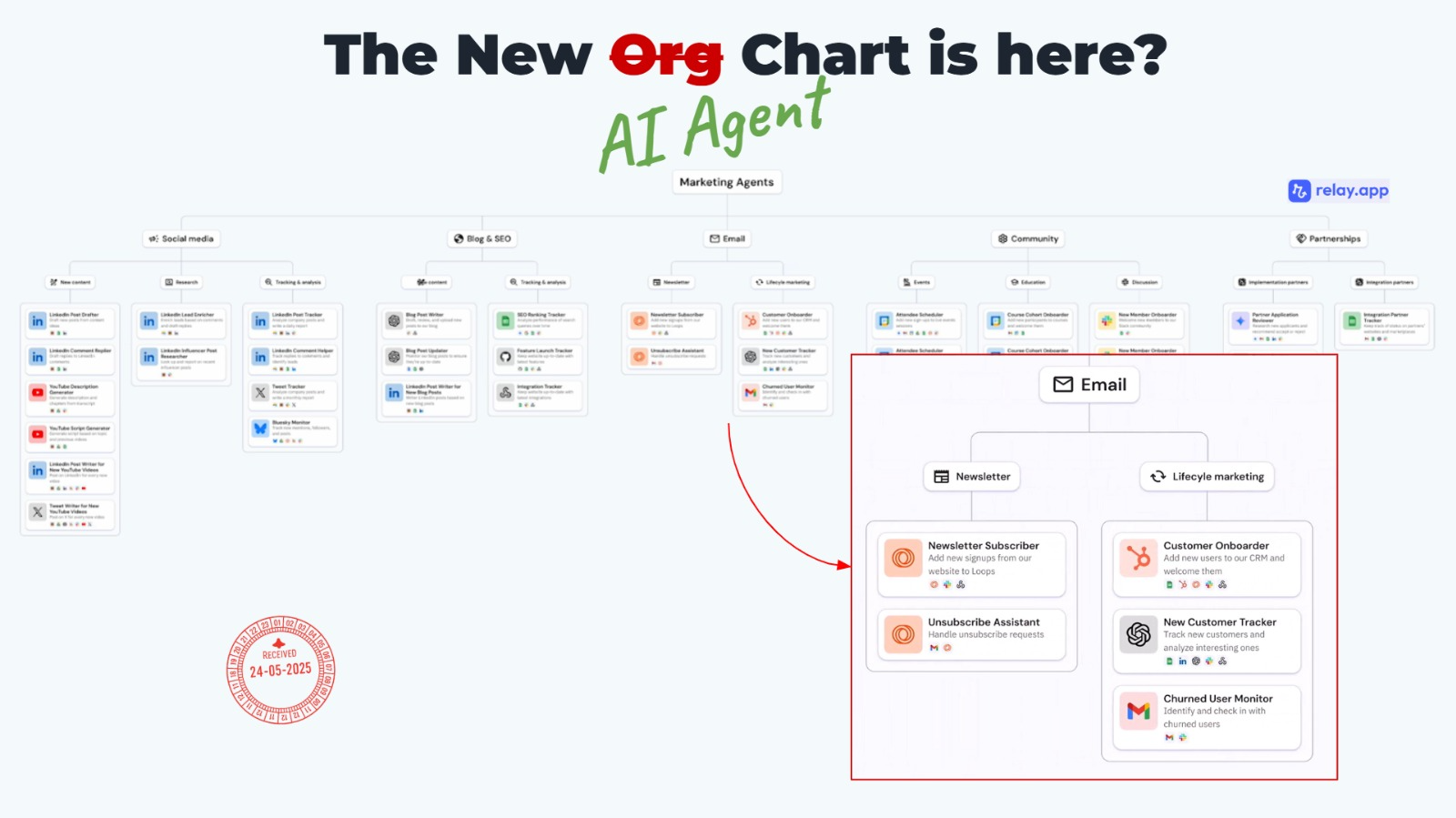
The post showed a template for the marketing team of a SaaS startup – organized according to ability rather than a tool, seamlessly combining functions, AI agents and human skills.
While this template is appropriate for a SaaS startup, we found a similar pattern across more than 1,600 global martech stacks: there is no one-size-fits-all model. Each organization brings together a unique mix of capabilities shaped by industry, business model and company size.
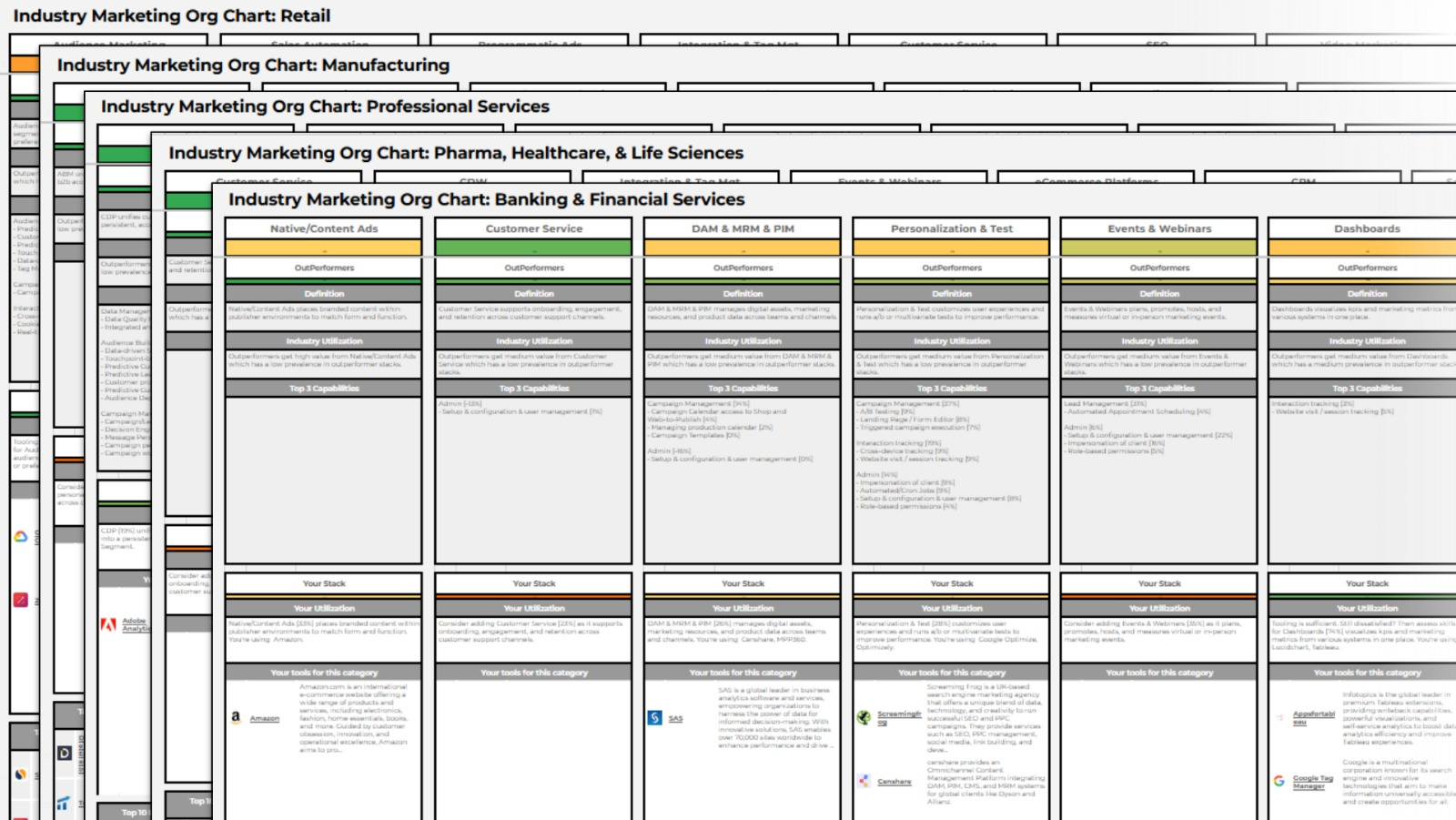
Tests comparing capacities in different sectors confirmed this: the differences are large. This is the future of stack management – not tools, apps or categories, but capabilities organized around the tasks at hand.
Manage your martech stack through capabilities
The benefit now comes from how you connect and apply what your tools can do. A martech stack functions as a living system of capabilities, powered by SaaS, AI agents, workflows, and human skills – each serving a clear purpose within the whole.
It’s not about how many tools you have, but how well they work together to achieve real results. The companies that lead the way will be those that view capability management as a strategic priority and adapt their systems as quickly as their markets change.
Energize yourself with free marketing insights.
Contributing authors are invited to create content for MarTech and are chosen for their expertise and contribution to the martech community. Our contributors work under the supervision of the editors and contributions are checked for quality and relevance to our readers. MarTech is owned by Semrush. The contributor was not asked to make any direct or indirect mentions of it Semrush. The opinions they express are their own.
#Martech #stacks #evolve #capabilities #tools #MarTech