

Only a handful of countries, including India and Vietnam, do not yet participate in CARF, making country selection increasingly important for crypto investors.
The Crypto-Asset Reporting Framework (CARF) is an international initiative designed to improve reporting and compliance on crypto asset ownership across all jurisdictions.
For expats, investors and financial institutions, understanding CARF and which countries participate (or don’t) is critical to ensuring regulatory compliance and avoiding fines.
This article covers:
- What is the reporting framework for crypto assets?
- How does CARF ensure continued compliance?
- Which countries are not part of CARF?
- How do you avoid capital gains taxes in crypto?
Key Takeaways:
- CARF introduces automatic global reporting for crypto assets.
- Reporting will begin in phases from 2027 to 2029.
- Crypto exchanges and custodians bear the reporting burden.
- CARF reduces the ability to store crypto offshore without disclosure.
My contact details are hello@adamfayed.com and WhatsApp +44-7393-450-837 if you have any questions.
The information in this article is intended as general guidance only. It does not constitute financial, legal or tax advice, and is not a recommendation or invitation to invest. Some facts may have changed since the time of writing.
What is CARF reporting?
The Crypto-Asset Reporting Framework, or CARF, is a global standard for collecting and exchanging information about crypto asset holdings and transactions.
It requires crypto service providers, such as exchanges and custodians, to report users’ crypto activities to tax authorities.
CARF aims to increase transparency, reduce tax evasion and harmonize reporting standards internationally.
CARF reporting covers several types of crypto assets, including cryptocurrencies such as Bitcoin, Ethereum, and other tokens that meet the framework’s definition of crypto assets.
What is the purpose of CARF?
CARF’s primary goal is to ensure that taxpayers accurately report crypto holdings and transactions to their local tax authorities.
By enabling automatic exchange of information (AEOI) between participating countries, CARF aims to:
- Prevent tax evasion through anonymous or cross-border crypto transactions
- Improve compliance of financial institutions and crypto service providers
- Standardize reporting requirements globally, making compliance easier for international investors
CARF Reporting Requirements
CARF requires crypto service providers to collect and report user identities and crypto transaction data to tax authorities.
In practice, this means that exchanges, custodians and certain wallet providers must report information such as customer identification data, crypto asset balances and transaction activity.
Reports are typically submitted annually and automatically shared among participating tax authorities under information sharing agreements.
Who is likely to be affected?
Anyone using a CARF-compliant crypto platform could be affected, regardless of where they live.
This includes individual investors, expats and offshore clients who hold crypto through exchanges or custodians operating in CARF jurisdictions.
Crypto companies themselves are also directly affected, as they bear the reporting and compliance burden.
Non-CARF countries
As of December 2025, only five relevant jurisdictions, such as Argentina, are still non-CARF, while more than 75 jurisdictions have committed to CARF reporting between 2027 and 2029, according to the OECD.
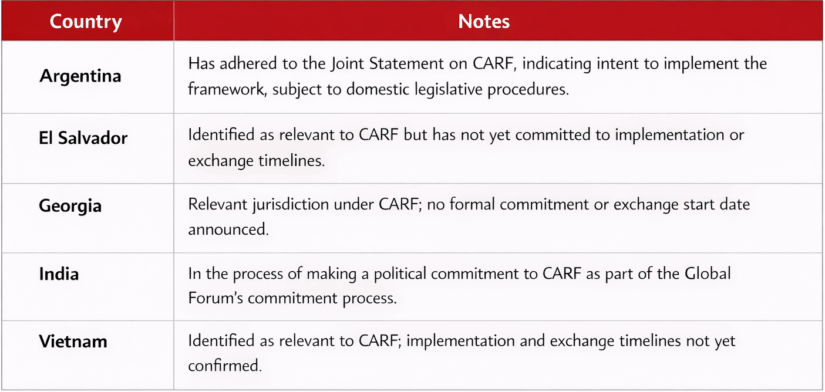
Non-CARF countries are jurisdictions that have been identified as relevant to the Crypto-Asset Reporting Framework, but have not yet formally committed to implementing CARF.
The Global Forum has identified the following jurisdictions as not yet committed to CARF implementation:
- Argentina
- El Salvador
- Georgia
- India
- Vietnam
Some of these jurisdictions have expressed their intention to adopt CARF in the future, but until national legislation and exchange agreements are in place, they will remain non-CARF jurisdictions.
Importantly, non-CARF status does not mean crypto activity is unregulated or tax-free.
Local tax reporting obligations may still apply, and CARF reporting may still occur indirectly if crypto platforms operate in CARF participating countries.
Which countries are part of CARF?
CARF countries, such as the United Kingdom and the UAE, are jurisdictions that have formally committed to implementing the Crypto-Asset Reporting Framework and automatic information exchange.
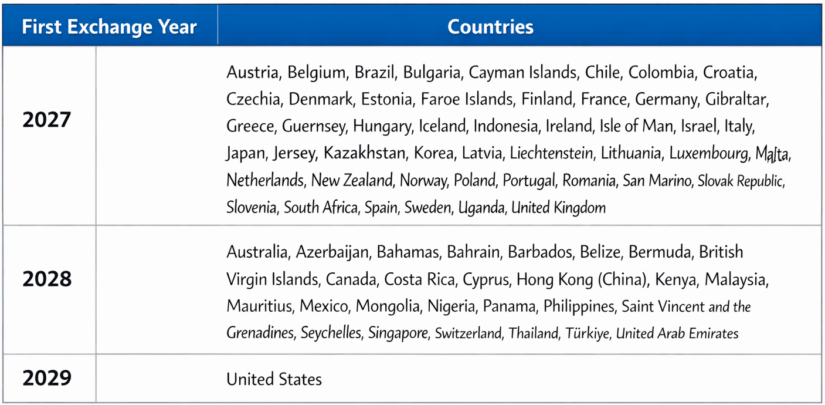
The Global Forum has grouped CARF countries according to their planned first year of exchange:
Jurisdictions undertaking first CARF exchanges by 2027
- Austria
- Belgium
- Brazil
- Bulgaria
- Cayman Islands
- Chile
- Colombia
- Croatia
- Czech Republic
- Denmark
- Estonia
- Faroe Islands
- Finland
- France
- Germany
- Gibraltar
- Greece
- Guernsey
- Hungary
- Iceland
- Indonesia
- Ireland
- Isle of Man
- Israel
- Italy
- Japan
- Jersey
- Kazakhstan
- Korea
- Latvia
- Liechtenstein
- Lithuania
- Luxembourg
- Malta
- The Netherlands
- New Zealand
- Norway
- Poland
- Portugal
- Romania
- San Marino
- Slovak Republic
- Slovenia
- South Africa
- Spain
- Sweden
- Uganda
- United Kingdom
Jurisdictions undertaking first CARF exchanges by 2028
- Australia
- Azerbaijan
- Bahamas
- Bahrain
- Barbados
- Belize
- Bermuda
- British Virgin Islands
- Canada
- Costa Rica
- Cyprus
- Hong Kong (China)
- Kenya
- Malaysia
- Mauritius
- Mexico
- Mongolia
- Nigeria
- Panama
- Philippines
- Saint Vincent and the Grenadines
- Seychelles
- Singapore
- Switzerland
- Thailand
- Turkiye
- United Arab Emirates
Jurisdictions undertaking first CARF exchanges by 2029
The United States is notable because it will not participate in CRS but will implement CARF-style reporting through its own regulatory and tax enforcement framework.
How many countries are crypto legal?
Crypto is legal or allowed in approximately 110 to 120 countries around the world.
These jurisdictions generally allow individuals to own, trade or use crypto assets, although regulatory treatment varies widely.
Remark:
- Legal or tolerated: approximately 110–120 countries
- Restricted or partially prohibited: about 30-40 countries
- Generally prohibited: less than 10 countries
Even in countries where crypto is legal, there may be restrictions through banking access, exchange licensing, taxation or reporting requirements such as CARF or CRS style rules.
How much crypto can I withdraw without paying taxes?
There is no universal tax-free threshold for cryptocurrency withdrawals under CARF.
CARF handles reporting, not taxation.
Whether tax is due depends on local rules, including capital gains thresholds, holding periods and whether crypto is treated as income or as an asset. In many jurisdictions, even small profits may be taxable.
What is the difference between CARF and CRS?
CARF applies to crypto assets, while CRS applies to traditional financial accounts.
CRS relates to bank accounts, investments and custodial assets. CARF fills the gap by focusing on crypto assets that previously fell outside standard financial reporting frameworks.
Together they create broader global financial transparency.
What are the main differences between FATCA and CRS?
FATCA is focused on the US, while CRS is a global standard.
FATCA requires reporting from US persons to the IRS. CRS enables mutual exchange of financial information between participating countries.
CARF follows the CRS model, but focuses specifically on crypto assets rather than bank or investment accounts.
| Function | CARF | CRS | FATCA |
| Full name | Reporting framework for crypto assets | Common reporting standard | Foreign Accounts Tax Compliance Act |
| Domain | Crypto assets (cryptocurrencies, certain tokens) | Traditional financial accounts (bank accounts, investments) | Foreign accounts of US persons |
| Issuing agency | OECD / Global Forum | OECD | United States (IRS) |
| Who must report? | Crypto exchanges, custodians, certain wallet providers | Banks, financial institutions | Foreign financial institutions |
| Who is reported | Crypto asset holders | Account holders | US citizens, residents and entities |
| Type of reporting | Automatic exchange of crypto asset information | Automatic exchange of financial account information | Report to the tax authorities |
| Geographic reach | Global (OECD-led) | Global (100+ countries) | US-focused |
| First reporting period | 2027–2029 (phased) | Ongoing | Ongoing |
| Does cryptocurrency cover? | Yes | No | Indirectly (via US tax rules) |
| Cover bank accounts? | No | Yes | Yes (for US persons) |
| Sanctions for non-compliance | Determined by local tax law | Determined by local tax law | Heavy US penalties and withholding |
In short
As CARF is rolled out from 2027 to 2029, the scope of crypto reporting will rapidly expand.
Investors using exchanges or custodians in CARF jurisdictions can expect greater visibility from tax authorities, even if they reside in non-CARF countries.
Frequently asked questions
What is the penalty for not reporting cryptocurrency?
The penalties for not reporting cryptocurrencies depend on local tax law, and not CARF itself.
CARF enables information sharing, but enforcement is handled domestically. Penalties may include fines, interest on unpaid taxes, audits or criminal prosecution in cases of intentional tax evasion.
Do I have to report crypto if I haven’t sold?
Yes, even without sales, reporting may still be required.
Under CARF, exchanges can report holdings and balances, not just divestitures. Tax obligations depend on local rules, but visibility to tax authorities may exist regardless of the activity.
What is a non-CRS country?
A non-CRS country does not automatically exchange financial account information with other jurisdictions.
Likewise, non-CARF countries do not participate in the automatic reporting of crypto assets, although this does not eliminate local tax or disclosure obligations.
Tormented by financial indecision?

Adam is an internationally recognized financial author with over 830 million answer views on Quora, a best-selling book on Amazon, and a contributor to Forbes.
#List #NonCARF #Countries #CryptoAsset #Reporting #Framework