

Preparation of the exhibition Leonora Carrington In Palazzo Reale in Milan.
Curata da Carlos Martin and Tere ArcQThe exhibition is the result of a long preparation and complex negotiations. Produced by Palazzo Reale, together by MondoStre, Civita exhibitions and museums and Electa, the operation continued, despite the threat of American tasks and the fear that some lenders were back because of the geopolitical situation (which we may unfortunately have to get used to the near future). But the efforts are well rewarded. The quality is confirmed by the fact that after Milan it is also organized by the Musée du Luxembourg in Paris.
In addition to the rhetoric related to gender equality, Carrington offers a look that goes beyond any label. The route of the exhibition seduces both the women’s audience, who will find a courageous explorer of the female universe in Carrington and in general of the human soul, that the audience of men who can observe the X -rays of the female’s complexity. For example the difference between the thin sign of Carrington in “Double Portrait with Max Ernst“(1938) and the masculinity of the red in the painting”Divinity“By Max Ernst (1940), his life partner between 1938 and 1940.
Leonora Carrington, A map of the human animal1987
Leonora Carrington was an energetic character, a woman with a complex and moon personality. During his life, art has represented the tool for the inner research to create useful maps to orientate himself in his visionary life, fishing among the deepest demons in search of truth.
Carrington, born before her time, lives his golden season today: it is that we are the most mature audience to understand it better. “Artist women generally talk about different and unconventional things and do this differently. Leonora Harrington has left a pictorial and literary heritage, no matter how very important and rich intellectual,” said the curator Carlos Martin.
Carrington’s life is new. From excellent family, born in 1917 in England, he grows among the Celtic fairy tales told by his grandmother and the rigid Victorian conventions. Relationships with the father are contradictory: Leonora Carrington knows and falls in love with one Has love For Max Ernst (she is not more than twenty years old, he 46 years old) but their relationship is forced to escape with her father and the two are forced. They will find refuge (she little more than twenty years old, he 46 years old) first in Paris, where Carrington participates in the international surrealistic exhibition, and then in Saint-Martin-D’ardèche, in the south of France. Here he receives the visit from some friends such as Leonor Fini, Lee Miller, the Éluard, Man Ray and Tristan Tzara. With the start of the war, Max Ernst, from German descent, is trapped by the French authorities and Leonora Carrington flight to Spain with the intention of reaching Lisbon to cross the Atlantic Ocean. Once in Madrid, Carrington undergoes rape by the Franco soldiers, followed by a serious nervous crisis. In August he was admitted to a hospital in a sanatorium in Santander on behalf of his parents. In 1941 he reached New York, where he resumed relations with the community of European artists, including André Breton, Roberto Matta and Marcel Duchamp and the following year he landed in Mexico, where he met the man of his life “Chiki” Weisz, a photographer of Robert Capa.
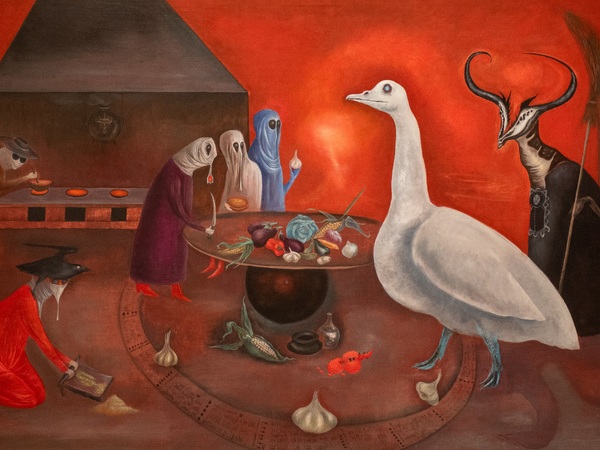
Leonora Carrington, Grandmother Moorhead’s aromatic cuisine1975
The information system that the visitor accompanies at the exposure spaces, together with the many photos it published in black -white, alone or with Max Ernst, to the pages of the books he published with the illustrations of Max Ernst, until the two audiovisual documents, is very effective. One in particular, the interview on video, is a valid contribution that brings the public closer to Leonora Carrington. Sometimes it speaks in Spanish, sometimes in English. With the face marked by wrinkles, the living look and the sturdy voice, Leonora Carrington tells about herself. Everything is gone now, which remains is the love for his children. She says it herself. And that love flows into the cloths of the Mexican period, exhibited in the adjacent room, where it is easy to trace the references to the Italian Hot painting.
The exhibition is the map of a geographical and mental journey, initiative and spiritually looking for identity. The mirror of current issues to make it more contemporary: Woman, Migrant, Avant -Garde to the themes of minorities, ecology and feminism, but all this appears as a superstructure that histories the artist, who is crushing her to become the heroine of our time, is sought in the Carrignon. Without a doubt Leonora Carrington was an artist and unconventional person.
The works of the Mexican period are common: alchemical, esoteric, magical visions. Worlds inhabited by men, animals and plants as if they were syncretism between the Italian pictorial story and the Mexican tradition. And then unusual topics: the house and the kitchen, for many women who expression of the place of oppression, for Leonora Carrington they become spaces of creativity and laboratory where female power is exercised. Some works that resume the atmospheres of the Flemish painters, improve the ancestor forces of women as a custodian of the earth and healercurator.
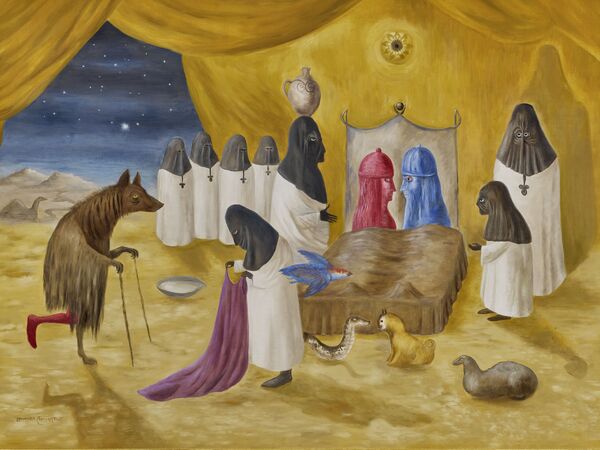
Leonora Carrington, The loved ones1987
They called her a woman of the Renaissance, total artist. In his art he experienced various techniques and topics. But not only: he deepened different topics: religion, mathematics, hermetism as only certain figures of humanism have been able to do.
A small note. In a room in the Prado Museum in Madrid, in addition to a few portraits of Velásquez, a bust woman was painted by Pablo Picasso. The effect is quite surprising because you don’t expect it, but no explanation is required. Picasso was aware of the inheritance that the art of great masters had practiced on him, and he, great artist, had developed his language that continued and overcame tradition.
The Milanese exhibition states on the dialog that Leonora Carrington includes the artists of the many re -births (Italian, Vlaams). It would have been nice to admire the visions that inspired them to understand the power of that dialogue, never interrupted through the centuries that the artists pack the artists together with Carrington.
#Leonora #Carrington #surrealistic #dream #conquers #Milan #Arte.it