

The International Monetary Fund (IMF) warned that the increasing adoption of stablecoins could weaken central banks’ control over monetary policy and threaten countries’ financial sovereignty.
While stablecoin adoption makes payments faster and cheaper for people, “it reduces the ability of a country’s central bank to control its monetary policy and serve as a lender of last resort.” the IMF said in a blog post which highlighted the findings of a 56-page report on the subject.
The promise that stablecoins offer is also coming with the risk of “countries losing control over capital flows,” it added.
Stablecoins can ‘rapidly enter an economy’
Historically, investors who wanted to hold US dollars or a fiat currency other than that of their country had to hold cash or open specific bank accounts.
But stablecoins allow anyone to access the underlying asset it represents on-chain, something the IMF says allows cryptos to “rapidly penetrate an economy through the internet and smartphones.”
The cross-border nature of stablecoins could simplify transfers and payments, but also complicate monetary policy and financial stability in emerging markets. A new IMF report explores the challenges and opportunities. https://t.co/eVss5tPsFn pic.twitter.com/ERq3MwxPTz
— IMF (@IMFNews) December 4, 2025
“The use of foreign currency-denominated stablecoins, especially in cross-border contexts, could lead to currency substitution and potentially undermine monetary sovereignty, especially in the presence of unhosted wallets,” the IMF said.
It cited citizens in regions such as Africa, the Middle East, Latin America and the Caribbean, who are increasingly holding their money in stablecoins rather than in local foreign currency bank accounts. That often happens concerns about financial instability and even survival, the report said.
The IMF also said that it is becoming more difficult for central banks to steer their countries’ monetary policies because they do not have accurate data from local currency accounts.
CBDC has difficulty competing with stablecoins
Given that stablecoins operate on a distributed ledger and do not require a central third party to process and validate transactions, a central bank would have very little control if stablecoin adoption and use continue to rise.
In an effort to regain some of the control lost to stablecoins, many central banks have proposed creating their own central bank digital currencies (CBDCs). These tokens are similar to stablecoins, but are issued and maintained through a central bank. This means that a central bank could also better monitor and limit transaction activity.
But the IMF warned that if foreign currency-denominated stablecoins were to become entrenched in payment services, local alternatives such as a CBDC would find it difficult to compete.
Stablecoins in US dollars dominate the market
According to CoinMarketCap, the stablecoin market has grown to approximately $316 billion this year.
It gained momentum after US President Donald Trump signed the GENIUS Act into law, providing regulatory clarity in the US for the first time.
That clarity sparked a stablecoin frenzy, with several major traditional financial companies launching their own tokens.
Currently, stablecoins pegged to the US dollar account for more than 90% of the market. Leading the industry are Tether’s USDT and Circle’s USDC. Combined, these two stablecoins have a capitalization of more than $250 billion, according to data from CoinMarketCap.
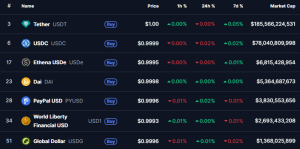
Top stablecoins by market capitalization (Source: CoinMarketCap)
With the rise of stablecoins and the dominance of USD-pegged tokens, the European Central Bank (ECB) recently highlighted the potential risks of the continued growth of these cryptos.
“Significant growth in stablecoins could lead to an outflow of retail deposits, reducing an important source of funding for banks and leaving them with more volatile funding overall,” the ECB said.
Related articles:
Best Wallet – Diversify Your Crypto Portfolio

- Easy-to-use, feature-driven crypto wallet
- Get early access to upcoming token ICOs
- Multi-chain, multi-wallet, non-custodial
- Now in the App Store, Google Play
- Stake to earn native token $BEST
- 250,000+ monthly active users
#IMF #stablecoins #threaten #central #bank #control