

What he and his colleagues discovered was startling: a brutal drought and extreme heat wave that began in September 2023 had turned the lake into a steaming cauldron. The lake water reached a temperature of 41 degrees Celsius, or 105.8 degrees Fahrenheit – hotter than most spa pools.
Their findings, published on Thursday Science magazine highlights the impact of global warming on tropical regions and aquatic ecosystems as the United Nations COP30 climate talks get underway in Brazil.
“You couldn’t put your finger in the water,” lead author Fleischmann from the Mamiraua Institute for Sustainable Development in western Brazil told AFP.
He recalled the “psychological impact” of seeing the carcasses of Amazon dolphins and tucuxis, another species of freshwater dolphins.
BRUNO KELLY / REUTERS
It is an “overlooked problem,” he said, adding that tropical lakes, essential for food security and the livelihoods of local communities, have been far less studied than those in Europe and North America, and were assumed to be relatively stable.
While this study focused on 2023, another record-breaking drought occurred in the Amazon a year later. Such events are becoming more frequent, more severe and longer lasting due to human-induced climate change.
In total, the team visited ten lakes in the central Amazon, with five of the lakes showing exceptionally high daytime water temperatures of more than 37 degrees Celsius, much higher than the 29-30 degrees Celsius considered normal.
The most extreme value came from Lake Tefe, where the surface area decreased by about 75%.
According to the Consumer Product Safety Commission, a hot tub is typically set between 100 and 102 degrees Fahrenheit, or just below 40 degrees Celsius.
Officials from the World Wildlife Fund Brazil said that in the week of September 23, 2023, 153 dolphins were found dead, including 130 pink dolphins and 23 tucuxi dolphins. Both are listed as endangered on the IUCN Red List and the latter are considered “the guardians of rivers and a symbol of good luck,” according to RiverDolphins.org.
‘The climate emergency is here’
What made it even more remarkable, Fleischmann said, was that the same temperature was found not just at the surface, but throughout the entire two-meter-deep water column.
Using computer models, the team identified four key factors: strong solar heating, shallow water, low wind speeds and high turbidity – a measure of water haze.
These factors reinforce each other. Shallowness increases turbidity, which traps more heat, while little wind removes less heat, leaving the water more exposed to clear skies and intense sunlight.
Another stressor on aquatic life was the wide swing between highs and lows, with the high of 41ºC in Tefe followed by an overnight low of 27ºC.
BRUNO KELLY / REUTERS 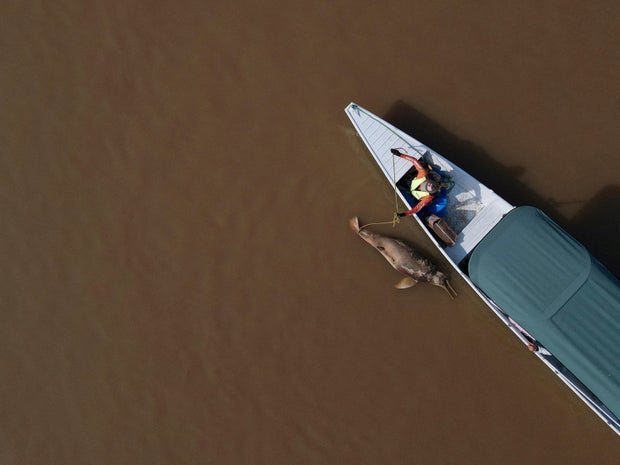
While much of the national and global attention focused on the more than 200 dolphin deaths recorded in less than two months, they represented only the tip of a broader socio-ecological crisis that also included mass fish deaths.
There was even a phytoplankton bloom that turned the lake red as the algae came under pressure — the subject of another forthcoming paper that Fleischmann co-authored.
To understand longer-term trends, the researchers reviewed NASA satellite data dating back to 1990 and found that Amazonian lakes are warming at about 0.6 degrees Celsius per decade, higher than the global average.
“The climate emergency is here, there is no doubt about it,” Fleischmann said.
He added that he would attend the COP30 summit to advocate for long-term monitoring of Amazonian lakes and greater involvement of local populations – including indigenous peoples, non-indigenous river dwellers and Afro-descendant communities – in developing solutions.
Research published in the journal Hydrological Processes found that droughts have “significant impacts on extreme river water temperatures” as radiation is more intense during these periods while water levels are lower and river velocities low.
“Rising river water temperatures can have significant and often damaging impacts on aquatic life, impacting both individual species and entire ecosystems,” study co-author and professor at the University of Birmingham. David Hannah said. “Drought conditions often coincide with high atmospheric temperatures and such trends will become more intense and frequent with climate change.”
#Hundreds #dolphins #dead #Amazon #Lake #water #hotter #jacuzzi #study #finds