Hundreds of claims a day: are these the most dangerous jobs in Australia?

Hundreds of claims a day: are these the most dangerous jobs in Australia?

3 minutes, 34 seconds Read

A third of jobs accounted for more than half of Australia’s serious workplace injury claims in 2024, while only three in 10 injured workers across the workforce reported receiving workers’ compensation benefits.
Safe Work Australia’s Key Work Health and Safety Statistics Australia report for 2025, released on Friday, revealed that 188 workers died from traumatic injuries while working in Australia in 2024, with a rate of 1.3 deaths per 100,000 workers.
Over the past decade, that figure has fallen by 24 percent, compared to 1.7 fatalities per 100,000 workers in 2014.
Workers aged 45 and over accounted for more than half of recorded worker deaths.

Australia’s peak body representing workers, the Australian Council of Trade Unions (ACTU), said while a drop in mortality is welcome, 188 families still lost a loved one last year.

Vehicle incidents were responsible for 42 percent of employee fatalities in 2024. Source: SBS news

ACTU assistant secretary Liam O’Brien said in a statement: “Health and care workers, tradies, factory workers and the people who keep our communities safe are most at risk.”

“One workplace death is one too many, and our work is far from done.”

There were 146,700 serious workers’ compensation claims involving the loss of at least one week or working time in the period 2023-2024 – more than 400 serious claims per day.

What did the report reveal?

Safe Work Australia’s report shows that four sectors accounted for more than half of the 146,700 serious workers’ compensation claims in 2024.
Those industry departments were health and social assistance (19.9 percent), construction (12 percent), manufacturing (10.1 percent), and public administration and safety (9.2 percent).
However, these sectors represented only 36.3 percent of the jobs filled that were covered by a workers’ compensation system.
Overall, across all industries, three in 10 injured workers reported receiving workers’ compensation, while the remainder did not file a claim or receive no compensation.
The ACTU raised concerns that seven in 10 injured workers were not receiving compensation, citing barriers to reporting and under-reporting that obscured the true costs of workplace injuries across Australia.

When it comes to fatalities, machine operators and drivers accounted for 61 worker deaths in 2024, with a rate of 6.7 fatalities per 100,000 workers. This was followed by blue-collar workers (50 fatalities), managers, technicians and skilled workers (28 fatalities).
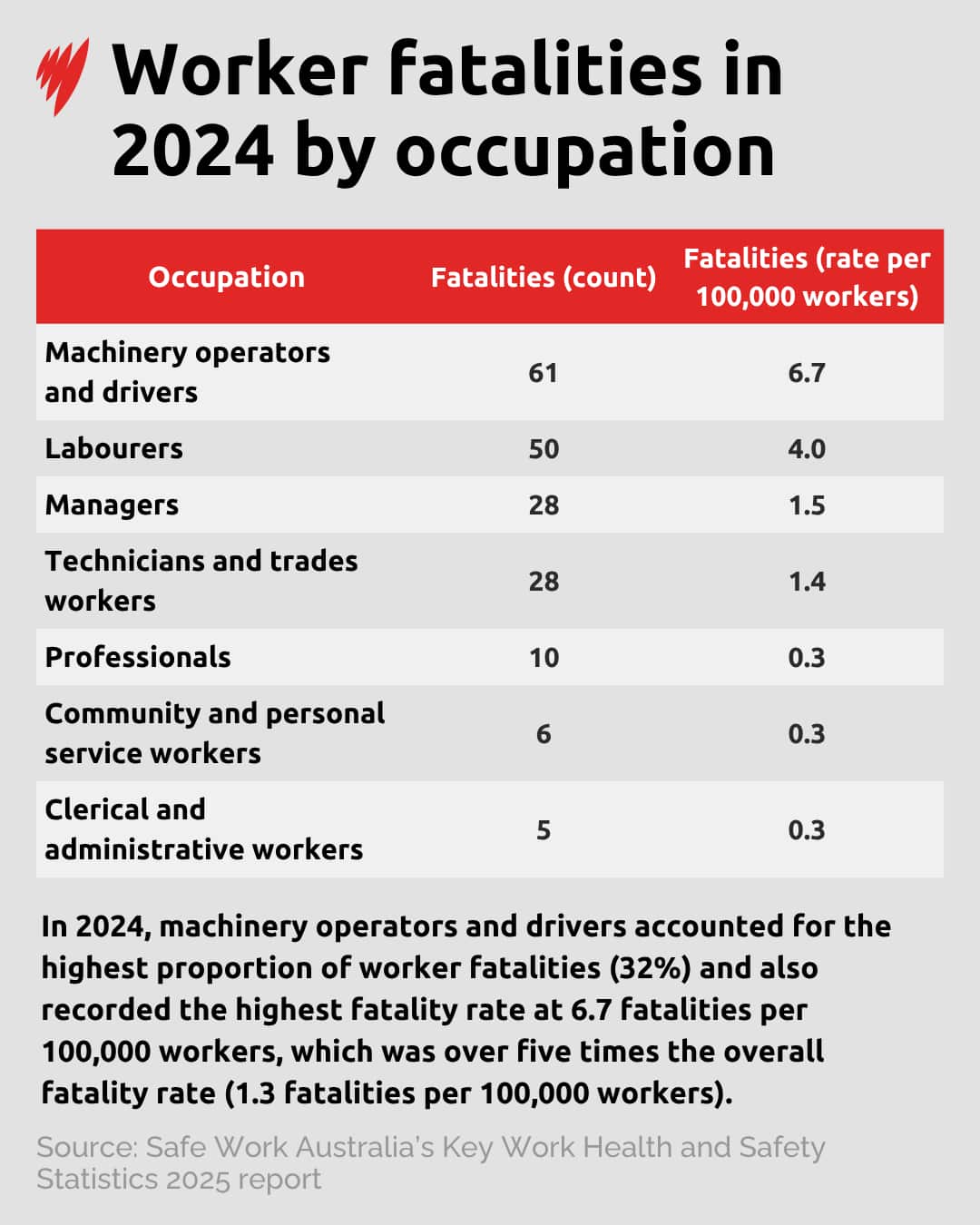
A graph showing worker fatalities in 2024, divided by occupation.

According to the report, operators and drivers accounted for the highest percentage of worker fatalities in 2024 (32 percent) and also recorded the highest mortality rate: 6.7 fatalities per 100,000 workers. Source: SBS news

The agriculture, forestry and fishing sectors had 13.7 fatalities per 100,000 employees in 2024, followed by the transport, postal and warehousing sectors (7.4 fatalities per 100,000 employees) and mining (3.4 fatalities per 100,000 employees).

Vehicle incidents were by far the most common cause of death at 42 percent, and 66 percent of employee fatalities in 2024 had at least one vehicle directly involved in the incident.
Other causes of death included falling from a height (13 percent), being struck by moving objects (9 percent), being struck by falling objects (7 percent), and being trapped by moving machinery or equipment or between stationary and moving objects (both 5 percent).

Workers aged 45 and over accounted for more than half of recorded worker deaths.

Mental health claims are increasing

The report also shows that serious claims for mental health conditions have seen the biggest change among all serious injury groups in recent decades, with an increase of 161 per cent.

Mental stress is now the fourth most common cause of serious claims, at 11.5 percent.

The average time lost to serious claims related to mental stress is approximately five times greater than the average time lost to all serious claims, and results in significantly more time off work.
Mental health claims also represented the most expensive form of workplace injury – leading to more than four times the average compensation paid for all serious claims.
Although men were responsible for the vast majority of deaths (180) in 2024 and accounted for 58 percent of all serious claims, the report found that women’s serious claims were more than twice as likely to involve mental health problems as men’s.
On average, women’s claims were also associated with longer absences from work. The average compensation for serious claims remains 20.4 percent higher for men – $17,600 to $14,600.
The ACTU said unions are calling for greater legal protection for workers exposed to psychosocial hazards in the course of their work, such as violence and aggression, sexual harassment and discrimination.
O’Brien said: “Employers should treat work stress and intensification with the same seriousness as any other health and safety consideration.”

#Hundreds #claims #day #dangerous #jobs #Australia

Similar Posts

Leave a Reply

Your email address will not be published. Required fields are marked *