

Then the intermediate devices appear. Tablets, small laptops and whatever is between your breakpoints. The layout is technically responsive, but the text feels too wide or too tight. You add another breakpoint to patch it, and suddenly a simple content wrapper has four different width values to manage.
That’s where clamp() helps. In this guide, we’ll build responsive content wraps with clamp() in Divi 5 so that your layouts remain readable on all screen sizes.
Why fixed container widths can cause problems on different devices
A container width of 1200px looks neat on desktop monitors. Open that same page on a tablet and the numbers no longer line up. Your maximum width is set to 1200px, but the viewport is only 1024px. Something has to give.
Most builders solve this with breakpoints. Desktop gets 1200px. At your tablet’s breakpoint, go to 900px. Mobile devices under 768px get the full width. Three breakpoints, three values, problem solved.
Except that tablets don’t all measure 1024 px. Some iPads are 810px wide in portrait orientation, and iPad Minis can be narrower. Medium screens land between breakpoints. Smaller laptops often reach their maximum speed around 1280px. Your three breakpoints cover the theoretical range, but miss the actual devices.
The ranges between breakpoints become problem zones. Everything in that range gets the breakpoint it is closest to, regardless of whether that size actually works. An 850px screen can display tablet styles designed for larger tablets. A 950px screen can end up with tablet styles that still feel too wide or too tight. Neither looks good.
Adding more breakpoints just moves the problem. Four breakpoints mean four holes. Seven breakpoints mean seven holes. Each section needs testing, maintenance and separate values for each section using the maximum width.
How clamp() helps in adaptive design
clamp() is a way to make the size of an element respond to the screen width without breakpoints. Instead of setting a container to 1200px on desktop, 900px on tablet, and fullwidth on mobile, you write one value that calculates itself based on the current viewport.
The function takes three numbers: a minimum, a preferred value, and a maximum. The preference value uses viewport units to achieve responsive behavior. Write clamp (320px, 80vw, 1200px) and your container width will be 80% of the screen width, but only within those boundaries.
On a 900px tablet, 80vw calculates 720px. That falls between 320px and 1200px, so the container will have a width of 720px. On a 400px phone, 80vw equals 320px, which is also within range, so the container gets 320px. On a 1600px monitor, 80vw calculates to 1280px, but that exceeds 1200px, so the container stops at 1200px instead.
Each viewport width gets its own calculated size. An 850px screen gets 680px. A 1050px screen gets 840px. A 1280px screen gets 1024px. Each calculation is done automatically based on the center value of 80vw, filling in all measurements between your breakpoints without the need for manual definition.
Building Content in Divi 5 with clamp()
Content wraps need consistent widths, but manually managing them across dozens of sections quickly becomes tedious. Divi 5 gives you a system to set this up once and reuse it everywhere. Let’s see!
Deciding on your content packaging values
Three numbers form the basis of any clamp() width formula. The minimum is suitable for mobile screens. The maximum desktop width. The middle value creates the scaling behavior between these boundaries.
Start with your maximum first. Text-heavy content stops around 800px to keep reading comfortable. Push layouts with images and sidebars to 1200px. Choose what suits your content type.
Your minimum works with small phones. Most sites use 320px. Some are moving to 360px as they skip older devices. The middle percentage comes from simple division.
Let’s say you want a maximum of 1200px. Most containers reach their maximum around a viewport width of 1600px. Divide 1200 by 1600. You get 0.75. Convert that to the width of the viewport by moving the decimal two places to the right. That gives you 75vw.
A maximum of 800px works the same way. Divide 800 by 1600. That equals 0.5, which becomes 50vw. The formula remains consistent. Maximum shared by target window, then convert to vw.
Your final clamp() will look like clamp(320px, 75vw, 1200px) or clamp(320px, 50vw, 800px). The VW percentage always comes from that distribution. Change your target viewport and the percentage will change too. Using 1920px instead means dividing by 1920, which produces different numbers.
Create maximum-width variables in the Variable Manager
Divi 5 includes design variables, a system that stores reusable values throughout your site.
Design variables are containers that contain specific numbers, colors, or text strings. When you change a design variable once, every element that uses that variable is automatically updated.
The Variables Manager contains all your design variables. Number variables specifically store numerical values, such as width, spacing, and font sizes. You can save clamp() formulas as number variables and apply them anywhere Divi accepts width settings.
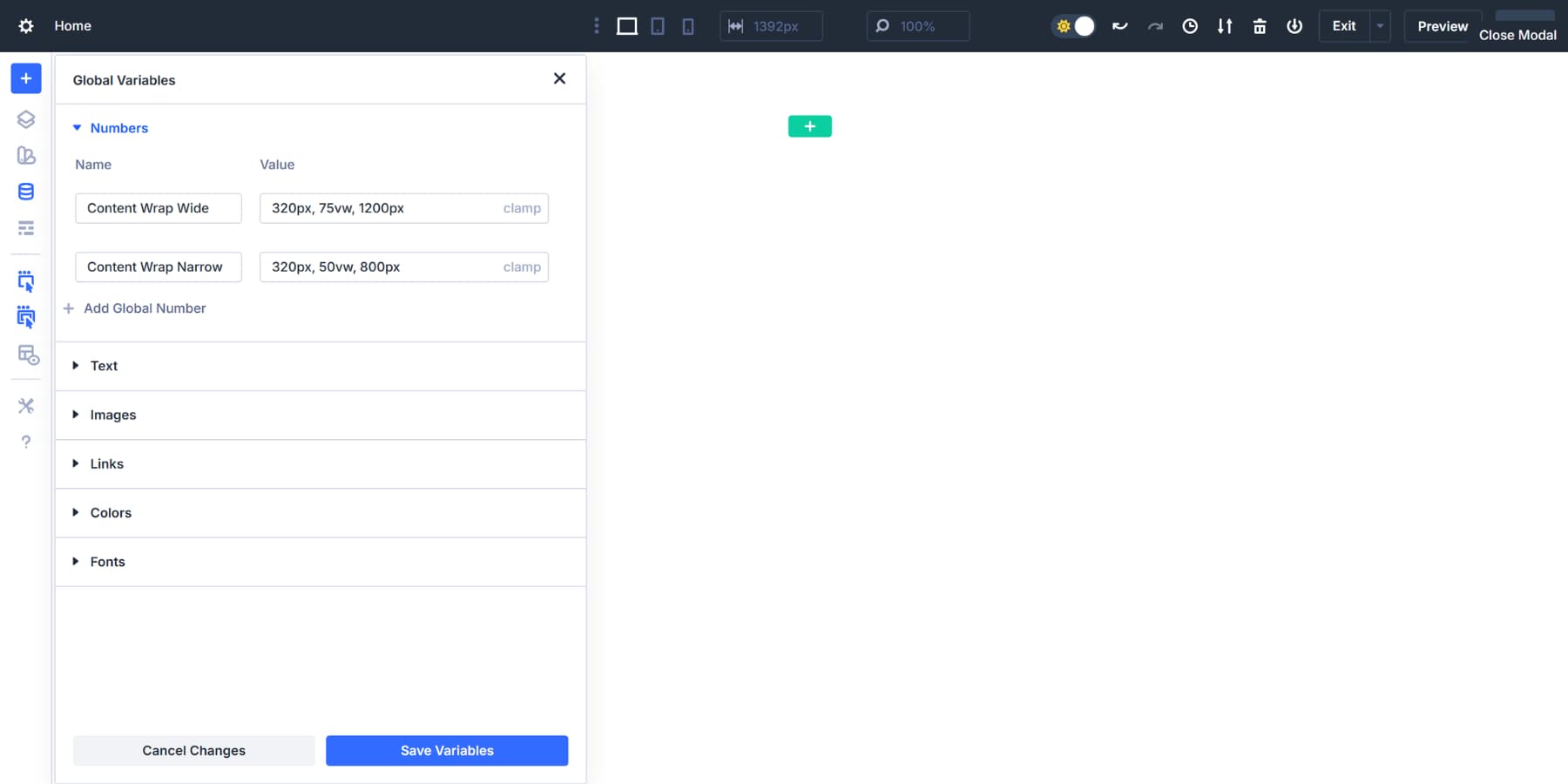
Click on the Numbers tab. This tab stores all numeric values, including clamp() formulas for width, spacing, and font sizes.
Create your first width variable:
- Click the plus icon to add a new number variable
- Call it Content Wrap Wide
- Type clamp(320px, 75vw, 1200px) in the value field
- The 320px handles mobile phones
- The 1200px limits the desktop width for comfortable reading with images
- The 75vw comes from 1200 by 1600 division, aimed at typical desktop viewports
Create a second variable for text-rich content:
- Add another number variable
- Call it Content Wrap Narrow
- Type clamp(320px, 50vw, 800px) in the value field
- The maximum of 800px ensures that the line length remains readable
- The 50vw comes from dividing 800 by 1600
You can skip this step and type clamp() formulas directly into the width fields as you build, since Divi 5 supports advanced units. But storing them as number variables changes the workflow. Each width setting sitewide provides direct access to those values. More importantly, updating a variable as soon as it occurs propagates everywhere it appears.
Apply clamp() to maximum row width
Rows enclose all of your content, making them the perfect starting point for width control. When a row has a defined maximum width, everything within it follows that limit. Set it once at the row level, and your columns and modules will automatically inherit that container size.
Click on a row on your page to open the settings panel. Navigate to the Design tab and find Dimensioning. The Max option width appears at the top of this group.
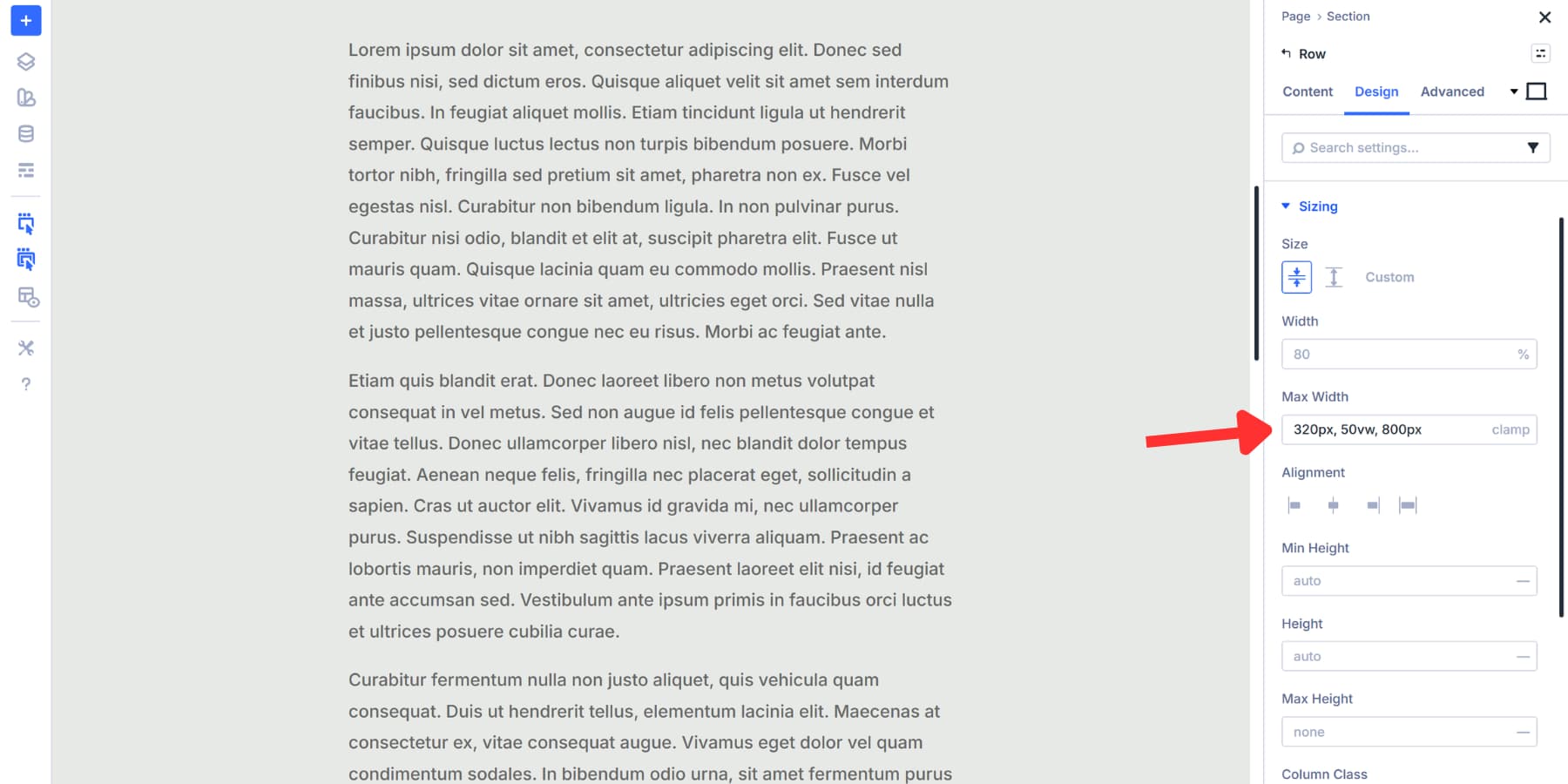
Click the variable icon next to the field. A drop-down list shows all your saved design variables. Select Content Wrap Wide for rows of images, buttons, and mixed content. The 1200px maximum keeps these layouts balanced and readable.
Choose Content Wrap Narrow for text-heavy sections such as blog posts, descriptions, and articles. The 800px cap prevents long line lengths that strain the reader’s eyes.
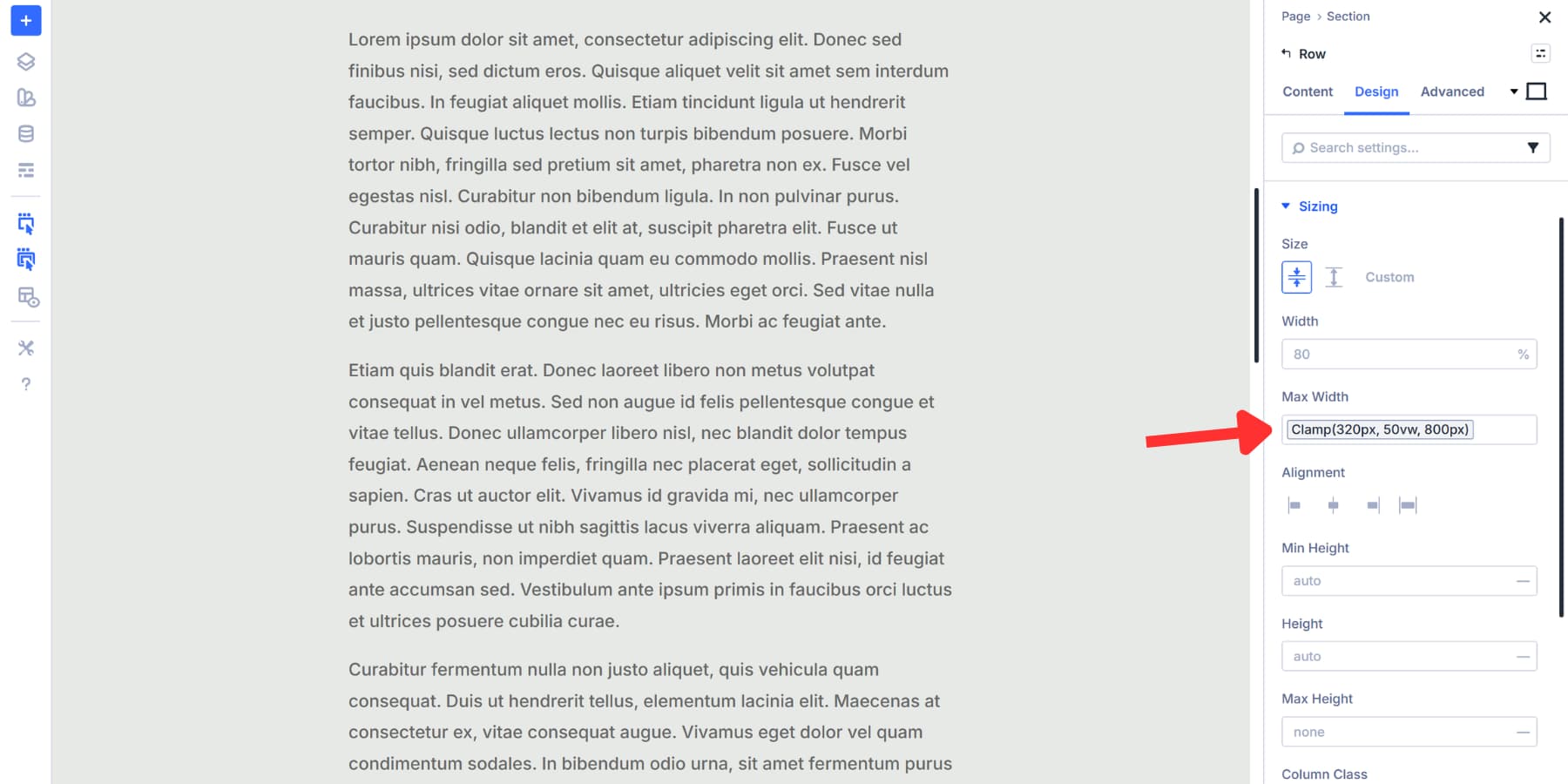
The row applies the new width immediately. The clamp() formula handles all window sizes automatically. Desktop shows full width. Tablets scale proportionally. Phones reach the minimum of 320px.
If you are not using design variables, you can enter your clamp() values directly into this field.
Test and adjust
Your clamp() values should work correctly from the start if you calculate them correctly in the first step. Divi 5 includes seven customizable breakpoints that let you preview your design on different screen widths.
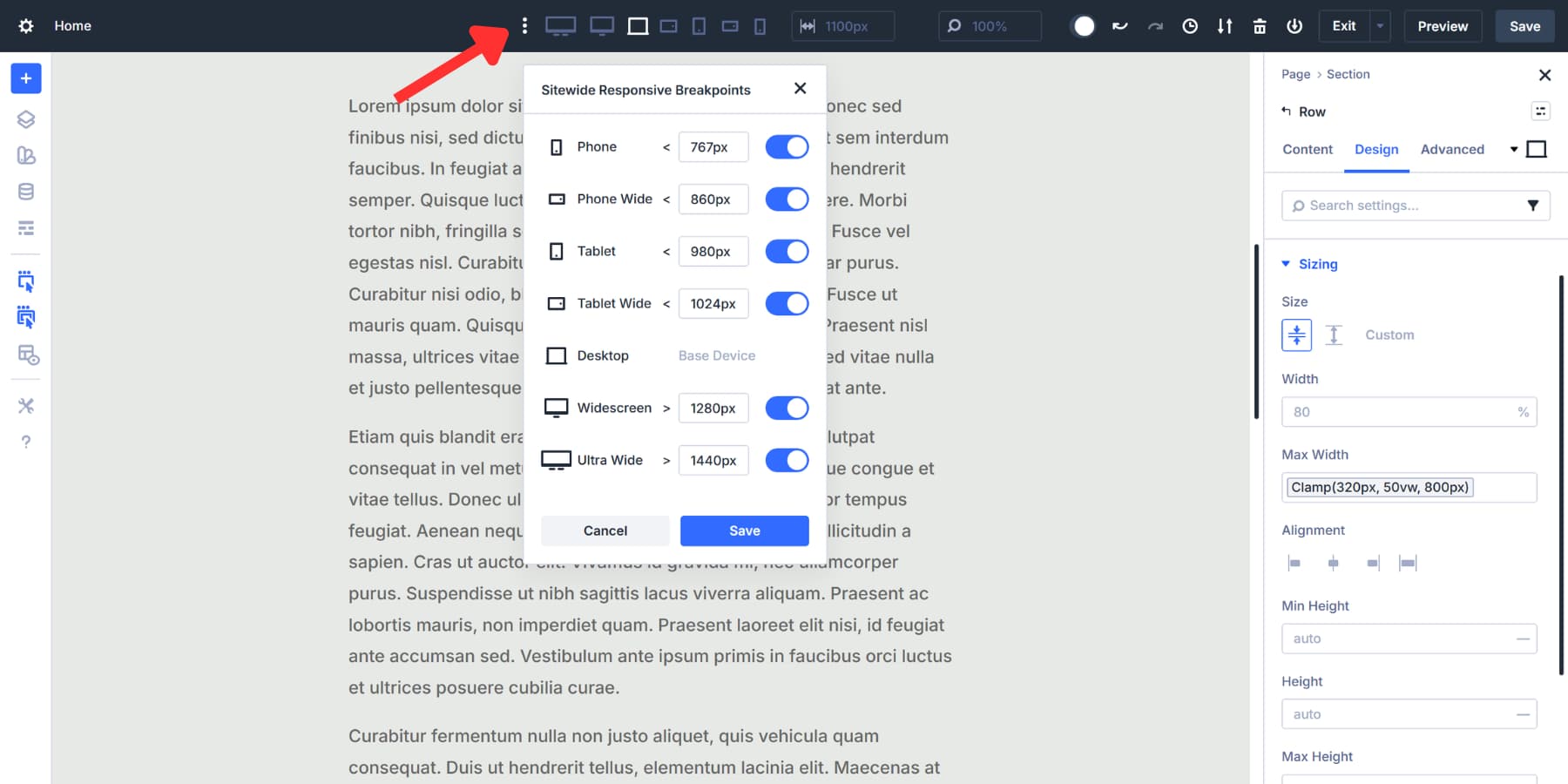
Click through each breakpoint in the Visual Builder to see how your content scales across different breakpoints.
Pulling on the edge of the canvas also resizes smoothly as it passes through each breakpoint.
The middle value in your clamp() formula handles the calculations automatically in each viewport. Each screen width between your minimum and maximum becomes its own proportional size, eliminating the need for manual adjustments.
If anything needs to be adjusted after viewing an example, adjust the design variable accordingly. Every section and row that uses it will be updated automatically. You edit one value and the changes appear everywhere that value is applied.
Create element presets
Element Presets in the Divi 5 Bundle complete style packs for sections, rows, columns and modules. After you set a section with the clamp() width variable, you can save all the settings applied to that section as one reusable preset.
Open a row with your content width applied. Click the preset icon in the upper right corner of the row settings. Select New Preset from Current Styles. Call it something obvious, like Hero Section Wide or Text Content Block. Save it.
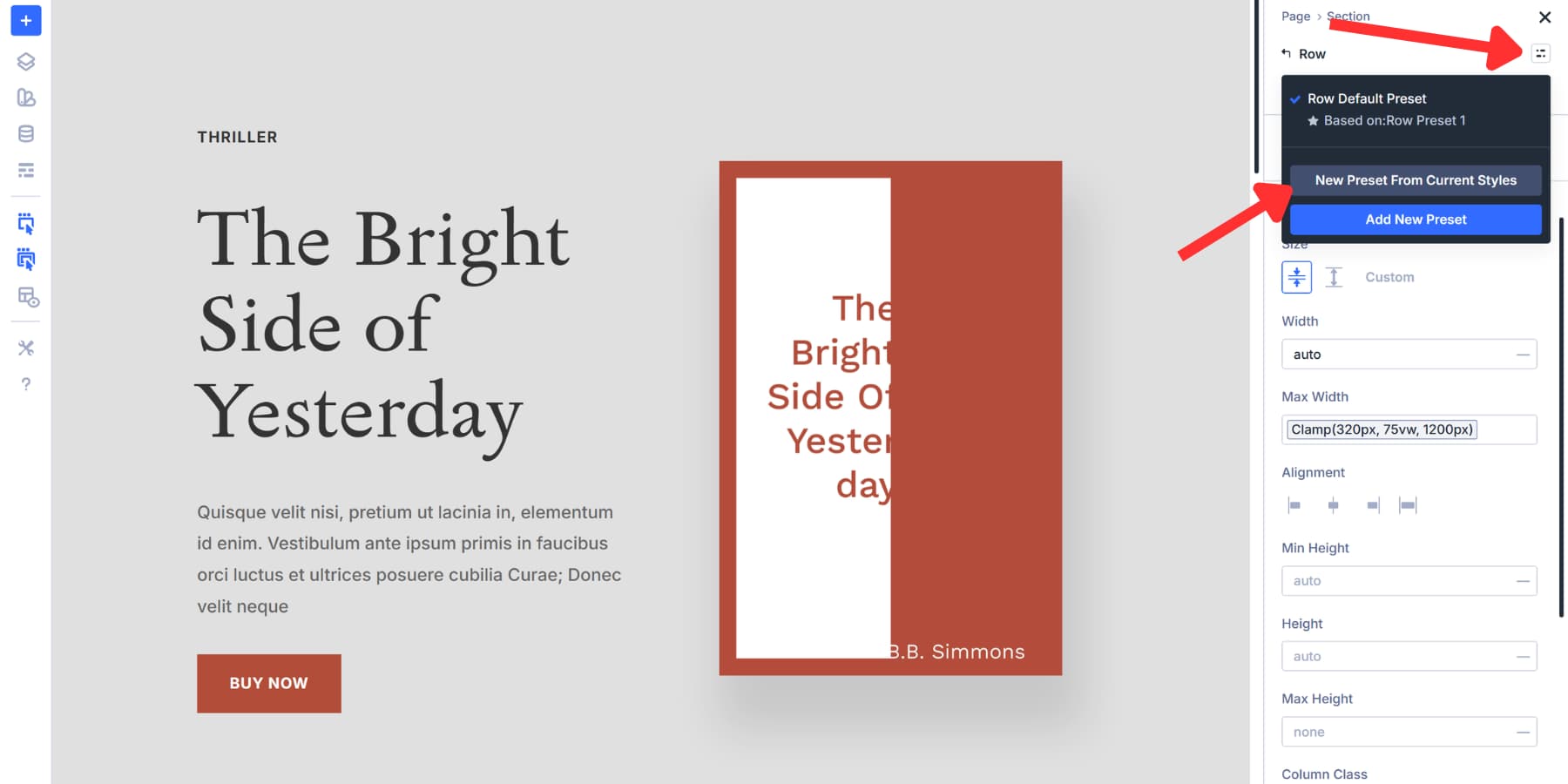
That preset will appear in the drop-down menu of each row. When you add a new section anywhere on the site, click the preset dropdown and select your saved preset. The section inherits the width, padding, background, borders, and any other settings you recorded. The preset stores the reference to your design variable, not a fixed pixel value.
Change the design variable once and any section using that preset will automatically update sitewide. Change the value in the design variable and all presets will be adjusted accordingly.
This makes Divi 5 a solid web design tool where design variables, presets, and breakpoints work together to help you build a maintainable design framework rather than just dropping elements onto a page.
Try clamp() in Divi 5 today!
Breakpoints worked when screens came in three sizes. Now they come in hundreds. Trying to catch every device with manual width is cumbersome and no longer makes sense.
clamp() handles the entire range automatically, so you can focus on the design itself. Divi 5 provides the infrastructure to implement this approach anywhere on the site, without having to write code.
Every width setting you save is now immediately spread across dozens of sections. Your layouts work seamlessly on any device, eliminating the need for constant back-and-forth adjustments. Download Divi 5 and see how much faster building becomes when your containers can handle themselves.
#create #responsive #maximum #widths #content #wraps #clamp #Divi