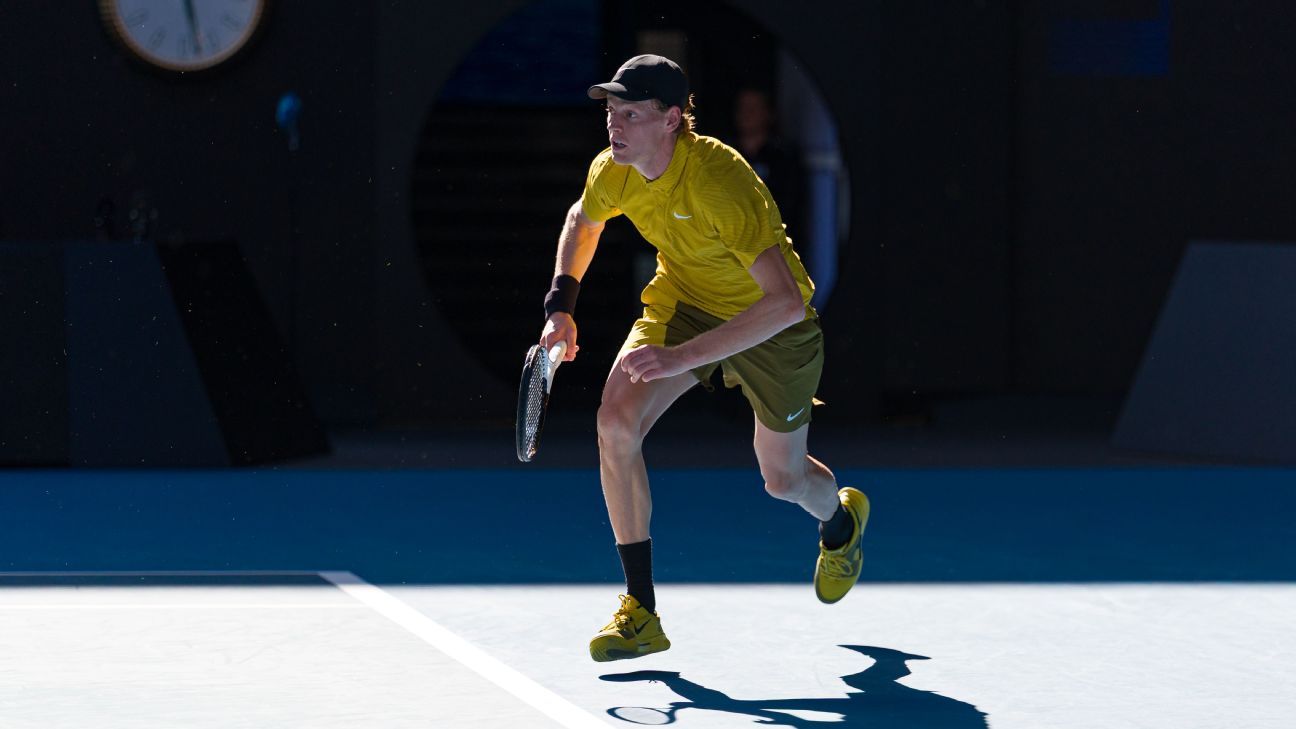

If it ain’t broke, don’t fix it. Good advice, you might think, especially for Jannik Sinner, who won two of the four majors in 2025 and was within one point of a third.
But when the man denying him the other two slams is Carlos Alcaraz, standing still is not an option. Alcaraz leads their head-to-head matchup 10-6, has won seven of the past nine meetings, and until Sinner defeated him last summer to win his first Wimbledon title, Alcaraz had won five in a row.
For Sinner, something had to change. Immediately after losing to Alcaraz in the US Open final last year, he knew exactly what he needed: variety.
“I was very predictable today,” he said in New York. “During this tournament I didn’t make a single serve-volley, didn’t use a lot of drop shots, and then you get to a point where you’re playing against Carlos and you have to get out of the comfort zone. I’m going to aim to… [try] to be a little more unpredictable as a player, because I think that’s what I have to do… to become a better tennis player.”
Sinner is the two-time defending champion at the Australian Open, which started on Sunday. If he were to win another, he would be the only man, other than Novak Djokovic, who did it twice, to claim three consecutive titles in the Open era. And yet, as Sinner begins his title defense, he knows that if he faces Alcaraz in the finals, he may have to offer something different.
The transition started quickly. Sinner won four of his five events after the US Open, including the ATP Tour Finals, relying largely on his usual style of excellent basic play but also mixing things up more often, using drop shots more regularly and making more trips to the net.
Tennis Data Innovations reports thisSinner has increased his variation (the extent to which a player varies his shot selection) from 11.7 percent to 13.7 percent. That is still well below the Tour average of 19.1 percent, but represents an increase of 17 percent.
He also increased his slice usage from 3.6 percent to 4.2 percent, went from 1.5 percent of drop shots to 2 percent and, in the biggest bump of all, increased his net play from 3 percent to 4.3 percent.
Improving his net play was one of Sinner’s main offseason goals. “We’ve been working a lot on the transition to the net,” Sinner said at Melbourne Park on Friday. “We changed a few things in storage. But it’s all small details. When you’re at the highest level, small details make a difference. I would say [in] During the first matches you try to get used to the feeling of competition and then you try to add something. We’ll see how it goes. We look at the conditions under which we play.”
Variety comes easy for Alcaraz, who likes to get to the net when he can and who hit three drop shots while serving for the victory in Tokyo in his first ATP Tour event after the US Open.
Changing your natural game is far from easy. Take Coco Gauff, who won her second Grand Slam title last year but whose efforts to turn around her fragile second serve are still a work in progress.
Ivan Lendl worked tirelessly to improve his net play in an attempt to win Wimbledon in the 1980s, even skipping the French Open where he had won three times. It didn’t work. Andy Murray, with the help of Lendl as his coach, added more power and aggression to his natural game, but it took time to pay off. Jack Draper was a natural counter-puncher (someone who is most comfortable turning defense into attack) because, as he has explained, he was small as a child. It took him time to become more aggressive.
It can also be dangerous to focus too much on one person. Roger Federer admitted he had to change his game to beat Rafael Nadal. It wasn’t until years later, when he made other changes, including using a racket with a larger head, that he discovered the secret and won seven of their last eight battles.
Sinner’s changes are less drastic and intended to improve his chances against everyone, not just Alcaraz. “When you add something to your game, the goal is to get better as a tennis player,” Sinner said. “It’s not about beating one guy. It’s more about feeling comfortable in any situation. That’s what we tried to do in the offseason.
“We have worked a lot physically. The physical part is so important now because the matches can be very long but also very intense. The tennis is very fast now. You have to be at the highest physical level for as long as possible. The season is very long, so you have to manage your body in the best possible way. Also the mental ability to always stay there will be very important.”
There is little wrong with Sinner’s game. Last year he was the first man to top the statistics in terms of percentage of service games won and return games won. But especially against Alcaraz, even a small improvement can make a big difference.
#Jannik #Sinner #changed #game #ahead #Australian #Open