

Porsche is a brand synonymous with the legendary flat six, but despite electrification on the horizon, if you thought the German brand was done with combustion engines, think again. The the automaker’s latest patent for a new W18 powerplant has recently surfaced, unveiling a design that feels like a deliberate pushback against the entire EV narrative that dominates the industry. This comes at a time when Porsche’s operating profit fell 67 percent in the first half of 2025 due to factors such as a slowdown in sales in China and US tariffs. CEO Oliver Blume is set to leave and Michael Leiters will take over in 2026. Despite financial pressure and an ongoing restructuring of the EV roadmap, engineers in Zuffenhausen are still finding ways to reinvent mechanical performance.
The W-based configuration is not new within the wider Volkswagen Group. Bentley’s legendary W12, used in models such as the Continental GT Speed and Flying Spur, has long proven how smooth, compact and powerful this layout can be. Bugatti also experimented with W engines in the early modern period. Several pre-production Veyron concepts featured an 18-cylinder engine before the design eventually evolved into the production W16 used in the Veyron and Chiron during the glorious Pïech era. The new Tourbillon marked the end of that chapter, but the W philosophy clearly lives on within the Group.
Porsche’s new interpretation goes one step further. The patent outlines an 18-cylinder engine built around three banks of six cylinders, each with its own turbocharger, feeding a single crankshaft. It is modular, scalable and optimized for space, meaning the layout offers flexibility for nine, twelve, fifteen or eighteen cylinders depending on the application, all fitting within the footprint of an inline six-cylinder. The main difference from the old VW-style W layout is notable. That version combined two VR6 blocks, while here everything runs to one central crankshaft, a real W. This reduces turbo lag with shorter trajectories, less resistance and more pressure.
The timing of this patent is telling. Porsche initially had an ambitious plan to be 80% all-electric by 2030, but that plan has been scaled back following a global slowdown in demand for electric vehicles. The brand now sees more value in a diversified approach, where gas and electric models are sold side by side. You can already see that with the new Macan, the Cayenne, and the same will likely happen with the next 718 Boxster and Cayman, which were originally planned to go all-electric but are now expected to retain combustion engines.
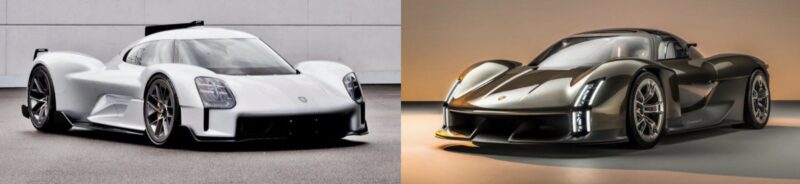
It’s worth noting that sometimes an engine only exists as a full testbed that lends its findings to other projects. There may never be a W18 on the road. Maybe it just means a smarter V6, a better turbo or a cooler intake system. But if the W18 do could it go into production, and if it were to receive some form of electrification, could it support Porsche’s long-awaited successor to the 918 Spyder, Carrera GT and 959? Porsche concepts like the 919 Street and Mission X already gave a taste of that direction, and we did get the 963 RSP, but that was a one-off. A production halo supercar would create a holy trinity of the new era, ready to take on the likes of the Ferrari F80 and McLaren W1.
#Heres #Porsches #wild #W18 #engine #patent