

As digital nomad visas spread across Europe, two models have emerged: highly visible, lifestyle-based programs designed to attract attention, and quieter, regulated residences built for structural sustainability.
Bulgaria’s recently launched digital nomad visa is an example of the latter, offering legal clarity and predictability that contrasts with the more saturated, media-focused programs in Portugal and Spain.
Comparing these regimes shows how visibility, tax treatment and policy design determine long-term residency stability, risk exposure and strategic options for expatriates.
Key Takeaways:
- Bulgaria, Portugal and Spain cater to different types of digital nomads.
- Quiet EU residences (such as Bulgaria) offer sustainability and legal clarity about hypes.
- Tax predictability and freedom of choice are stronger in Bulgaria; The lifestyle appeal is stronger in Portugal.
- Understanding saturation and policy exposure is critical for long-term planning
My contact details are hello@adamfayed.com and WhatsApp +44-7393-450-837 if you have any questions.
The information in this article is intended as general guidance only. It does not constitute financial, legal or tax advice, and is not a recommendation or invitation to invest. Some facts may have changed since the time of writing.
How visas for digital nomads differ in Bulgaria, Portugal and Spain
The Bulgarian visa for digital nomads is embedded in immigration law, the Portuguese visa emphasizes lifestyle branding, and the Spanish program is somewhere in between with its evolving rules.
- Portugal’s digital nomad visa came early, was heavily marketed and positioned as a lifestyle product: sun, city hubs and access to the EU. The question followed immediately.
- The Spanish visa has also been branded for lifestyle mobility, but the rules have been more cautious and incremental, reflecting political negotiations over housing markets and taxes. Saturation is lower than in Portugal, but regulations are sometimes ambiguous.
- Launched in December 2025, Bulgaria’s digital nomad visa has been quietly embedded into immigration law, formally defining digital nomads as a legal category without hype or lifestyle marketing.
Taken together, Portugal, Spain and Bulgaria illustrate three different approaches to visas for digital nomads.
Portugal is selling the lifestyle, Spain is negotiating the impact, and Bulgaria is rewriting the legal framework, making its digital nomad visa less visible but structurally more sustainable within the EU.
Who is eligible for each digital nomad visa?
Portugal ensures local economic participation, Spain verifies solvency and housing compatibility, and Bulgaria confirms external economic ties without competing with local labor.
In short, all applicants must meet the minimum income thresholds, even if the target varies by country.
- Portugal sets thresholds to ensure economic participation and spending within the local economy.
- The Spanish thresholds focus on solvency and housing compatibility, with some flexibility for freelancers and start-up founders.
- The Bulgarian thresholds screen for external economic involvement, explicitly excluding local labor competition.
How much does a digital nomad visa cost for Spain vs Bulgaria vs Portugal?
Government fees for a digital nomad visa vary by country: Spain charges a minimum of €160, Portugal around €260 and Bulgaria €150 minimum.
The total application fee (including translations, apostilles and health insurance) is normally between €200 and €400 for Spain and Bulgaria, and slightly higher for Portugal.
A comparison of the digital nomad visas for Bulgaria, Portugal and Spain
| Country | Launch/marketing | Visa philosophy | Eligibility filter | About. Government costs |
| Bulgaria | December 2025; unobtrusive, no lifestyle marketing | Structural integration in immigration law | Ensures external economic connection; prevents competition with local labor | €150–€200 |
| Portugal | 2022; heavily marketed towards lifestyle and mobility | Global competition for talent; lifestyle brand | Encourages local economic participation and spending | ~€260 |
| Spain | Phased rollout 2023–2024; step by step and carefully | Balances lifestyle appeal with domestic political constraints | Checks the solvency and compatibility of homes; flexible for freelancers/startups | ~€160–€180 |
What are the tax implications of visas for digital nomads?
Portugal relies on fiscal stimulus measures, Spain on transitional rules, Bulgaria on clarity.
- Portugal offers special regimes for nomads and NHR 2.0 participants, which are attractive but subject to change.
- Spain offers some exemptions and simplified tax treatment for the early years, but the rules vary by region and are evolving quickly.
- Bulgaria applies standard tax rules with a flat personal income tax of 10% once residency thresholds are met.
Programs marketed with incentives often experience volatility; Programs marketed around clarity and justice are more sustainable.
How long can you stay under these digital nomad visas?
Bulgaria maximum two years; Portugal encourages progress; Spain allows multi-year residence with possible extension.
- The Portuguese visa often encourages progression towards permanent residency and citizenship.
- Spain offers a multi-year residence permit (usually renewable for 1 to 2 years) with possible transition to long-term residency.
- Bulgaria limits residence to two years, without immediate permanent residence permit – intentional freedom of choice.
Bulgaria’s optionality reduces political pressure and could be attractive to experienced, globally mobile professionals.
Are digital nomad visa countries saturated?
Portugal has the highest saturation, Spain moderate, Bulgaria low. Popular visas attract attention, while silent visas remain administratively manageable.
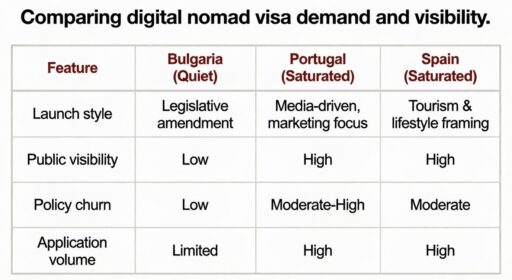
- High demand in Portugal has led to pressure on the housing market, political scrutiny and policy tightening
- Spain’s moderate popularity means there is some control, but volatility is lower than in Portugal.
- The Bulgarian visa operates below the visibility threshold, keeping policy changes minimal.
Saturation risk is a prohibitive factor in residency planning, and quiet programs are inherently more predictable.
What these digital nomad visa comparisons reveal about internal competition in Europe
Visas for digital nomads in Europe are not just about mobility; instead, they reflect strategic competition for different talent segments.
Portugal competes on the world stage. The visa is lifestyle-oriented, highly visible and marketed to attract remote workers looking for sunshine, city centers and access to the EU.
The focus is on visibility, branding and immediate demand, positioning Portugal as a magnet for internationally mobile talent.
Spain takes a more measured approach. The program is incremental, politically negotiated and takes into account domestic constraints such as the housing market and taxes.
The country combines the appeal of lifestyle mobility with risk management, ensuring the compatibility of solvency and residency.
Bulgaria operates quietly but structurally. The visa is enshrined in immigration law, is unobtrusive and policy-driven.
The goal is not to attract attention or create hype, but to anchor a sustainable framework that integrates remote talent without disrupting local labor markets.
Paradoxically, the most sustainable digital nomad programs in the EU are often the least flashy.
By minimizing the hype and focusing on structural integration, countries like Bulgaria are creating visas that are less vulnerable to political shifts or market saturation, even if they don’t make headlines.
However, as the market only launched in December 2025, it is still too early to say definitively how demand and saturation may develop over time.
Frequently asked questions
What is a quiet EU residence?
A residency path embedded in the law, unobtrusive and low in saturation, designed for stability and predictability rather than attracting large numbers of applicants.
What is the cheapest digital nomad visa?
The cheapest digital nomad visas in terms of application fees are offered for free, such as in Georgia and Mauritius.
Both are legitimate programs designed for remote workers, although they have different eligibility criteria and income requirements of approximately $1,500 for Mauritius and $2,000 for Georgia.
Which European country has the easiest digital nomad visa?
Romania and Croatia both offer simple applications, moderate income requirements and simple processes for new applicants.
Is Portugal or Spain better for digital nomads?
Portugal offers high lifestyle appeal, strong marketing and rapid adoption, but a higher saturation risk. Spain balances lifestyle with domestic risk management, offering moderate visibility and incremental regulations.
The choice depends on whether mobility, lifestyle or regulatory clarity are priorities.
Is it difficult to get a digital nomad visa for Portugal?
Not special, but applicants must meet income thresholds, provide proof of employment or freelancing, and follow application procedures.
Demand is high, so preparation and timely submission are important.
Which country has the longest visa for digital nomads?
The Thailand Destination Thailand Visa allows a stay of up to 5 years, the longest single-issue nomad visa currently available.
Which country has the best digital nomad visa?
Spain, Thailand and Portugal – Spain offers long-term access to the EU and residency pathways, Thailand offers the longest duration and low cost of living, and Portugal offers a balance of lifestyle, community and EU benefits.
Which digital nomad visa leads to permanent residence?
The Portuguese visa encourages progression towards permanent residency and eventual citizenship. Spain allows potential long-term stay with extensions. The Bulgarian program does not offer a direct path to permanent residency.
Are tax rules stable under digital nomad visas?
No. Digital nomad visas allow you to live and work remotely, but they do not guarantee stable or fixed tax rules.
Tax residence, rates and reporting requirements may still change based on local law, your physical presence or obligations in your home country.
Tormented by financial indecision?

Adam is an internationally recognized financial author with over 830 million answer views on Quora, a best-selling book on Amazon, and a contributor to Forbes.
#Headline #Quiet #Residencies #Visa #Options #Digital #Nomads