

Gold is king. But are you paying too much?
In recessions it is said: ‘cash is king’. We cannot go into a recession because the gold price has crushed cash prices.
Six all-time gold price highs have been recorded in the past ten trading sessions in the US. And gold is not the only precious metal that is being bid on. Seven all-time highs have been recorded in silver, six all-time highs in palladium and three in platinum. As a side note, there have also been five new all-time highs in the S&P500 and one in Bitcoin. All have achieved significant volume.
Figure 1. Gold price. September 29, 1995 – October 7, 2025
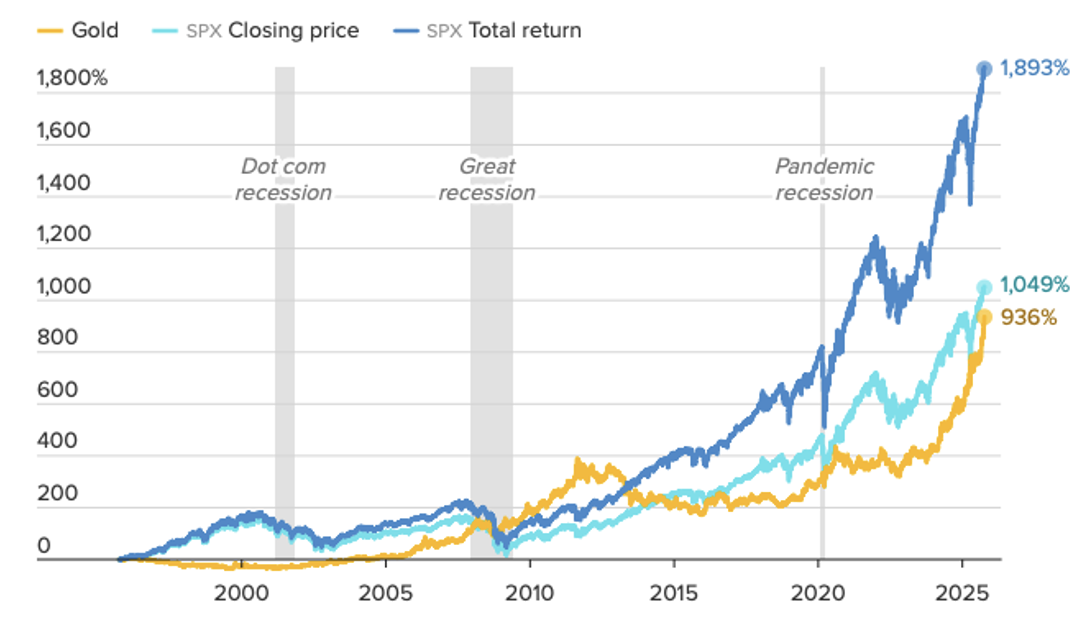
Source: Factset, CNBC
What is the logic that investors and consumers apply to justify buying gold today? The top five reasons are:
- A hedge against inflation: Gold tends to hold or rise in value during periods of rising prices because it cannot be printed in the way that fiat currencies can. For example, during the inflation peak of the 1970s, the price of gold rose by more than 2,000 percent, while the US dollar lost purchasing power.
- A safe haven in economic uncertainty: In times of crisis, such as stock market crashes, recessions, or financial crises (for example, the 2008 global financial crisis or the 2020 COVID-19 pandemic), investors turn to gold’s promise of stability. For example, in 2008, gold gained five percent, while the S&P 500 fell 37 percent.
- Protection against currency devaluation: With fiat currencies, for example the US dollar, prone to weakening due to money printing to finance exploding debt levels, gold is seen as a store of value.
- Geopolitical risk bufferAmid wars, trade tensions or political instability (for example, the conflict between Russia and Ukraine, which will push gold to over $2,000 per ounce by 2022), demand rises. Gold’s track record has helped in this regard, with the yellow metal helping to maintain prosperity during, for example, the 1973 oil crisis and Brexit.
- Central Bank and institutional purchases: More than 20 percent of global gold reserves are held by central banks, with net purchases of more than 1,000 tons per year in recent years. China’s central bank officially purchased 44 tons in 2024 and 39 tons so far in 2025, bringing its official reserves to over 2,300 tons. Meanwhile, Russia, for example, has been a net buyer, with a collective holding of over 35,000 tons as of 2023 (IMF data). This institutional validation indicates trust.
The thing is, these arguments were also promoted as reasons to buy gold in 2024, 2023 and even 2022.
A crowd attracts a crowd, and new highs bring more purchases, especially from those who have hesitated in the past. Trends arise because information is unevenly distributed and because investors respond to the information at different speeds.
When prices rise sharply, as gold is doing now, it is important to understand that this may be due to previously hesitant buyers – who may have been waiting for a pullback – eventually giving in (throwing in the towel) and withdrawing for fear of missing out on further gains.
Considering the logic behind today’s purchase is no different than that of three years ago, it’s more than likely that we’ll see the gold price react to this Fear Of Missing Out (FOMO) purchase – an indication that the run could at least be approaching a short-term peak.
Figure 2. The queue at ABC Bullion Company, Sydney, October 15, 2025
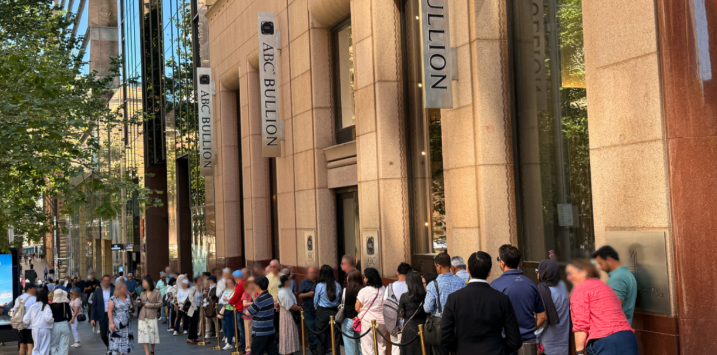
Figure 2 shows a large queue forming at the ABC Bullion store on Martin Place in Sydney, where people, reacting to news of record highs in the gold price, wait to buy physical gold (and possibly silver) with Australian dollars. How can I tell they are buyers instead of sellers? I asked.
However, this blog is not a prediction of where the gold price will go. Instead, it’s a warning about the frictional costs of buying physical gold from stores like ABC Bullion.
Figure 3. ABC Bullion buying/selling price of physical gold, 9:00 a.m., October 15, 2025
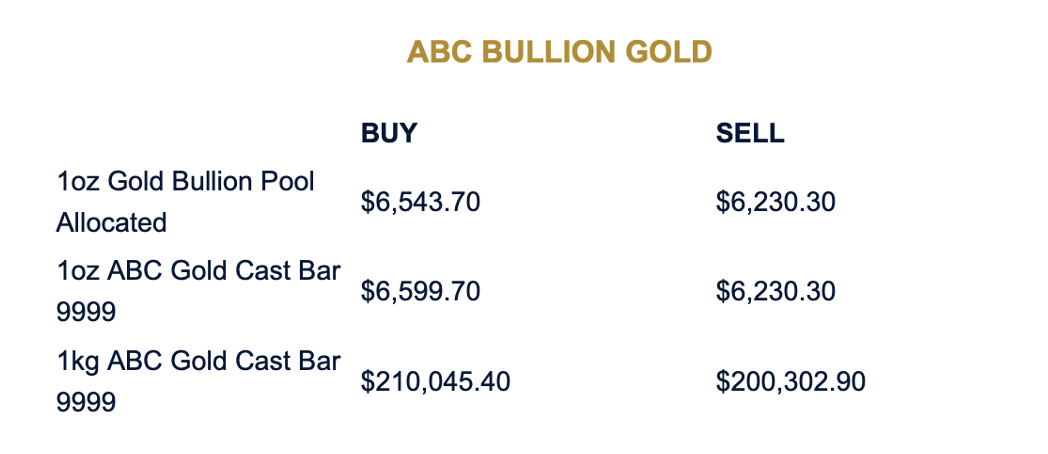
Source: ABC Bullion Daily Email
If someone in that line buys an ounce of physical gold, they will have to pay $6,599.70 at the time of writing. That is higher than the spot price of physical gold, which is $A6,423.30 on the same day.
And if they walk out of the store, change their mind just a second later and re-enter the store to sell the same ounce of gold, they will only receive $A6,230.30.
The difference represents an immediate loss of $369.40 or 5.5 percent. That 5.5 percent is risk-free revenue for ABC Bullion, and it is the “frictional” cost of trading physical gold.
As a side note, ABC Bullion is a vertically integrated precious metals group founded in 1972 and half-owned by Andrew, Paul and Phillip Cochineas. Other shareholders include CEO Janie Simpson, her father Francis Gregg and presumably others. It sells through ABC Bullion, refines through ABC Refinery, sells in Hong Kong through Goldenage International, provides warehousing facilities through Custodian Vaults and produces the Melbourne Cup trophy through WJ Sanders. The company reportedly generated A$18.5 billion in revenue by 2024 – more than Gina Reinhradt’s Hancock Prospecting.
These revenues are at least partially due to the huge brokerage the company earns when people trade physical gold. For a buyer of a kilo of gold bullion, the friction cost is just under A$10,000.00.
My question is, why pay this when you can get the exact same exposure to gold through an exchange traded fund? Buying shares on the ASX-listed ETF GOLD would result in significantly lower costs.
The ASX-listed GOLD ETF is managed by Global X and the Australian manager is Global X Management (AUS) Limited. The fund’s vault is located in London.
Each unit of the GOLD ETF represents a fraction of a fine troy ounce of gold. Buying 107.4 GOLD ETF units would provide equivalent exposure to an ounce of gold, requiring an outlay of A$6,331.
Importantly, however, a round-trip trade on the ASX would incur brokerage fees of between $20 and $40 through Nabtrade or Commsec – which is a far cry from the $370 associated with buying and selling an ounce of physical gold at ABC Bullion.
One kilogram of gold is equivalent to 32.15 troy ounces. Therefore, buying 32 Troy ounces through the GOLD ETF would incur an outlay of approximately A$203,000 and brokerage fees of just $220 to $240 through Commsec and Nabtrade. Double that for a round trip and it’s still miles away from the $10,000 spread you’ll hand over to ABC Bullion for the same trade.
So why does anyone buy physical gold?
One reason that has been explained to me is the belief that if anarchy were to break out in Australia, or if the country were invaded, our paper money would be worthless and that having a few ounces of gold would help keep the lights on and food on the table.
The problem with this idea is that in a lawless society, a gold treasure is likely to be stolen or forcibly taken from its holder. Having physical gold reserves is likely to be a liability rather than an asset in the scenarios considered by many who buy physical gold.
And so buying physical gold is irrational on several fronts. Perhaps leave its accumulation to the central banks and military leaders. And if your only reason for buying gold is the belief that its price will continue to rise, then buy the ETF instead of physical gold.

Roger Montgomery is the founder and chairman of Montgomery Investment Management. Roger has more than three decades of experience in fund management and related activities, including equity analysis, equity and derivatives strategy, trading and securities brokerage. Before founding Montgomery, Roger held positions at Ord Minnett Jardine Fleming, BT (Australia) Limited and Merrill Lynch.
He is also the author of the best-selling investing guide to the stock market, Value.able – how to value and buy the best stocks for less than they are worth.
Roger regularly appears on television and radio, and in the press, including ABC radio and TV, The Australian and Ausbiz. View upcoming media appearances.
This post was contributed by a representative of Montgomery Investment Management Pty Limited (AFSL No. 354564). The main purpose of this message is to provide factual information and not advice about financial products. Furthermore, the information provided is not intended as a recommendation or opinion about any financial product. However, any comments and statements of opinion should contain general advice only, prepared without taking into account your personal objectives, financial circumstances or needs. Therefore, before acting on any information provided, you should always consider its suitability in the light of your personal objectives, financial circumstances and needs and, if necessary, seek independent advice from a financial advisor before making any decision. Personal advice is expressly excluded in this message.
#Gold #king #paying