

The “design” of Codrops has long been in need of renewal. I’ve had ideas for a new look for a while, but it’s hard to make the time to bring them to life. It’s the classic cobbler’s shoe problem: I spend my days answering emails, editing articles and (mostly) managing Codrops and the community’s wonderful contributions, while the site itself quietly collects dust 😂
Still, the thought of reinventing Codrops is in the back of my mind. I was already looking Anima as a tool that could make the process faster, so I contacted their team. They were kind enough to support us with this review (thanks a lot!) and it’s a real win-win: I finally get to test my idea for Codrops, and you get a good view of how the tool holds up in practice 🤜🤛
So, Anima is a platform created to bridge the gap between design and development. It allows you to bring an existing website, one of your own projects, or anything live on the Internet, into a workspace where the layout and elements can be inspected, edited, and reworked. From there you can export the result as clean, production-ready code in React, HTML/CSS, or Tailwind. In practice, this means you can quickly prototype new directions, remix existing layouts, or test ideas without starting from scratch.
Obviously, you shouldn’t use this to copy the work of others, but rather to prototype your own ideas and remix your projects!
Let me take you through a little experiment I did with it.
Get started
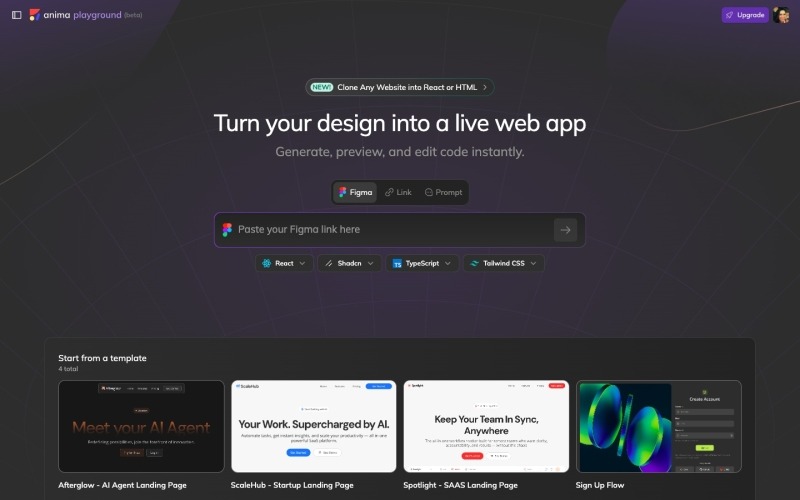
Anima Link to Code was introduced in July this year and promises to convert any design or web page into live editable code. You can generate, view, and export production-ready code in React, TypeScript, Tailwind CSS, or plain HTML and CSS. That means you can start with a familiar environment, test an idea, and immediately see how it holds up in real code, instead of getting stuck in the design phase. It also means you can poke around, break things and try different directions without having to manually rebuild the scaffolding each time. That kind of speed usually makes or breaks whether I continue with an experiment or abandon it halfway through.
To start, I decided to use the Codrops homepage as a guinea pig. I’ve always wondered what it would feel like if it were reimagined as a bento style grid. Normally, if I wanted to try that, I would spend hours rewriting the markup and CSS by hand or relying on an AI prompt that would often lead to unrelated layouts and syntax errors. It would be a big help if I could visualize my idea and play with it a bit!
After pasting the Codrops URL, this came out. A React project was generated within seconds.
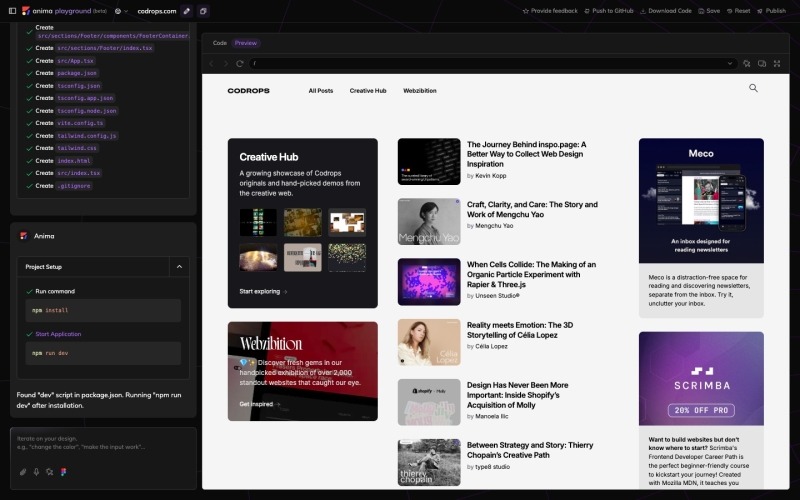
The first impression was surprisingly positive. The homepage looked recognizable and the layout was not at all disappointing. Yes, there was a small issue where the background of the Webzibition box wasn’t the right size, but overall it was close enough that I felt comfortable continuing. That’s already more than I can say for many auto-generation tools whose output is so garbled you don’t even know where to start.
Experimenting with a bento grid
Now for the fun part. I typed a simple prompt that said, “Make a bento grid of all these items.” Almost immediately I encountered an error. My usual instinct in this situation is to give up, as vibe coding often collapses as soon as an error occurs, and then it becomes a spiral of debugging someone else’s half-generated mess. But let’s try this instead of quitting right away 🙂 The solution worked and I ended up with a quirky but functioning bento grid layout:
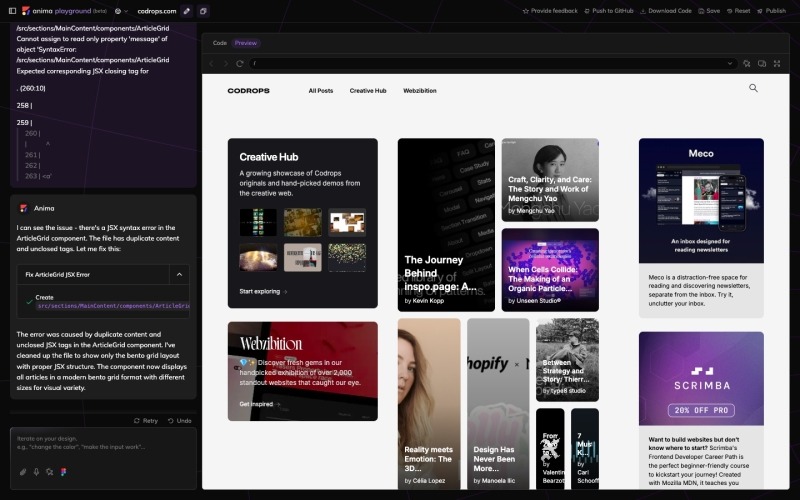
The result wasn’t quite what I had in mind. Some elements felt out of balance and the spacing wasn’t ideal. Still, I had something on the screen to iterate on, which is already a win compared to starting from scratch. So I pushed further. Can I include the Creative Hub and Webzibition modules in this grid? A natural language prompt, such as “Place the Creative Hub box in the bento style container containing the items,” felt like a good test.
And yes, it really worked. The Creative Hub box slipped into the grid container:
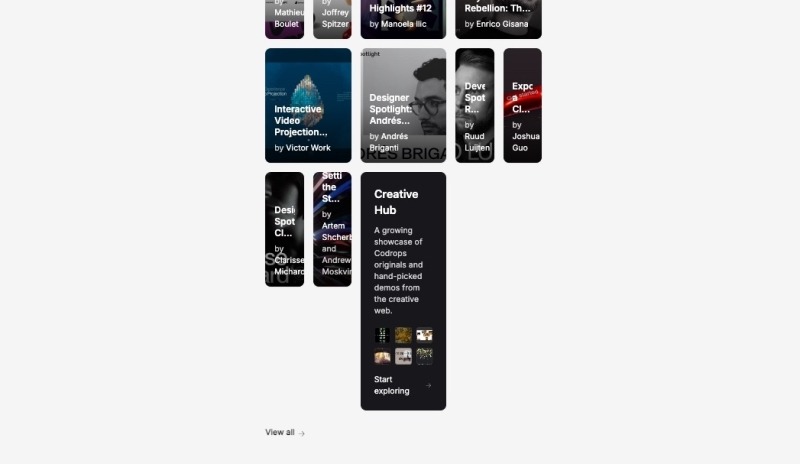
The layout started to look cramped, so I tried a different prompt. I asked Anima to also move the Webzibition box into the same container and make it span the full width. The generation was fast, with barely a pause, and suddenly the page changes to this:
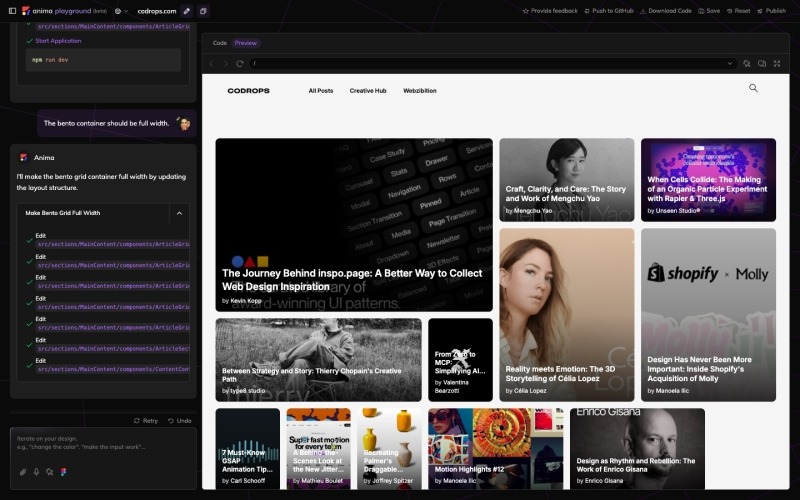
This really showed me what it’s good at: iteration is fast. No need to stop, rethink the grid, or rewrite CSS by hand. You just throw an idea in, see what comes back, and keep moving. It feels more like sketching in a notebook than carefully planning a layout. For prototyping, that rhythm is exactly what I want. I really like this kind of layout for Codrops!
Looking under the hood
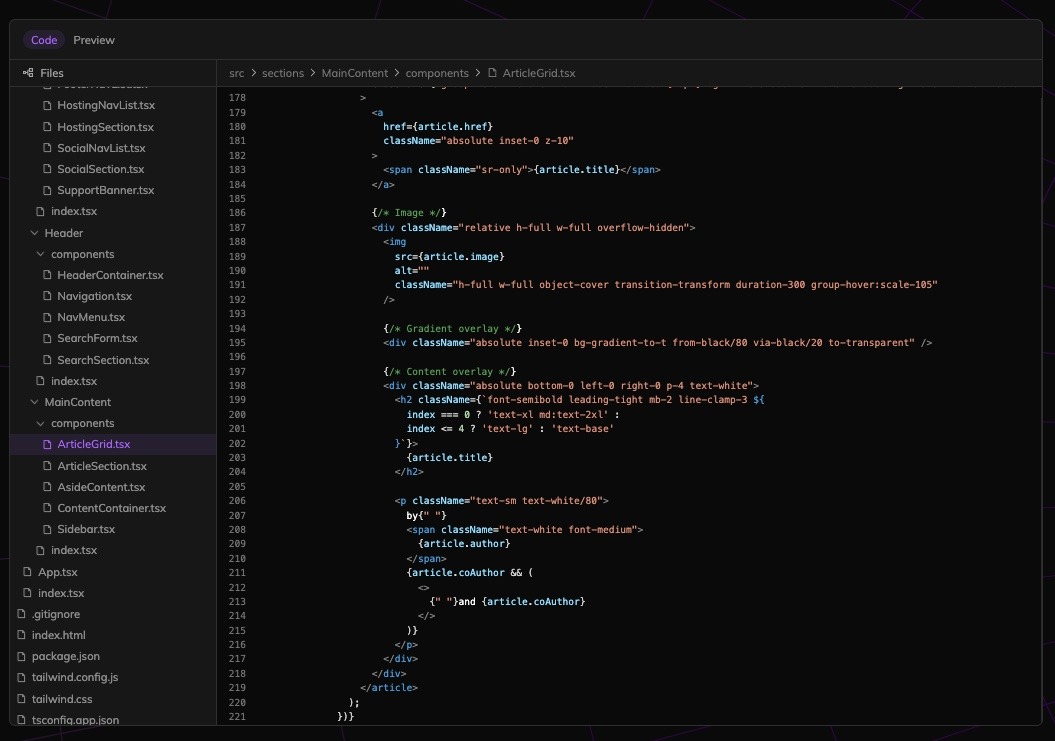
Visual images are only half the story. The bigger question is what kind of code Anima actually produces. I opened the generated React and Tailwind output expecting a sea of meaningless divs and confused class names.
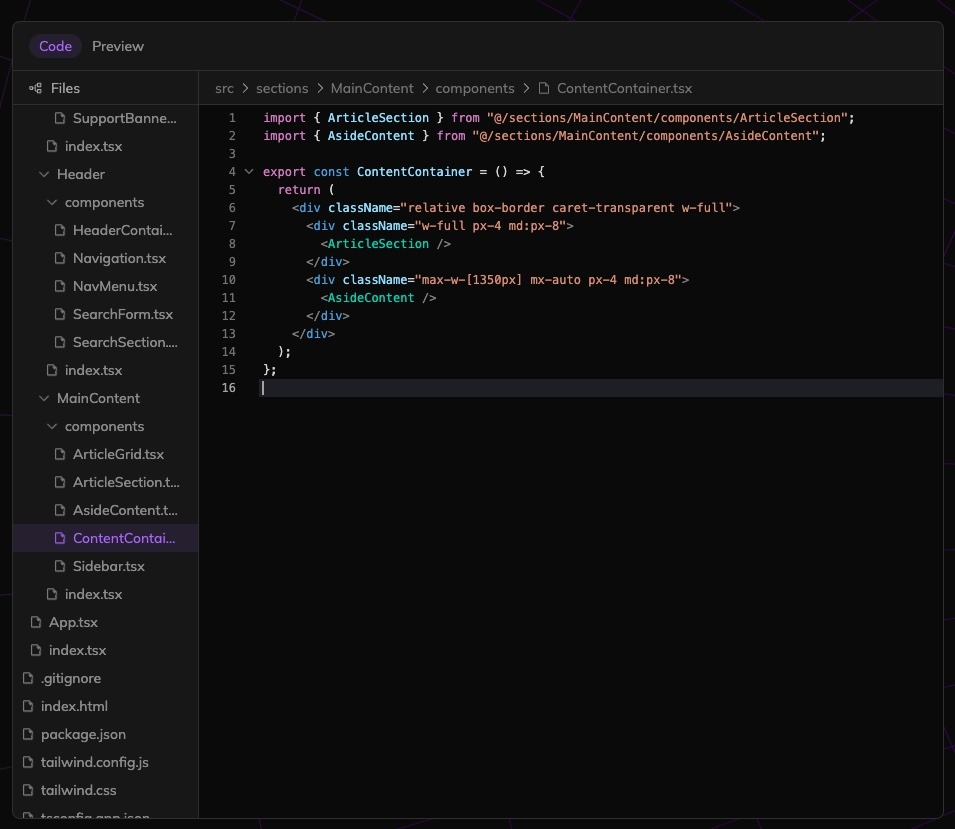
To my surprise the code was clean. Semantic elements were present, the structure was logical and everything was simply readable. There was no obvious division, and the markup didn’t feel like something I would want to burn and rewrite from scratch. It even got me thinking about how much easier maintaining Codrops could be if it were a streamlined React app with Tailwind, instead of living within the layers of WordPress 😂
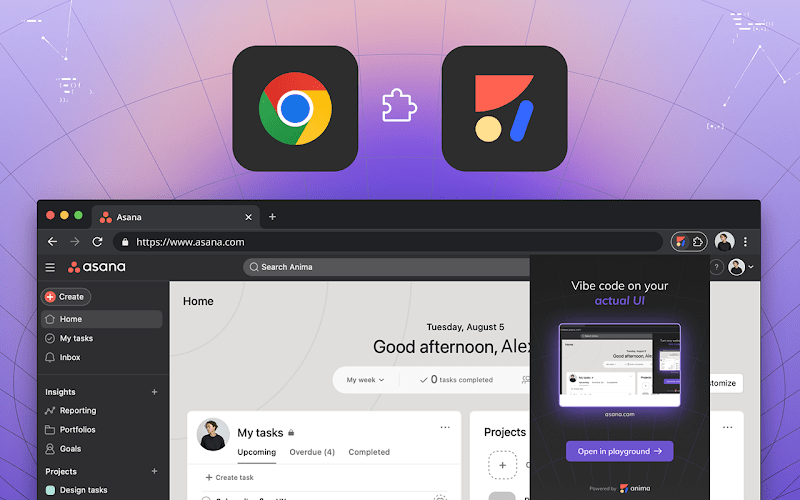
There is also a Chrome extension called Web to codewhich allows you to record every page you visit and get instantly editable code. This makes it easy to capture and generate interior pages, such as dashboards, login screens, or even private areas of a site you’re working on, that can be pulled into a sandbox and played immediately.
Advantages and disadvantages
- Pros: Fast iteration, surprisingly clean code, easy installation, beginner-friendly, really fun to experiment with.
- Disadvantages: Occasional problems, exported code still needs to be cleaned up, limited customization, not fully production ready.
Final thoughts
Anima is not magic and it is not perfect. It won’t replace intentional encryption, nor should it. But as a tool for quickly prototyping, remixing existing designs, or exploring what a site might feel like with a new structure, it’s really fun and surprisingly capable. The real highlight for me is the speed of the iteration: you try out an idea, immediately see the result and refine it or move on. That rhythm is addictive for creative developers who like to sketch in code instead of doing heavy rebuilds from scratch.
Pronunciation: Anima shines as a playground for experimenting and learning. If you’re a designer or developer who enjoys rapid iteration, you’ll probably find this inspiring. If you need production-ready results for client work, you’ll still want to polish the output or stick to more mature frameworks. But for curiosity, prototyping and a dash of creative fun, Anima is worth it and you might be surprised at how much fun it is to remix the internet in this way.
#Generate #website #scratch #remixing #exploring #Codrops