

Despite the funds themselves delivering solid returns, investors get significantly less out of them on average. They say that over the past ten years we have received approximately 1.2% less per year than the investments actually yield!
That may not sound like much, but over ten years it equates to losing about 15% of your potential profits over a ten year period.
So what goes wrong? More importantly, as a thoughtful long-term investor, how can you avoid falling into these traps and give yourself the best chance to capture your fair share of returns? Let’s see, we’ll see….
Oh, don’t forget to register for our next public webinar, taking place this Friday, October 3 with Alan Purcell from Cloud Accounts (Registration is free here!).
The return gap: what it means for you
Every year Morningstar publishes a fascinating study called Note the gap. The 2025 edition has just been released (watch it here via a secure Tresorit Link I created).
It once again highlights one of the biggest challenges investors face: we, the investing public, are often quite stupid!
Morningstar looked at more than 25,000 U.S. stocks investment funds and ETFs over the ten years to the end of 2024. This is the main conclusion:
- Funds returned 8.2% per year (time-weighted) – what you would have earned if you had invested a lump sum at the start and kept it untouched.
- Investors earned 7.0% per year (dollar weighted) – what people actually earned if you take into account real buying and selling decisions.
That 1.2% deficit is the “behavioral gap.”
It comes from mistimed buying and selling, chasing good funds, panicking during recessions, or simply tinkering too much.
And here’s the sting: even good habits like drip feeding investments can contribute to this gap, because they mean money isn’t invested for the full period. But it’s the bad habits, like panic selling and FOMO buying, that really do the damage.
Who had the most difficulty?
The research delves deeper into the question of where investors achieve more (or less) of the returns from their funds.
- Allocation funds (such as target date funds) had the smallest gap, with investors capturing almost all of the returns. Why? Because these funds automate diversification and rebalancing, investors didn’t have to or couldn’t tamper with the investment!
- Sector equity funds had the largest gap. Investors missed out on 1.5% per year here. These funds are often used speculatively, in the pursuit of technology or energy booms. It’s a bit like ‘Thematic Investing’, which I see some companies advertising here. This is basically chasing the current hot topic (currently AI/Data Center, or ESG a few years ago).
- Bond funds were another weak spot where investors only collected about half of the proceeds. Timing interest rate movements is notoriously difficult, and many have tried (and apparently failed).
- ETFs delivered higher raw returns, but had larger gaps than traditional ‘mutual funds’. Why? Because they are usually fully liquid, you can buy and sell every day, and some investors couldn’t resist making a profit by over-trading!
The pattern is clear: the more opportunities we have to ‘do something’, the more likely we are to sabotage ourselves.
It reminds me of that wise investment mantra; ‘Don’t just do anything, stay seated’!
Why does this happen?
In essence it is about the return gap human behavior.
We are programmed to act. We want to run when the markets are down and chase shiny things when they are up.
It feels safer, better and more right in the moment, but it becomes costly over time.
Morningstar also found:
- Higher tracking error funds (those that strayed from the benchmark) had larger gaps. Investors had difficulty holding on to this.
- Funds with volatile cash flows (lots of people getting in and out) had worse results. More trading = less return.
- Cheaper funds had smaller gaps than expensive ones, but it wasn’t just about cost. The key was the context: low-cost funds are often core holdings in advised investment and retirement accounts, where investors have an advisor between them and their trades, and so are more likely to leave them alone, and therefore do well!
- Volatile funds had the biggest holes. When funds fluctuate wildly, investors are more likely to jump in and out of the ship at the wrong times.
So yes, the markets are important, the fees are important and the fund choice is important, but our behavior as investors is more important.
The consumer results
What does all this mean for you as you sit at your kitchen table and think about your retirement or investment plan?
It means that success doesn’t just come from choosing the “best” fund. It comes from creating a system and mindset that helps you achieve as much return as possible.
If your fund earns 8% but you only pocket 7%, that’s not a market problem – that’s a behavioral problem. And the solution is not more information or more trade. It’s less.
How to close your own gap
Here are five practical steps that will help you keep more of your investment returns (whatever that may be!) over the next decade:
1. Automate everything you can
The research shows that investors in automated, all-in-one funds achieved higher returns. Why? Because they didn’t interfere. Use automation for contributions, rebalancing, and even retirement withdrawals. Less temptation, less tinkering. Ideally, you have an advisor who will stop you making bags when you feel the urge!
2. Cheap core holdings
While low-cost funds are not a panacea, they are typically used in more disciplined ways. Build your portfolio around globally diversified, low-cost funds or ETFs that you can hold for decades (assuming this meets your volatility, return, risk profile, etc.).
3. Beware of ‘exciting’ funds
I was quoted in the Sunday Times this weekend about unregulated investment funds – where I continue to beat the drum for transparency and consumer protection around these matters. Specialized funds such as technology, biotechnology or energy may look tempting, but these are also where the biggest gaps (and capital risks) often arise. If you have to dabble, keep it small and treat it like fun money, not core money.
4. Reduce ‘dealing’ to a minimum
The data is clear: the more you trade, the less you earn. Before making any changes, ask yourself the following questions:Am I reacting to headlines, fear or FOMO? Or is this really part of my long-term plan?’ If it’s the former, resist and sleep on it.
5. Create a safety margin
Morningstar suggests haircutting your expected returns to account for unavoidable gaps. For example, if your financial plan assumes 6% growth, perhaps plan for 5% growth. That way, even when behavioral costs creep in, your plan stays intact?
The role of a financial plan
Ideally, a solid financial plan and an advisor are your anchor. It sets out your long, short and medium term goals, clarifies the role of each investment pot (as I call them) and helps you easily stay on track when markets test your nerves or tempt you with shiny things. Don’t be the magpie!
At Informed Decisions we often remind clients: the market will do what it does, but it’s your job to do so too control what you can – costs, discipline, behavior. The rest is noise.
That’s why financial planning isn’t just about numbers. It’s about emotion, perspective and thinking about your future self.
When you know your plan is robust, you will be less tempted to make hasty decisions. You are less tempted to be the magpie.
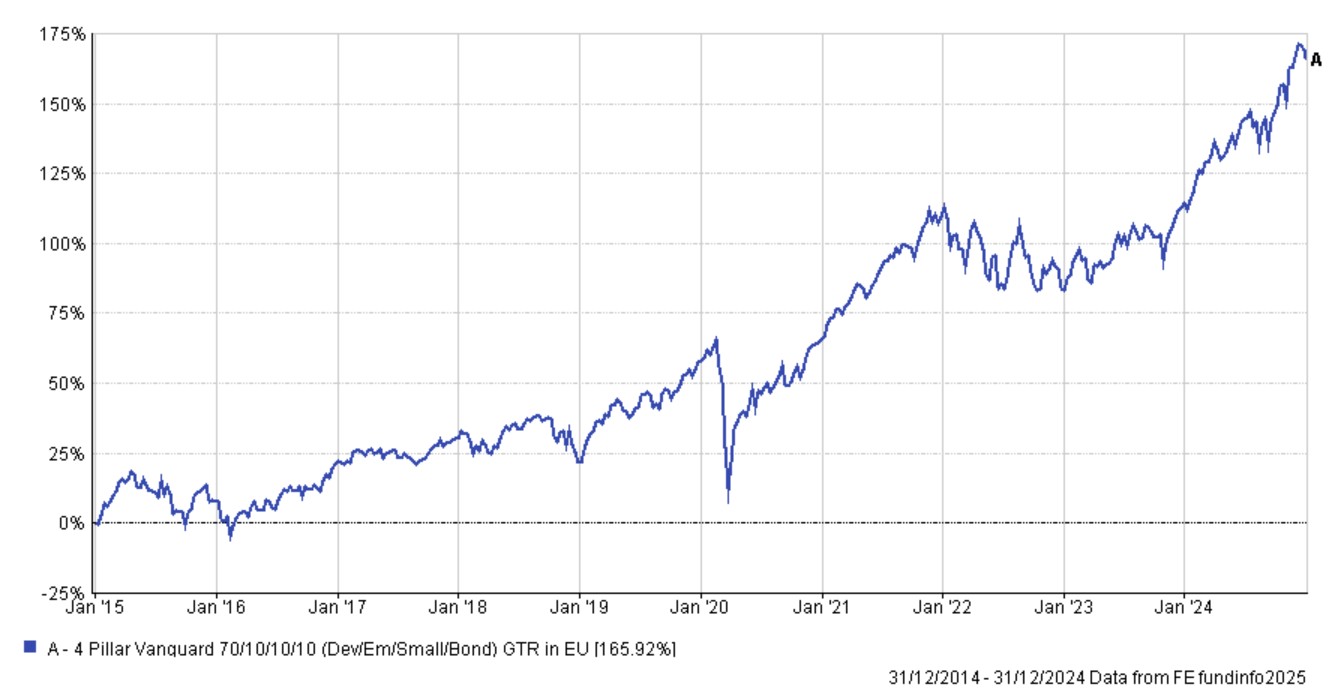
Furthermore, you would hope that your financial planner and advisor would have helped you not only stay invested, but also invest in productive vehicles and galaxies.
Here’s an example of a Vanguard portfolio of 90% stocks and 10% bonds that we deployed for some that delivered a gross return of 165% over the same ten years, or an annual return of more than 10%.
Final thoughts
The Note the 2025 gap study is sobering, but it’s also a great reminder (hence why I’m sharing it!?).
It reminds us that the biggest determinant of success is not whether the MSCI or the S&P 500, or the Eurostoxx 50, or whatever else you see goes up or down next year, but whether you stick with your strategy through thick and thin.
The good news? The divide is not inevitable.
With the right structures, mentality and support you can tilt the odds firmly in your favor.
So if you only take one thing away from this piece, let it be this:
Success in investing is less about picking winners and more about avoiding unforced errors. (just like in tennis!).
Do less. Stay the course. Capture more of what the market offers you.
This is how ordinary investors achieve extraordinary results.
The financial media is whipping us into a frenzy, so when the next blow comes in the chop, maybe read this out loud every night before bed!
I hope it helps.
Thank you,
Paddy.
#Dont #magpie #investment #returns