

Warning: This article contains disturbing content and contains the names of Aboriginal people who have died.
A week after he allegedly shot dead three people at Lake Cargelligo in NSW’s central west, Julian Ingram remains at large.
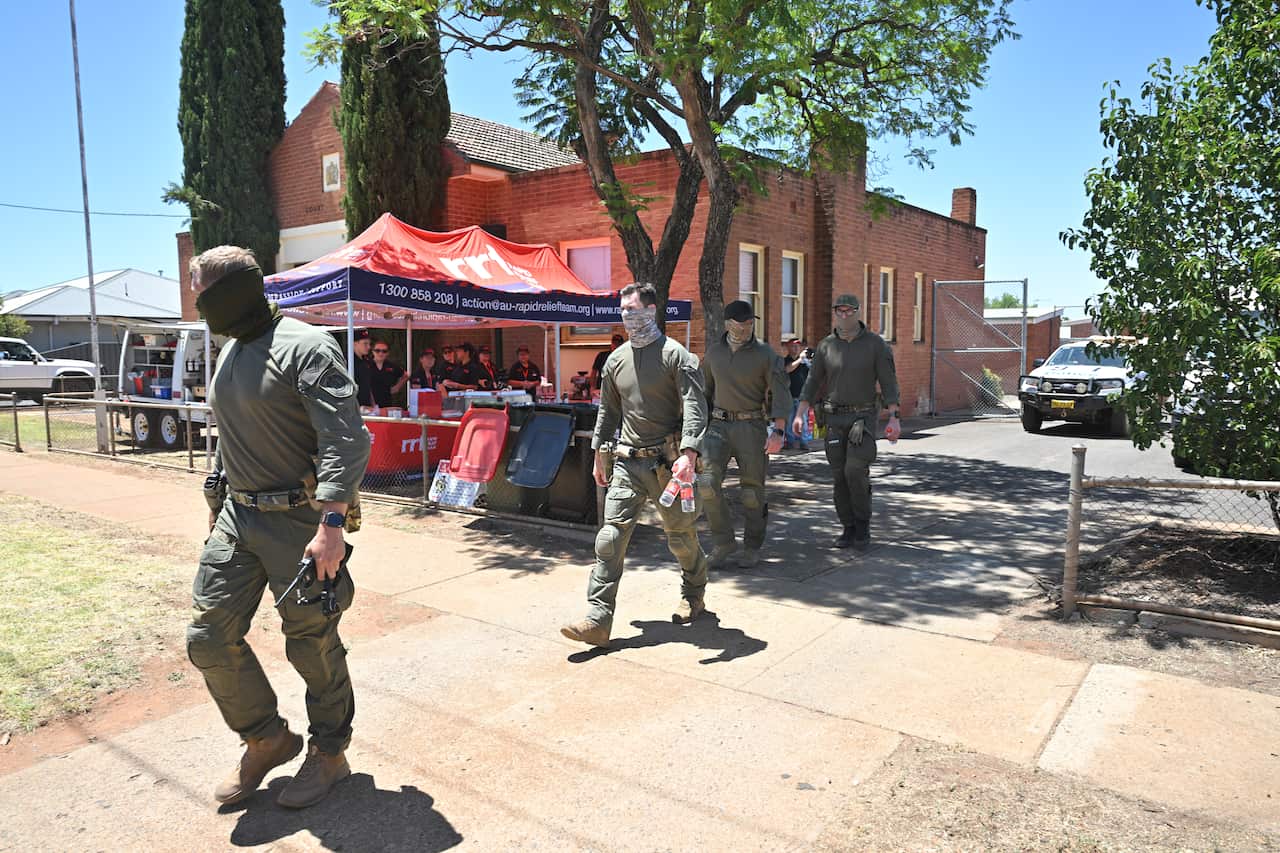
A large-scale police operation will continue from Friday, with police from surrounding commands, Defense Force helicopters, riot police, negotiators and murder investigators searching across the region.
On the afternoon of January 23, local police responded to reports of gunfire on Bokhara Street, where a 32-year-old man and a 24-year-old pregnant woman were found dead in a vehicle.
Twenty minutes later, police attended a home on Walker Street where a second woman, believed to be the 24-year-old’s aunt, had been fatally shot, while another man had been shot and seriously injured.
It is alleged that Ingram shot all four victims, killing three. He then fled the city in a work vehicle, believed to be a white Ford Ranger.
Speaking to media outside the Lake Cargelligo police station on Thursday, Deputy Commissioner Andrew Holland confirmed that Ingram had been spotted at Mount Hope.
“We can confidently say he may be getting help from people he knows in the community,” he said.
“He’s worked for the council, he’s worked his way towards Mount Hope… he knows where the water sources are, he knows where the shelters are.
“We have to work systematically through these locations… before we can move on to the next location.”
The Deputy Commissioner confirmed that the search would continue and noted that Aboriginal community liaison officers had played an important role.
“The search will continue… indefinitely until we find someone. We will obviously have the appropriate resources in place to ensure that the community is safe, and we will of course continue until we can locate this man.”
Crime related to domestic violence
Ingram has a lengthy criminal history and was out on bail after being charged with domestic violence in November.
He was released by police under strict conditions after being deemed ‘low risk’ as he had not committed a violent crime in five years.
On December 3, a magistrate at the Lake Cargelligo Local Court confirmed Ingram’s bail. However, an interim domestic violence order (ADVO) was issued on behalf of the 24-year-old pregnant woman Ingram is now accused of murdering.
A requirement of Ingram’s bail conditions was to report daily to the Lake Cargelligo Police Station. Assistant Commissioner Holland confirmed that Ingram’s last report was at 8.12am on Thursday, January 22 – more than 30 hours before the first shot was fired on Bokhara Street.
In addition to Deputy Commissioner Holland, the media was addressed by NSW Police Commissioner Mal Lanyon.
“What we witnessed at Lake Cargelligo is a terrible tragedy that should not have happened. Domestic and family violence continues to plague our community,” he said.
“There is little doubt that there is significant support in the regions, and I think what we need to continue to work on in my role as Commissioner is and will be to work across government to ensure that all possible services are available.”
The commissioner said the fact that more than 33,000 individuals have been charged with domestic and family violence in 2025 is a “disgrace,” calling the issue a “key priority” for him because of its impact on communities like Lake Cargelligo.
‘Painful reminder of ongoing crisis’
The impact has spread across New South Wales, with growing frustrations over the lack of adequate action against domestic and family violence.
In a statement, the Domestic Violence NSW (DVNSW) Aboriginal Steering Committee said the “devastating killings” at Lake Cargelligo are “not isolated incidents”.
Each statistic represents an Aboriginal woman or child who has been failed by government systems
“They are a tragic and painful reminder of the ongoing crisis of domestic and family violence affecting Aboriginal communities across NSW, particularly in regional and remote areas,” they said.
The committee recognized the gross over-representation of Aboriginal women and children in domestic and family violence statistics.
As it stands, Aboriginal women and children in New South Wales experience more violence, serious injuries and deaths than any other population group.
“Each statistic represents an Aboriginal woman or child failed by government systems designed to protect and support.”
In response, the committee has challenged the state government.
“We call on the NSW Government to go beyond expressions of sympathy and provide genuine recognition of this over-representation, based on truth-telling about the impacts of colonisation, systemic racism, intergenerational trauma and chronic under-investment in Aboriginal-led responses,” they said.
The organization said such recognition “must be accompanied by action” and is proposing a minimum 50 per cent increase in “core funding for specialist home and family services in NSW” that are Aboriginal-led, community-controlled and provide culturally safe and trauma-informed services.
“Meaningful government commitment means secure long-term funding; partnership with Aboriginal expertise; and accountability for outcomes for Aboriginal women and children. Without this we will continue to see avoidable violence, harm and loss,” they said.
“Our communities deserve safety. Our women and children deserve to live free from violence.”
1800RESPECT (1800 737 732)
13YARN 13 92 76
Aboriginal Advisory Services 0410 539 905
1800 RESPECT (1800 737 732)
Lifeline 13 11 14
#Domestic #violence #crisis #scrutiny #man #hunt #continues #Cargelligo #Lake