

It was a grand display of living history, made even better by the presence of Jorge Ricardo, who rode in fourth place Open the door. Ricardo, 64, is at the top of the jockey world with a winning total now approaching 13,400.
Dettori drew the curtain on an international odyssey that spanned parts of five decades. Larger than life and with a personality to match, the native of Milan, Italy, went out the way fans of the game wished all their heroes could go out: smiling, waving and winning.
The game has been there before, but not often enough. Saying goodbye is usually a hush-hush affair, even for racing’s biggest stars.
Eddie Arcaro’s last ride in North America took place on Aqueduct racecourse on November 13, 1961. Arcaro, then 46, was running a few races in Australia and New Zealand over the holidays and was reportedly preparing for the spring season in New York when he dropped his retirement announcement during a press conference at Toot Shor’s Restaurant in Manhattan on April 3, 1962. The news made the front page of the New York Times.
Angel Cordero Jr. was still recovering from the effects of a terrible accident that occurred at Aqueduct in January 1992 when he tearfully announced his retirement that May. He had broken his arm and three ribs and lost his spleen. Three years later, Cordero briefly returned to competition, winning a stakes race at El Comandante in his native Puerto Rico, followed by a handful of rides in New York. Then he quit for good.
It was Cordero’s high-flying act of triumphant horses that was copied by Dettori, first as a tribute and eventually as a trademark demanded by his fans. Cordero, in turn, was inspired by Avelino Gomez, whose soaring descents marked his Hall of Fame career while racing primarily in Canada, where he won most of his 4,081 races. There he died from injuries sustained in an accident Woodbine on June 21, 1980, while riding in the Canadian Oaks. He was 52.
Avelino Gomez performs the flying dismount that Angel Cordero Jr. and would later inspire Frankie Dettori after winning the 1963 Futurity Stakes aboard Bupers at Aqueduct Racetrack
The great jockeys who get to choose how to end their careers consider themselves lucky. Pat Day, Jerry Bailey, Sandy Hawley and Chris McCarron were among those who circled the moment and arrived in one piece.
Bill Shoemaker concluded his farewell tour of America’s racing circuits after 41 years in the saddle with the legend’s final ride on Santa Anita Park on February 3, 1990. A crowd of 64,573 people showed up to watch the 58-year-old Texan finish fourth that day and be carried off the track on the shoulders of his fellow runners, including a young apprentice named Frankie Dettori, who spent winters in California honing his skills.
The greatest of all finals, however, occurred sixty years ago this March, when John Longden selected the prestigious San Juan Capistrano Handicap on the final Saturday of the 1966 Santa Anita season for the final ride of a career that began in the early 1920s. Longden was 59 years old at the time, but felt older, and it didn’t help that just two months earlier he was thrown and then kicked by a filly, suffering a pinched nerve in his back.
Longden had already won 6,030 races – including all three jewels of the 1943 Triple Crown on Count Fleet – and had surpassed Sir Gordon Richards at the top of the winners list a decade earlier. He knew the end was near, but he wanted to ride George Royal one more time, especially since they had won the San Juan together the year before.
Longden kept his cards with him until the Tuesday before the race, when he was scheduled to attend the Pasadena Sports Ambassadors Club for a banquet in his honor. He remained silent as he was praised by friends and colleagues until Dick Nash, Santa Anita’s publicity director, asked, “John, it’s just been your birthday.” What are your thoughts about the future?’
“Then he said he was going to do his last race at George Royal in the San Juan,” said Dan Smith, Sea‘s retired director of media relations, who was Nash’s assistant at the time. “Because of John’s status, that was big news. I think Alex Kahn from UPI (United Press International) was there that evening and called the story into his office. On that Thursday we had a press conference in the publicity offices that was very well attended. Then on Friday the race entries came out, and believe me, George Royal was in trouble.”
The field for the ’66 San Juan was led by Hill Rise, winner of the Man o’ War Stakes and the Santa Anita Handicap in 1965. The mare Straight Deal was fresh off victories on the dirt in the Santa Margarita Handicap and on the turf in the Santa Barbara Handicap. Polar Sea, Tudor Fame and Cedar Key had won the stakes on the match, CV Whitney’s Tom Cat was a tough customer, and Plaque, a son of Princequillo, had already been a brave second on the match in the Arcadia Handicap and a division of the San Luis Rey Handicap.
That Saturday started damp and gloomy. Even as the afternoon warmed, a layer of winter smog descended, typical of the time before the advent of the catalytic converter. Longden was named on four horses and to the delight of the 60,792 attendees he immediately won the fourth race with Chiclero, a fast son of Nashville.
Longden’s horses remained unplaced in the sixth and seventh, after which it was time for the San Juan. In the side of owners Robert Hall and Ernie Hammond from British Columbia, Longden got a lead from trainer Don Richardson and took to the track for the last time.
“George Royal’s odds were 6-1, but based on his record they should have been closer to 20-1,” Smith said. “There was so much sentimental money for John.”
The race started at the top of the hill course, almost completely obscured by the smog. When the field passed the stands the first time, Plaque and Bobby Ussery were in the lead, while Longden was at the back.
“George Royal was a runner, he really was,” Smith said. “And John rode like he had a license to do something. In the first turn he crashed the hell out of Cedar Key. Then, at the back end, where he started picking off horses, he shut down Hill Rise and Manny Ycaza. He dared them to take him down.”
George Royal stopped the free-running Plaque at the eighth pole and threatened to postpone the race, but Ussery’s horse fought back. They touched the wire as one, and the picture gave George Royal the nod, by the nose.
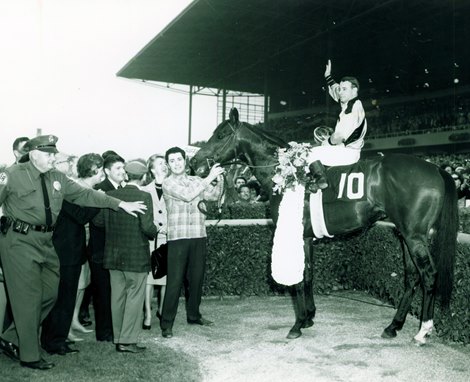
John Longden in the winner’s circle aboard George Royal after their victory in Longden’s career finale, the 1966 San Juan Capistrano Handicap at Santa Anita Park
Wrapped in flowers and surrounded by family, officials and media, Longden removed his helmet in front of the roaring crowd, proudly displaying his fancy toupee as he choked back tears. In the press box, Los Angeles Times columnist Jim Murray tried to piece together the meaning of such a miraculous moment that collided with the end of an era.
“A race meeting in California without John Longden in the irons?” Murray wrote. “Unthinkable. Unsustainable. France without love. Paris without spring. Italy without music. Germany without bands. Baseball without beer. Weddings without tears.”
Smith headed straight to the jockey’s room to catch the reaction of riders who would never have known the race without Longden. Inside, on a blackboard, someone had freshly scribbled: “Only 968 winners left against 7,000. Do you really think you’ll quit, John Longden?’ Bill Shoemaker, a 34 year old boy, was asked if he thought he would break Longden’s record.
“I just hope I live as long as Longden,” Shoe replied.
At the door of the room, Smith encountered Ussery.
“I was trying to be profound,” Smith recalled. “I said, ‘Hey, Bobby, maybe it was for the best the way it turned out. You could be like Bob Ford, the guy who shot Jesse James.'”
Ussery, competitive to the core, spit out a blunt nickname and added, “I wanted to beat that old man so bad I could taste it.”
#Dettoris #grand #finale #rivaled #longago #swan #song