

Bitcoin (BTC ($93,716.00)) price action caused a Death Cross on Sunday, November 16, after the 50-day moving average fell below the 200-day moving average.
Historically considered a bearish technical signal, the event has sparked new debate among traders and analysts. The key question: does this mark a local low, or is there a threat of a further decline?
What is a Death Cross and why it matters for the Bitcoin price now
In technical analysis, a Death Cross occurs when short-term price momentum falls below long-term trends, indicating potential downward pressure. At the time of writing, Bitcoin is trading around $93,646, having fallen below the $94,000 threshold for the first time since May 5.
Market sentiment is extremely bearish, with the Fear & Greed Index dropping to 10, indicating extreme fear. Meanwhile, whale selling and outflows from spot ETFs have accelerated the recent downward moves.
Amid these negative sentiments and fears of further negative consequences, analysts say a Death Cross does not automatically predict crashes.
Historical data from 2014 to 2025 shows mixed results in the short term, but strong rebounds in the medium to long term in many cycles.
Historical performance: short-term losses, medium-term gains
Data shared by Mario Nawfal and on-chain analysts indicates the following:
- 1-3 weeks after the cross: the return is almost 50/50 between profit and loss; the average return is slightly positive (~0.25–2.35%).
- 2 to 3 months after the cross: Average gains increase to 15 to 26%, indicating a possible recovery if historical patterns hold.
- 12 months later: results vary widely; some cycles delivered over 85% gains, others suffered serious pullbacks, depending on the macro context.
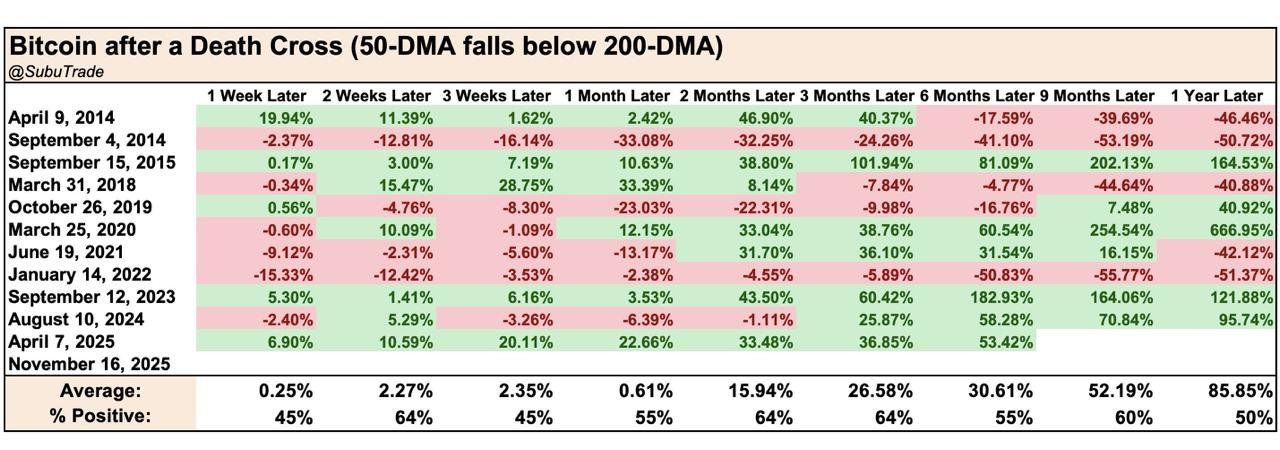 Bitcoin Price After Death Cross. Source: Mario Nawfal on X (Twitter)
Benjamin Cowen and Rekt Fencer argue that previous Death Crosses have often marked local lows, rather than market tops. The timing of the next jump can be critical. If BTC does not recover within seven days, analysts warn that another decline could precede a bigger recovery.
What’s next for Bitcoin investors? Key levels and market signals
Technical and macro indicators highlight crucial thresholds:
- Support range: $60,000-$70,000, a potential bottom as selling pressure increases.
- Bullish confirmation: Reclaiming the 200-day moving average as support could be a sign of renewed upside momentum.
Analyst Brett notes that the 50-week MA remains a more decisive long-term indicator than the Death Cross alone.
Historical cycles indicate that death crosses during bull markets often precede rallies toward new all-time highs. Conversely, during bear markets they are usually short-lived.
Nevertheless, investors should keep a close eye on short-term price movements because historical data implies:
- A rebound within a week could indicate that the bull cycle remains intact.
- If a recovery does not occur, it could lead to another decline, creating a macro lower high before a bigger rally takes place.
Meanwhile, medium-term projections point to a recovery gain of 15-27% over the next 2-3 months if BTC follows its average historical behavior.
The long-term benefit remains plausible, but the variability is high, highlighting the importance of combining technical, on-chain and macro analysis for informed strategic decisions.
Although the Death Cross suggests caution, history shows that Bitcoin often rebounds after similar events. Traders should remain alert, keep an eye on key support levels and be prepared for short-term volatility, even as potential medium- and long-term profits remain within reach.
The Post Death Cross Confirmed: Is Bitcoin at Its Bottom or About to Crash? appeared first on BeInCrypto.
#Death #Cross #Confirmed #Bitcoin #Bottom #Crash #BitRss #Crypto #World #News