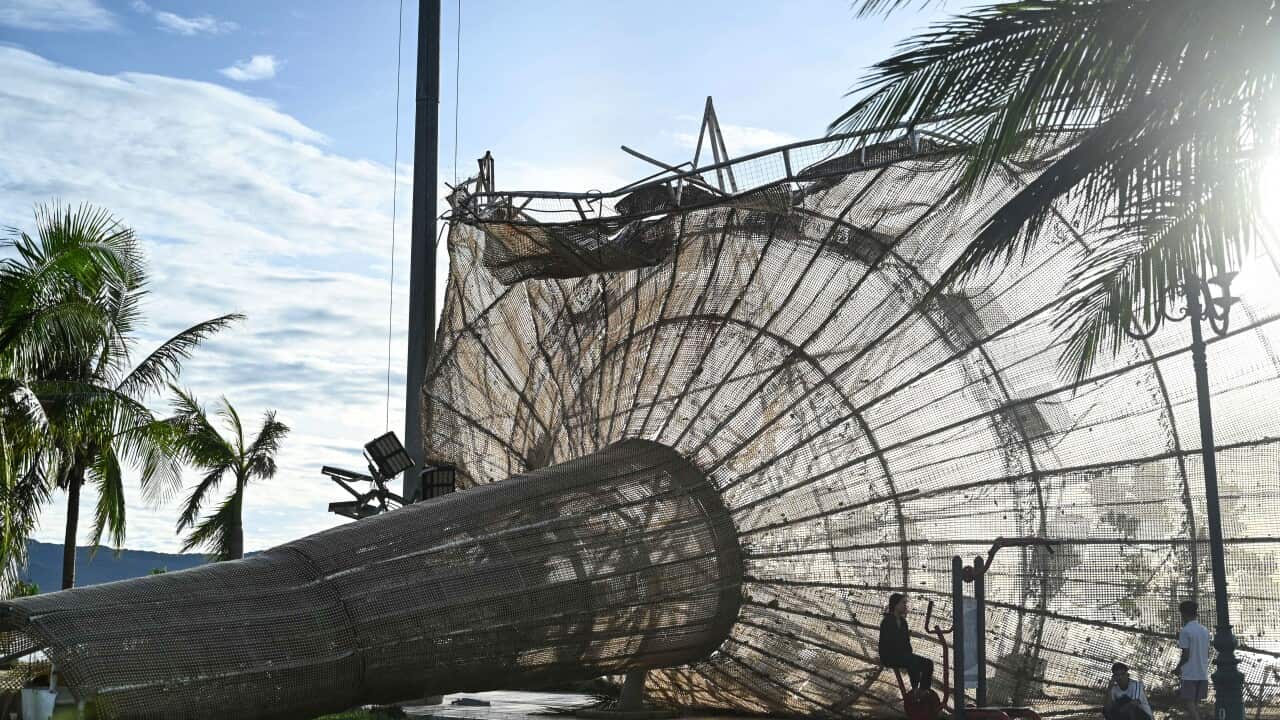

Typhoon Kalmaegi tore through Vietnam on Friday, claiming five more lives after its devastating passage through the Philippines, where the death toll rose to 188.
Kalmaegi brought record rains and flooding to the central Philippines this week, sweeping away cars, trucks and shipping containers before ravaging Vietnam late Thursday.
“The roof of my house just blew off,” said Nguyen Van Tam, a 42-year-old fisherman in Vietnam’s Gia Lai province, where the storm made landfall with sustained winds of up to 90 miles per hour, according to the Environment Ministry.
“We were all safe, (but) the typhoon was really terrible, so many trees had fallen,” he said, adding that his boat survived intact.
Vietnamese authorities were still assessing the damage on Friday, but the environment ministry reported five deaths and 57 houses collapsed in Gia Lai and neighboring Dak Lak.
Nearly 3,000 others had their roofs blown off or damaged, while 11 boats or ships sank.
On the streets along Gia Lai’s Quy Nhon Beach, rescuers and soldiers work with residents to clear uprooted trees, remove debris and retrieve sheet metal roofs that blew away overnight.
“This was a very big typhoon that hit us,” 64-year-old Tran Ngo An told Agence France-Presse. “This was the second time I witnessed such a typhoon. The other one was about ten years ago, but not as strong compared to this.”
The state-owned power company said 1.6 million customers lost electricity as the typhoon devastated the central coast, but service had been restored to a third of them by Friday morning.
Vietnam is in one of the most active tropical cyclone regions on Earth and is typically hit by ten typhoons or storms a year, but Kalmaegi was the 13th of 2025.
Scientists warn that storms are becoming more powerful due to human-induced climate change. Warmer oceans can make typhoons stronger quickly, and a warmer atmosphere holds more moisture, which means heavier rainfall.
The fast-moving Kalmaegi had already moved northwest towards Laos by morning with significantly weaker winds, but heavy rain was still forecast for much of Vietnam’s central coast, the national weather bureau said.
The storm was then expected to hit Thailand, which warned on Friday of heavy rain and flooding that started in the northeast but spread to the rest of the country.
Relentless rains
Kalmaegi had initially stormed the islands of Cebu and Negros in the Philippines before diving back into the sea.
Floods described as unprecedented swept through the worst-affected towns and cities of Cebu province, where the hunt for missing people continues.
Philippine authorities have raised the death toll to 188, while 135 remain missing.
The typhoon struck central Vietnam as it was still reeling from more than a week of floods and record rains that killed at least 47 people and submerged centuries-old historical sites.
Heavy rains that began in late October had drenched the former imperial capital of Hue and the ancient city of Hoi An, both UNESCO World Heritage sites, turning streets into canals and flooding tens of thousands of homes.
Up to 1.7 meters fell in a 24-hour period during a downpour, breaking national records.
With a coastline of over 3,200 kilometers and a network of 2,300 rivers, Vietnam is at high risk of flooding.
Before Kalmaegi, natural disasters had already killed or gone missing 279 people this year and caused more than $2 billion in damage, Vietnam’s National Bureau of Statistics said.
#Deadly #typhoon #Kalmaegi #ravages #Vietnam #killing #Philippines