

So do people actually care about Meta’s various AI tools and options, like generating images of yourself in fantastical scenarios, or videos that display whatever you want?
Are people actually using these tools at scale, or is Meta more excited about them than the public?
Well, that’s hard to say because while Meta has reported multiple times that its Meta AI chatbot is now the most used AI assistant in the worldMeta’s scale skews those statistics slightly, because Meta AI is built into the search function in every Meta app.
That means a lot of people are using Meta AI, whether they intended to or not, and with 3.54 billion daily active users on its appsthat’s a lot of people who might be considered Meta AI users, but aren’t coming to the platform specifically for the AI tools.
A more indicative measure would then be the use of Meta’s dedicated Meta AI app, which it launched in April, by rebranding the “Meta View” app, which was initially only the companion app for its Meta Ray Ban glasses.
Although even then there wasn’t much to do in the app if you didn’t have Meta AI glasses. And because Meta AI was built into the other apps, even the rebrand didn’t lead to much more initial usage, but as you can see in this graph from SimilarwebMeta’s AI app has seen a surge in popularity lately.
You can see the shift in interest after the rebrand in April, and then a big uptick recently.
Some have shared this chart to highlight the growing interest in Meta’s AI offering, and how Meta is winning in the AI race. But even this spike is apparently based on novelty, not long-term use and engagement.
That’s because Meta launched its AI-generated video content feed “Vibes” on the app in late September, reflecting the sudden spike in interest.
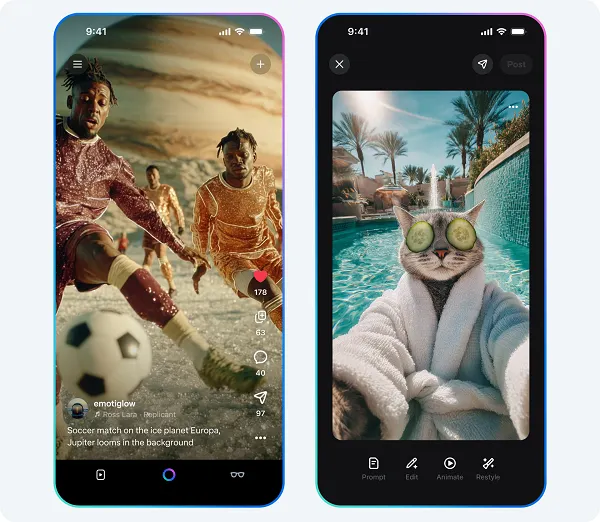
That led to many people downloading and using the app (Similarweb says the Meta AI app was downloaded 8.8 million times in October) to watch Meta’s AI videos, which also means these usage numbers are skewed by curiosity and not real, ongoing interest or engagement.
So what will be more indicative are the usage numbers that develop in the future, and will this week Business Insider did that gained a new insight in this aspect, after obtaining internal metadata about the use of the Meta AI app.
According to BI:
- Meta’s Vibes feed currently has about 2 million daily active users, which has decreased slightly week over week. That’s notable when you compare it to the download graph above, which shows that the app saw around 30 million monthly actives in October. And while this compares daily and monthly data points, the numbers suggest that the majority of people who download the app don’t come back to it often (note: social media apps see, on average, about half as many daily users as their monthly active user total).
- Most of Vibes’ growth in early November came from India (702,000 daily active users) and Brazil (114,000 daily active users)
- Vibes has 23,000 daily active users in Europe after the Vibes feed launched in the EU on November 6
- Vibes use has declined in parts of Southeast Asia, with the Philippines seeing a 9% decline in daily activities and a 7% drop in Thailand
The data shows that there is some interest in Vibes, but usage appears to be relatively low compared to the number of downloads and initial increase, suggesting that a feed of AI-generated clips is not good enough to hold the audience’s attention in a significant way.
That’s not surprising, considering the flow of junk in that stream. But that could also have further implications for Meta’s broader generation AI push, as it looks to spend a lot of money on the next phase of AI development.
And Meta is eager to get people to try out its generative AI tools. There are now prompts in virtually every part of the apps that let you chat with Meta AI, ask an AI bot a question, or tap an AI-generated search bubble, etc.
But do people really want this? Certainly the current wave of AI tools is interesting, and LLM-based systems have practical value in a range of contexts. But are Facebook and Instagram users really excited about creating images of themselves as astronauts, or short videos of things that don’t actually exist?
Because in my experience, the vast majority of this content would be considered “AI slop,” derivative, empty content, which really fits that description perfectly: it’s content, as in “things to watch,” but it’s not particularly interesting or entertaining.
There are of course exceptions to this, with some AI-generated videos and images being unique and interesting, demonstrating a new take on the form. But that really comes down to the creativity and skill of the creator. Some AI videos may look good, but without an interesting concept behind it, it’s just a showreel of what AI can do. Some AI-generated images come out great, but that’s usually because the person giving the directions understands the different elements of the image composition and can refine the output based on that.
While AI tools will open up more creative possibilities, human ideas remain at the core of creativity and are the heart of social networks, where human users go to communicate with each other.
This is why AI reply prompts feel a bit cold and empty, and why AI post suggestions seem pointless for the most part. Because social media is about “being social” and sharing your unique perspective and opinions with others.
If you rely on AI tools to guide this, what’s the point?
It feels more like a fast track to bots talking to more bots and simulating human engagement, while real people watch as these systems regurgitate and reshape an entire internet’s worth of past discussions.
Is that the kind of future we want?
And while AI prompts and tools can help guide your thinking, why post if you have nothing to say? Why would you feel the need to take up space, as if to fill in gaps in the discussion?
This is where AI bots feel intrusive and unfair, as they fill in the gaps in social apps, an additional, automated stream of content that doesn’t really add anything to the broader discourse.
You could argue that AI bots can help spark more discussion and help people clarify their conversation topics, and in some cases that may be true. But the value of your actual, personal contribution is that no one else can replicate your perspective. Why would you dilute that behind a manufactured digital filter?
So while Meta is eager to push its generation of AI tools and push users to explore what’s possible, and while Zuck and Co. see the current LLM-based AI push as the path to “superintelligence,” I tend to agree with former Meta AI chief Yann LeCun, who sees the development of LLM as largely a dead end in this regard, there is a circular loop that will not advance society in any meaningful way.
The real value of AI superintelligence, in the form of artificial general intelligence (AGI), is unlikely to come from data that already exists, but will come from research into developing machine systems that can replicate the human brain and actually use perception and understanding to truly ‘think’ for themselves.
That’s not what LLM systems do. In fact, the suggestion that these tools are even AI is itself a misnomer, because they are not “intelligent” in any way, they are just patterned predictions on a large scale.
Which again has its applications, and will have great benefits in some applications. But I don’t know if it contributes much to social media as a format.
#Data #shows #Metas #AIbased #Vibes #feed #struggles #hold #attention