

Join our Telegram channel to stay up to date with the latest news
Citigroup has invested in stablecoin infrastructure provider BVNK through Citi Ventures, just months after warning that the cryptos could drain deposits from traditional banks
BVNK’s platform serves as an on- and off-ramp for customers to move money between fiat and crypto. It is also backed by US crypto exchange Coinbase and fund manager Tiger Global Management.
The investment underlines TradFi’s shift from caution to joining the stablecoin ecosystem after the US GENIUS Act provided regulatory clarity on their status.
BVNK Valuation Exceeds $750 Million After Citi Investment
TThe company has declined to disclose the amount Citi has invested and at what valuation. But co-founder Chris Harmse recently confirmed that the investment’s valuation has risen well above the $750 million announced during the last funding round.
BVNK currently finds itself in a competitive market alongside newcomers such as Alchemy Pay, TripleA and even the established Ripple. All these companies are competing for the lion’s share of the cross-border digital money market.
Amid the strong competition, Harmse said BVNK has “dipped in and out of profitability” as the company invested in growth, but said the company is experiencing momentum, especially in the US.
The co-founder added that the US has been the company’s fastest growing market over the past 12 to 18 months. This growth was fueled by the passage of the GENIUS stablecoin Act, which was signed into law by US President Donald Trump earlier this year.
In August, US Treasury Secretary Scott Bessent expressed support for the adoption of stablecoins, saying these tokens “will increase access to dollars for billions around the world.”
Implementing the GENIUS Act is essential to securing U.S. leadership in digital assets.
Stablecoins will increase access to dollars for billions around the world and lead to a surge in demand for US Treasury bonds, which back stablecoins.
It’s a win-win-win for everyone involved:… https://t.co/p5nRQpBfnw
— Treasury Secretary Scott Bessent (@SecScottBessent) August 18, 2025
The regulatory clarity provided by the GENIUS Act has boosted the stablecoin market’s capitalization in recent months, with multiple financial institutions since signaling plans to launch their own stablecoins.
Over the past week, capitalization for the stablecoin sector rose to around $4.353 billion, according to the figures DefiLlama data.
After growing over the past seven days, the stablecoin market cap now stands at over $304.163 billion.
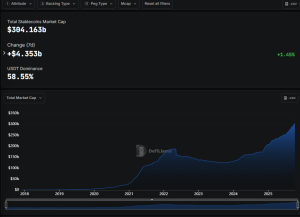
Market capitalization of Stablecoin (Source: DefiLlama)
In the past 30 days alone, $5 trillion in stablecoin transactions have taken place, according to the report analyzes in the chain from Visa.
One of the companies that has confirmed stablecoin plans is Citi, whose CEO Jane Fraser said in July, the same month the GENIUS Act was signed, that the bank was considering issuing its own stablecoin. She also said that Citigroup is developing custody services for crypto assets.
Through these products, Citi aims to securely deliver “the benefits of stablecoin and digital asset advances” to its customers by modernizing its own infrastructure.
Other companies are also exploring blockchain technology and tokenization. This includes Wall Street giant JPMorgan Chase, which has launched its own stablecoin-like token called JPMMD. Meanwhile, Bank of New York Mellon has said it is testing tokenized deposits. HSBC has also launched its own tokenized deposit service.
Citi had warned of the risk of deposit flight, similar to that seen in the 1980s
Citi’s investment in BVNK comes after one of its analysts, Ronit Ghose, warned in August that increasing interest in stablecoin payments poses a deposit flight risk for traditional banks, similar to what was seen in the 1980s when money market funds floated.In seven years, the economy has grown from $4 billion to $235 billion.
Major banking groups in the US have already raised concerns about interest-bearing stablecoins and have lobbied Congress to close what they called a “loophole” in the GENIUS Act.
The law prohibits stablecoin issuers from offering proceeds directly to token holders, but does not extend this prohibition to third parties or affiliates. This, according to the banking groups, opens the door for stablecoin issuers to circumvent the restrictions. For example, Coinbase is currently offering its users returns on Circle’s USD Coin (USDC) stablecoin.
If this “loophole” is not addressed, banking groups predict it could lead to an outflow of deposits of as much as $6.6 trillion from the traditional banking system. This could then fundamentally change the way banks finance loans.
However, the crypto industry has pushed back against the banking groups’ claims, with many dismissing them as just an attempt by banks to prevent competition. Some, including Stripe CEO Patrick Collison, have also said that stablecoins will now force banks to offer higher returns to customers.
Good article on the evolving stablecoin market structure. I would expand on it further: yes, I think stablecoin issuers will have to share the revenue with others, but this is just one example. Everyone will have to share the proceeds. Today, the average interest rate on American savings is… https://t.co/yjjLOzxoOk
— Patrick Collison (@patrickc) October 3, 2025
Related articles:
Best Wallet – Diversify Your Crypto Portfolio

- Easy-to-use, feature-driven crypto wallet
- Get early access to upcoming token ICOs
- Multi-chain, multi-wallet, non-custodial
- Now in the App Store, Google Play
- Stake to earn native token $BEST
- 250,000+ monthly active users
Join our Telegram channel to stay up to date with the latest news
#Citi #warned #stablecoins #drain #banks #backing #technology