

At TOKEN2049 Singapore, Capriole Investments founder Charles Edwards put aside his well-known Bitcoin bullishness to issue an unequivocal warning: a quantum “Q-Day” could come much sooner than most of the industry expects, with potentially existential consequences if Bitcoin’s core cryptography is not upgraded in time. “Within two to eight years, a quantum machine will break Bitcoin’s current encryption,” he told the audience, urging developers, companies and holders to treat the problem as urgent engineering, not a distant theory.
Edwards described Q-Day as the moment when a sufficiently powerful quantum computer could break widely used classical cryptography such as RSA – and, by extension, the elliptic curve cryptography (ECC) that underpins Bitcoin’s public-private key model. “Q-day is the day when a quantum machine will break classical encryption,” he said, adding that once that threshold is crossed, everything protected by these primitives – from financial networks to “sensitive data” and “of course Bitcoin” – will be at risk. He claimed that Bitcoin’s ECC would likely fall before the RSA as the industry approaches that breaking point.
Quantum Computing Could Break Bitcoin Within Eight Years
Pushing back on the common refrain that practical quantum attacks will still be decades away, Edwards argues that the timeline has been significantly compressed, citing both rapid technical progress and a collective incentive among states and major companies to accelerate. “Even quantum years away. If you ask ChatGPT or Grok, it will tell you in ten, twenty, thirty years. It’s nonsense,” he said. He pointed to the access to quantum computing already available through major cloud providers – AWS, Google and Azure – and its use cases in “drug discovery, defense, [and] optimizing bond yields,” presenting these as indicators of real traction rather than laboratory demonstrations.
Edwards anchored his prediction for the next two to eight years on a convergence of views that he described as independent and level-headed. He pointed to security specialist Jameson Lopp assigning “50% risk in four to nine years,” a “math PhD student specializing in quantum” at “2 to six years for Bitcoin,” and McKinsey’s estimate for Q-Day at RSA level in “2 to 10 years,” reiterating his belief that “Bitcoin will break years sooner.”
He also drew attention to a 2017 “Bitcoin quantum paper,” which suggested in his talk that “you only need 2,300 qubits – logical qubits – to break Bitcoin’s ECC,” noting the authorship of researchers affiliated with Microsoft, IonQ and Meta. While these numbers and connections were presented as evidence, his central message was less about a single study and more about the general direction of travel: a multilateral “quantum arms race” that he said has already generated “$55 billion” in commitments, with China “doubling America’s spending.”
According to Edwards, technological trend lines are strengthening that investment wave. He described the growth of qubits as “essentially a straight line on a log diagram,” claiming it is “advancing faster than Moore’s law,” and compared current skepticism to the disbelief many held about AI adoption in 2021 – just before chatbots went mainstream.
“Imagine 2021 and think of AI… You thought it would be years away. So ChatGPT happened. I think we’re in a similar moment with quantum. It’s ignored today, but it’s coming.” He also highlighted a perceived shift in sentiment toward Nvidia’s Jensen Huang, saying that after downplaying quantum timelines early this year, Huang later called quantum at “an inflection point” and has “spent billions buying quantum companies.” For Edwards, the message is simple: “As always, follow the money.”
The operational risks Edwards outlined for Bitcoin were concrete and immediate. If adversaries can derive private keys from public keys exposed on-chain, coins located at addresses that previously exposed public keys become vulnerable to theft. That set contains long-dormant ‘lost’ coins and possibly some Satoshi-era holdings.
“Satoshi’s coins will probably be dumped on the market,” he said grimly, not because the owner would necessarily take action, but because the associated keys could be calculated and the UTXOs could be swiped once Q-Day arrives.
He contrasted dormant addresses with actively maintained wallets, arguing that modern key management and timely migration would reduce exposure: “We want to maintain active wallets… it’s good to maintain security upgrades and the relevance of the technology over time.” He was referring to Michael Saylor’s recent comment about doing “something ethically correct and getting burned[ing] its coins,” and used it to underline a reversal of perceived safety: “Basically burned – the lost coins – the biggest risk because no one has maintained that infrastructure.”
In addition to the cryptographic breach itself, Edwards highlighted the logistical limitations of any industry-wide upgrade. Bitcoin can only process a limited number of transactions per day, meaning a migration to quantum-safe addresses cannot be done overnight. “We have long lead times to upgrade Bitcoin,” he said.
“For Bitcoin itself, if you ignore all other transactions on the network to simply move everyone to a new wallet, it will take at least a month… so we basically expect at least 6 to 12 months to resolve this.” On that basis, he argued that work on a concrete migration path cannot wait: “We really need to solve this next year – 2026 – in order to have a solution before 2027.”
Edwards pointed to ongoing engineering efforts as a starting point rather than a completed plan. “There are solutions to protect crypto… For example, there are a few BIPs like this one… from Jameson Lopp. So there are solutions. We can solve this, but it is urgent.”
Quantum will break Bitcoin and dump Satoshi’s coins on the market.
We must take action in 2026.
Watch this video to understand why.https://t.co/46Cqlv5RSH
— Charles Edwards (@caprioleio) October 13, 2025
He called on developers to evaluate proposals for quantum-resistant systems and called on the broader community to “engage with them [the] community, your social media, get involved in the Bitcoin improvement proposals. Rate them, give feedback, just talk.” The subtext was that governance friction – social consensus, customer implementation, wallet support, exchange coordination – becomes the deciding factor once a candidate plan is chosen, and that delay is itself a security risk if adversaries are watching their own clock.
At the time of writing, Bitcoin was trading at $111,161.
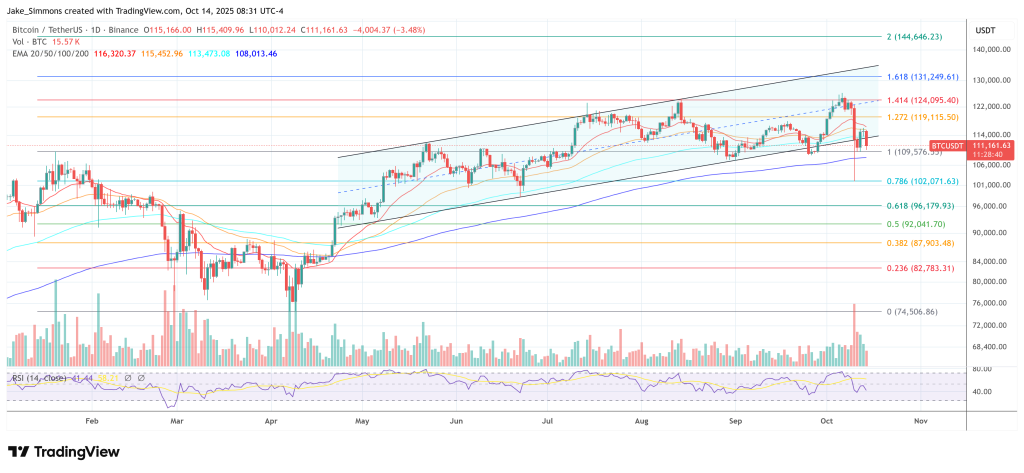
Featured image created with DALL.E, chart from TradingView.com

Editing process for bitcoinist is focused on providing thoroughly researched, accurate, and unbiased content. We maintain strict sourcing standards and every page is carefully reviewed by our team of top technology experts and seasoned editors. This process ensures the integrity, relevance and value of our content to our readers.
#Charles #Edwards #Predicts #Bitcoins #Quantum #Break #Years