

Cha Bum-kun had almost immediately become a crowd favorite, despite being completely unknown in Europe until now. His performances started turning doubters into fans right from the start. He worked well with Bernd Holzenbein, West Germany’s left winger during the victorious 1974 World Cup and Eintracht Frankfurt’s highest ever goalscorer in the Bundesliga. His viciously stabbing shots were often too strong for the goalkeepers to save, earning him the onomatopoeic nickname Tscha-bum. His ruthless drive and intelligent positioning skills, in addition to his scoring record, saw him selected in the season’s best XI by Kickerthe most important German sports magazine. He was joined in the front three by consecutive Ballon d’Or winning Kevin Keegan and Bayern hero Karl-Heinz Rummenigge. Cha played 31 games in the league and scored 12 goals, more than any other Eintracht player. His performances in the DFB-Pokal were less memorable as his side were eliminated in the last 16, but he would soon change that.
The best memories of his debut season in Germany came from the UEFA Cup. Although Eintracht’s league form was patchy and they conceded as many goals as Hertha were relegated, their performances in the UEFA Cup were far more convincing. Cha masterfully showed that his attacking contributions were not limited to scoring goals. He was a source of constant threat in the resistance bloc. He scored his second goal of the European campaign against Dinamo Bucharest and his third against Feyenoord.
In the semi-finals of the UEFA Cup, Eintracht faced Bayern Munich. They had defeated Bayern when they met for the first time in the league that season by pulling off a stunning turnaround. They trailed 2–0 until the 67th minute, but scored three times in the next eleven minutes to win 3–2. But during the return match in May, Bayern won 2-0. A fortnight later, Bayern defeated Eintracht again 2–0 in the first leg of the UEFA Cup semi-final. In the second leg, an inspired Bruno Pezzey, one of Austria’s best defenders, found the net twice in the 31st and 87th minutes to take the tie to extra time. Eintracht’s attacking unit, led by a tireless Cha, managed to score three more goals in extra time, winning the match 5-1 and drawing 5-3 to reach their first UEFA Cup final and first European final since their 7-5 defeat to an all-time great Real Madrid side in the 1959/60 European Cup final.
The first leg of the final was not that promising for Frankfurt as Borussia Mönchengladbach won a close game 3-2 against Lothar Matthäus, the reigning UEFA Cup champions. Eintracht had started the second leg with waves of attacks, one of which led to a rasping volley from Cha that flew just over the bar. The first half ended goalless. Borussia Mönchengladbach were constantly held back by the Frankfurt side, desperate for a goal, but they had to wait much longer than expected. One goal was all Eintracht Frankfurt needed to win the final as they had scored two away goals. They finally broke through Mönchengladbach’s defense in the 81st minute, with Schaub completing a move that saw Cha deliver a sharp and quick running pass in the build-up. Eintracht Frankfurt held on to win their first continental silverware. Although Cha’s name was not on the scoresheet, his performances prompted Lothar Matthaus to note that Cha was one of the best strikers in the world.
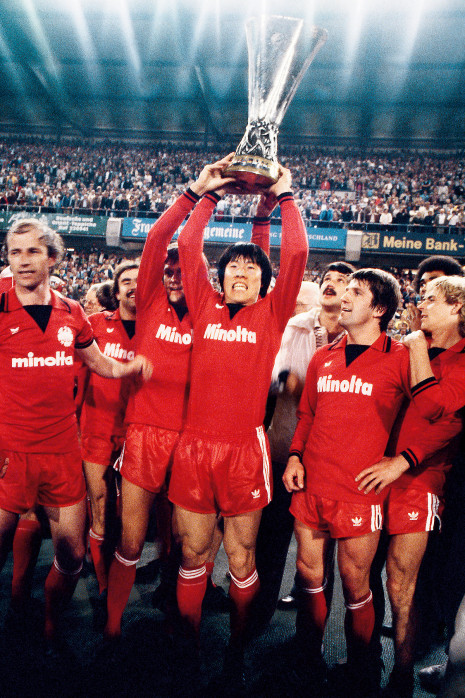
At the beginning of the 1980/81 season, Cha suffered an injury, but he still scored 8 goals in the league and took Eintracht Frankfurt to a 5th place. But he saved his best for the DFB-Pokal campaign, where he scored six goals in six appearances, with a goal in the second leg of the semi-finals and a headed goal in the 64th minute in the final against Kaiserslautern. Eintracht won their third DFB-Pokal trophy. The following season he scored 11 league goals. He followed that up with his most productive Bundesliga season to date, scoring fifteen times in the competition.
In 1983, Eintracht were experiencing serious financial problems and had to sell their stars to balance their books. After four glorious seasons in Frankfurt, Cha signed for Bayer Leverkusen shortly after turning 30.
Related
Discover more of
Subscribe to receive the latest posts by email.
#Cha #Bumkun #pioneer #Part