

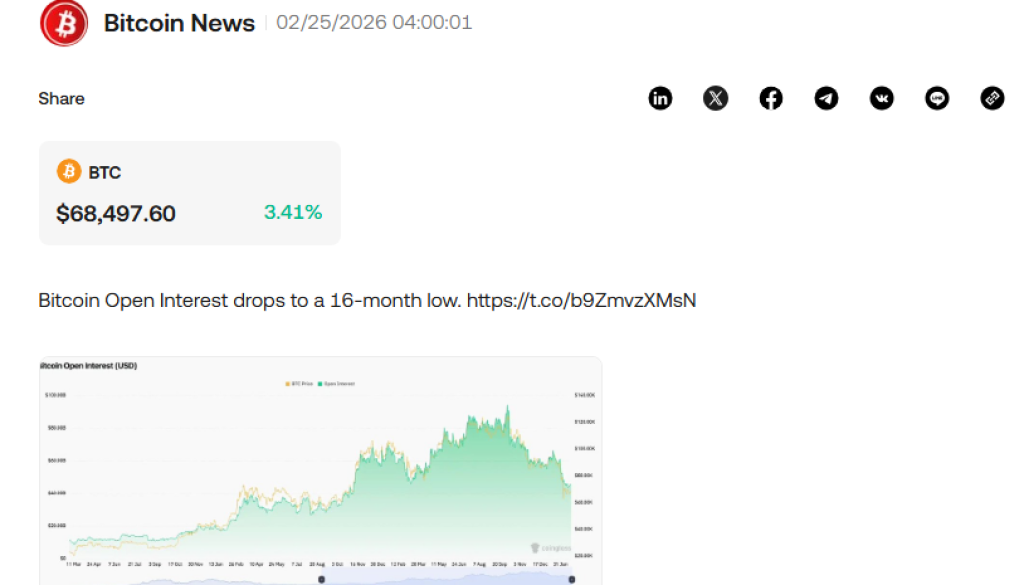
- Bitcoin open interest falls to a 16-month low, reaching 695,600 BTC valued at $44.22 billion at the end of February 2026
- The measure fell 53-55% from its peak of $94 billion in October 2025, after $5.2 billion in liquidations washed away debt
- Funding rates normalized to neutral after turning negative, indicating a balanced market where long and short positions do not dominate
Bitcoin open interest will fall to a 16-month low at the end of February 2026. Total open interest across all exchanges dropped to approximately 695,600 BTC. This currently equates to a value of approximately $44.22 billion. The level represents the lowest reading since August 2025. The metric plummeted 53-55% from October 2025 highs of over $94 billion. More than $5.2 billion in forced liquidations within two weeks contributed significantly. Financing rates normalized to neutral after extremely negative figures.
What caused Bitcoin’s open interest to drop so dramatically?
The combination of several factors caused a sharp decline in open interest on futures. The high volatility led to successive liquidations on the stock exchanges. Macro pressures and institutional withdrawal strengthened the selling.
What impact did liquidations have on open interest?
February 2026 brought extreme volatility to the Bitcoin futures markets. In just two weeks, more than $5.2 billion in forced liquidations took place. These liquidations systematically wiped out highly leveraged positions.
Long positions initially faced the pressure of liquidation. Traders who bet on continued price increases ended up on the wrong foot. Exchanges automatically closed their overleveraged long positions as prices fell. This created cascading effects that pushed prices down even further.
The lever reset has completely cleared up weak hands. Aggregate funding rates turned deeply negative during this period. Negative financing means that short positions are paid longs to hold positions. This temporarily indicated overwhelming bearish sentiment.
The current open interest of 695,600 BTC marks the weakest level in 16 months. The decline from peak levels was more than 50% in just four months. Such rapid declines usually indicate major shifts in market structure.
What macroeconomic factors contributed?
Broader economic conditions are putting pressure on risk assets, including Bitcoin. Sticky US inflation data disappointed market participants who expected rate cuts. The Federal Reserve maintained its aggressive stance for longer than expected.
A partial US government shutdown caused uncertainty in the markets. Delayed economic reports created an information vacuum for traders. This risky environment pushed capital away from speculative positions.
Global crypto exchange traded products saw five consecutive weeks of outflows. About $4 billion left these institutional vehicles. ETF outflows indicate that institutional investors are significantly reducing exposure to cryptocurrencies. Understanding how crypto markets work can help you interpret these moves.
How did seasonal factors play a role?
The Chinese Lunar New Year significantly reduced trading liquidity. The Asian markets normally account for significant Bitcoin trading volume. During the holiday period, many traders temporarily step away.
Geopolitical tensions continued to weigh on market sentiment in general. Ongoing conflicts and trade disputes create uncertainty for risky assets. Bitcoin is increasingly traded as a risky asset correlated with technology stocks.
The combination of seasonal illiquidity and geopolitical concerns exacerbated volatility. Lower liquidity means greater price fluctuations for the same order sizes. This volatility caused more liquidations, creating feedback loops.
Where are the Bitcoin funding rates now?
Funding rates normalized significantly after the leverage flush was completed. These rates indicate the balance between long and short positions. The current figures indicate relatively balanced market conditions.
What do stock market-specific prices show?
Binance Financing rates became slightly positive: +0.0037% to +0.0074% per 8 hours. Positive interest rates mean that long positions pay shorts to hold positions. This indicates that mildly optimistic sentiment is gradually returning.
Bite shows similar patterns with rates ranging from +0.0055% to +0.0100%. The positive funding indicates moderate optimism among Bybit traders. Longs willing to pay indicate a belief in potential upside.
OKX takes a more neutral stance with rates ranging from -0.0012% to +0.0041%. The near-zero funding indicates an indecisive market at the moment. Neither bulls nor bears clearly control sentiment on this stock.
Deribit consistently maintains a financing rate of exactly 0.0000%. The options-oriented exchange shows a completely neutral positioning. This stability contrasts with the recent extremely negative figures.
What has changed from earlier this week?
Financing rates were consistently negative in the period from February 23 to 24. Deeply negative yields indicated that short positions dominated market positioning. Shorts paid longs to keep their bearish bets.
The switch to slightly positive interest rates on major stock exchanges indicates a shift. Short sellers began closing their positions as prices stabilized. Some long positions returned and tentatively tested support levels.
The aggregated average funding for all scholarships is approximately -0.001%. This near-zero value confirms that the extreme leverage has been wiped out. The market reset creates a healthier foundation for future steps.
What does low open interest mean for the Bitcoin price?
Reduced open interest creates both risks and opportunities. The current situation differs significantly from highly leveraged environments. Market dynamics change as speculative positioning diminishes.
Does lower open interest reduce volatility?
Lower leverage generally reduces cascading liquidation risks. Fewer over-indebted positions mean smaller forced sales during declines. Paradoxically, this can lead to more stable price action.
However, reduced open interest sometimes also means less liquidity. Less active positions can lead to wider spreads. Orders can affect prices more dramatically than during high liquidity.
The current consolidation margin between $60,000 and $70,000 reflects this. Bitcoin trades defensively without strong directional conviction. Spot buyers and sellers are currently competing within this range.
What do analysts say about this situation?
Market analysts generally view the debt washout positively. Over-indebtedness creates fragile market conditions prone to crashes. Clearing weak hands strengthens the market structure in the long run.
Low open interest reduces immediate demand for Bitcoin. Fewer futures traders mean less speculative interest right now. But this also removes the downside risks of mass liquidations.
Many traders wait for a “decisive moment” to take positions again. A clear break above the $70,000 resistance could spark renewed interest. Alternatively, breaking support below $60,000 could accelerate selling. Learning about crypto market cycles provides context.
When can open interest recover?
Several catalysts could push open interest rates higher again. Positive macro developments such as interest rate cuts would help. Clear regulatory progress, particularly in the area of spot Bitcoin ETFs, is important.
The institutional influx recently ended the five-week drought. For some ETF products, net inflows broke out of the negative trend. This suggests that institutional interest may be stabilizing.
Technical breakouts from the current supply would pull traders back. Momentum traders wait for clear directional signals before committing. The current consolidation represents a decision point for the markets.
What should traders do with this information?
Low open interest creates a specific trading environment that requires adjustment. Strategies that are effective during periods of high debt no longer work the same way. Understanding current conditions helps navigate successfully.
Risk management becomes even more important during transitions. Position sizes should reflect reduced liquidity conditions. Wider stops may be necessary due to possible slippage.
Spot accumulation makes sense for long-term believers. Less speculative foam creates potentially better entry points. Dollar cost averaging during consolidation ranges has historically worked well.
Options strategies may currently offer better risk-reward value. Defined risk transactions are suitable for uncertain directional environments. Selling bounties during low volatility generates income safely.
Frequently asked questions
What does Bitcoin open interest measure?
Bitcoin open interest measures the total number of outstanding futures and options contracts on all exchanges. It represents the number of contracts currently open and unsettled, and reflects the level of speculative activity and leverage in the derivatives markets.
Why did Bitcoin open interest fall to a 16-month low?
Bitcoin open interest fell due to $5.2 billion in forced liquidations, outflows from institutional ETFs totaling $4 billion over five weeks, macroeconomic pressures from persistent inflation and seasonal illiquidity during the Chinese Lunar New Year, which reduced trading activity.
What do the current financing rates indicate?
Current financing rates between -0.001% and +0.0074% indicate a balanced market with neutral sentiment. The normalized prices show that the extreme leverage flush has been successfully completed, with neither long nor short positions aggressively dominating the current positioning.
Is Low Open Interest Bullish or Bearish for Bitcoin?
Low open interest is neither strictly bullish nor bearish, but indicates reduced speculative activity. It eliminates the downside risk of successive liquidations while showing less immediate demand, creating stable but directionless price action in the $60,000-$70,000 range.
When Could Bitcoin Open Interest Recover?
Bitcoin open interest is likely to recover when a clear directional catalyst emerges, such as a breakout above the $70,000 resistance, positive macro developments such as Fed rate cuts, or continued institutional inflows through ETF products breaking recent outflow trends.
#Bitcoin #Open #Interest #Drops #16Month #Means