

For two hundred years, it was almost legal where industrial centers were located. Industry always settled where everything was available: railways, ports, large markets, readily available labor and urban infrastructure that served the factories. Although energy was an important factor, it was not decided where a factory would be located; the location was mainly determined by proximity to transportation and labor.
Now a whole new era is dawning: industries are emerging from nowhere that don’t need ports, don’t need urban infrastructure and hardly need any labor. The most important factor is no longer people, but cheap, abundant and quickly accessible energy.
Bitcoin mining was the first to show what kind of world is coming: an industry that is no longer driven by people, but by the price of energy. Mining companies have shown that it is possible to bring huge data centers to the ends of the earth if electricity is cheap there. Now the AI industry is starting to follow suit – only they can’t run completely free, as many of their tasks can’t tolerate downtime and delays.
Bitcoin as a ‘switchable burden’
In Texas, where the electricity grid is an independent system, the system controller classifies large consumers in a separate category: these are switchable or adjustable consumers. Bitcoin mining is just that.
Mining operations can be shut down in seconds if the electricity grid becomes unstable, if there is overproduction of renewable energy sources, or if prices skyrocket due to heat. For example, Lancium and Riot are not just miners: they receive billions in network credits to suddenly reduce their consumption.
The economic logic is simple:
- miners bid for interruptible, very cheap energy that no other industry can use;
- and the network is given a buffer capacity that it can mobilize at any time.
This allows more renewable energy sources to be connected to the grid without the need to immediately build new transmission lines.
Bhutan, Texas, oil wells and negative prices
Bitcoin reveals where the world’s wasted energy is. Bhutan For example, the country has been producing hydropower for decades, which it has not been able to fully sell until now. Now the sovereign wealth fund, together with Bitdeer, is building a mining facility with a capacity of at least 100 megawatts as part of a $500 million green crypto program. So, renewable energy is finally being fully monetized, and according to the news, even state payments have been partially settled in crypto.
In West Texas, huge wind and solar farms often produce more power than the grid can support. The electricity price becomes negative more than once. This is perfect territory for mining: it is energy that would otherwise be ‘thrown away’. That’s how it is in America initiative has also been launched, where the energy and data center sectors are working together on new ‘flexibility hubs’ to tackle the AI-induced explosion in energy demand.
The same logic applies to the oil fields: Crusoe Energy installs mobile data centers next to wells where excess gas would otherwise burn like a rocket.
There are three conditions before a location can be a mining paradise
Mining companies around the world follow a surprisingly similar pattern. They are made where:
- energy is cheap, redundant or stagnant
- due to limited capacity, the network cannot carry the power
- local politics does not support or intervene
These areas are often far from cities and far from the working population. However, this is not a problem for the mining industry: several dozen engineers operate the tens of thousands of machines.
AI takes over the model – but only partially
The US Department of Energy warned in 2024: the energy demand of AI data centers will grow so quickly that tens of gigawatts of new loads will have to be supplied within a few years. This is why modular, renewable data centers are spreading. Soluna for example “green computing capacity” offers: if there is a lot of wind or solar energy, AI tasks are performed; if there isn’t enough, they stop or take it back.
As these new industries shape the map, another process is emerging: energy itself is becoming an economic attraction. The regions that previously started out at a disadvantage – because they were far from major cities or lacked a developed industrial infrastructure – are now at an advantage. An empty valley next to a hydroelectric power plant, a depopulated mining town or an industrial estate on the edge of a wind farm suddenly becomes a strategic area.
Local governments quickly realized this: in many parts of the world they are no longer trying to install factories, but instead competing with data centers, mining companies and modular server farms. Developers often ask for complete packages: electricity price discounts, accelerated licensing, infrastructure support. And the regions are competing with each other to see who can guarantee the most stable, cheapest and greenest energy – because this will decide where the next 100 megawatts of machines will arrive.
But in bitcoin mining the situation is much more difficult: an AI model provides real-time inference and cannot allow for hours of downtime. That’s why critical AI tasks are still tied to big cities and optical backbone networks. But training and large, non-urgent processes are already moving to remote locations with cheap energy.
Energy + machines = city?
Industrial zones are emerging in more and more places, where the machinery itself is the ‘city’. Bhutan’s mining campuses are far from settlements. Entire data center colonies are being built in the northern states of the US, managed by a few hundred people. This model predicts that completely new industrial landscapes could emerge around 2035: energy centers where people only operate machines and where industrial activity is no longer tied to cities in the traditional sense.
The hash rate migrates to where energy is cheapest
In recent years, the unprecedented mobility of bitcoin mining has reshaped the industry. After the Chinese bans, mining companies moved to the United States and Kazakhstan within months: by 2022, the United States already supplied around 38 percent of the global hash rate, and the leading US mining pools still produce more than 40 percent of the blocks today. Meanwhile, China has quietly recovered, especially in provinces where energy surpluses are still significant.
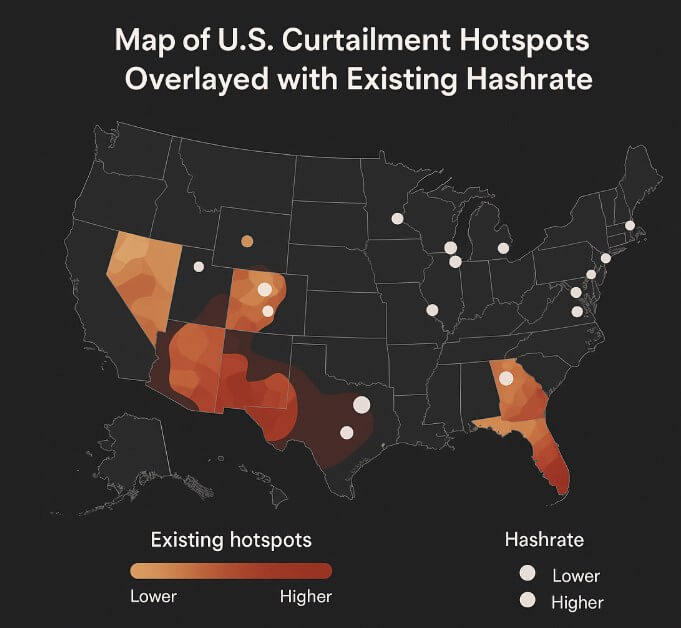
Bitcoin miners are concentrated in Texas, the southeastern states, and the Rocky Mountain region – regions that often generate cheap, excess energy due to restrictions on renewable energy sources.
Mobility is made possible by the fact that ASIC machines operate in containers, depreciate within two to three years and create the same Bitcoin everywhere – therefore the hash rate moves like a ‘liquid’ that follows energy prices. Where tax breaks, cheap hydropower, or flexible grid contracts are offered (such as in Kentucky or Bhutan), mines can be moved in almost minutes.
This dynamic is also redrawing the American map: in those states where overproduction due to renewable energy sources is common, mining companies appear in spectacular fashion – this is also shown on the map.
Waste heat has become a new business
One of the most exciting areas of mining is the use of heat. It is used for district heating in central Canada and for drying algae and firewood in Norway. And in Finland Marathon Digital (MARA) carried out a 2 megawatt pilot project in a local heating plant, where the heat from mining machines triggered the production of biomass or gas-based heat.
The formula is simple: if you buy energy cheaply, you can sell it twice. Therefore, cold countries have become particularly attractive.
Several countries and states have recognized the new industrial logic.
Kentucky gave miners a tax exemption on electricity. Bhutan has started the hydropower model at the state level. Salvador would build his own ‘energy city’ using geothermal energy and finance it with bitcoin bonds.
The competition is about who can provide the cheapest electrons, the fewest licensing hurdles and the fastest network connection. In other words: the political competition is no longer about jobs, but about energy parks.
What is at stake? A complete industrial revolution
The 19th-20th Centuries In the 19th century, industrial development followed people almost automatically: factories were built where large numbers of workers could be found, where transportation was easy, and where markets were accessible. Energy was present, but not controlled – the economy was organized around people, not energy sources.
Bitcoin mining was the first global industry to overturn this logic. It is a capital-intensive sector whose product is completely digital and limited by only one thing: the price of energy. You don’t need a port, you don’t need a city, there are no logistics chains. All you need is electricity – as cheap and stable as possible.
This model revealed where the world’s ‘wasted watts’ are: overproducing hydropower plants, wind and solar farms that cannot be integrated into the electricity grid, gas burned in oil wells, or wasted energy capacities in remote areas. And governments have begun to compete spectacularly to use these hidden energy reserves to their own advantage, luring miners and data centers with tax breaks, fast licensing and political capital.
If AI and high-computing systems adopt the same mobility, the data centers of the future will no longer be built where there are many people or cheap labor, but where wasted energy, cold water, rapid licensing and political stability converge. A single major infrastructure development – for example the construction of new transmission lines – could even completely reshuffle this map.
Of course, the process also has its risks. A bad turn in regulation could make billions of investments worthless overnight. In the case of AI, latency is another limitation: not all tasks can be executed to the end of the world. And on the mining side as well, crypto market cycles may overturn business models based on hash rate.
But the trend is still clear. Bhutan’s hydroelectric power stations are becoming bitcoins. Texas pays miners to shut down during heat waves. Kentucky is eliminating taxes, and China is – quietly – restarting mines in energy surplus states.
It is clear from these examples: energy has become the basis of the new industrial competition. Anyone who can supply cheap energy attracts industry. Those who don’t do that will be left behind.
If the Industrial Revolution organized the world around ports, the computer age will organize it around watts. And bitcoin is just the first sign of where the map is cracking.
#Bitcoin #mining #rewriting #map #industry