

Offshore bonds offer powerful tax benefits to UK residents and returning expats by allowing investment growth to grow tax-deferred and take 5% tax benefits.
They also offer strategic options for gifts, trusts and estate taxes.
This article covers:
- Are offshore bonds taxable in Britain?
- UK tax benefits of offshore bonds
- Disadvantages of offshore bonds to keep an eye on
Key Takeaways:
- Offshore bonds enable tax-deferred investment growth in Britain
- Assignments and trusts provide strategic planning for income and inheritance taxes
- Investors can withdraw up to 5% per year in a tax-efficient manner
My contact details are hello@adamfayed.com and WhatsApp +44-7393-450-837 if you have any questions.
The information in this article is intended as general guidance only. It does not constitute financial, legal or tax advice, and is not a recommendation or invitation to invest. Some facts may have changed since the time of writing.
What is an offshore bond in Britain?
An offshore bond is a life insurance policy issued by an offshore insurance company, usually located in a jurisdiction with favorable tax rules.
These bonds allow investors, including those moving to the UK or returning British expats, to invest in a variety of assets while taking advantage of certain tax benefits.
Offshore bonds are often used for long-term savings, wealth planning and investment growth because they provide flexibility and tax planning options not typically available in domestic investment accounts.
How are offshore bonds taxed in Britain?
Offshore investment bonds are subject to UK income tax and capital gains tax rules, but their structure allows for strategic tax planning:
- Gross addition: Income and gains within the bond accumulate without immediate UK tax liability. This tax deferral means that the investment grows inclusive of UK tax until withdrawals or redemptions take place. Please note, however, that withholding taxes may apply to dividends from foreign investments.
- Recordings: Each policy year, policyholders can withdraw up to 5% of the original premium (plus 5% of any additional premiums) without immediately being charged UK income tax. Unused allowances can be carried forward, allowing flexibility in tax-efficient income planning.
- Assignment: Offshore bonds can be donated by transferring ownership to a third party. The original policyholder will not be liable for any direct UK tax, and future tax will be applied based on the new owner’s circumstances.
- Exemption from time sharing: For those returning to Britain, any gain arising upon resumption of UK residency will be reduced proportionately based on the period spent as a non-resident, potentially reducing UK tax liability.
Tax benefits for offshore bonds UK
The tax benefits of offshore bonds in Britain offer a combination of growth, flexibility and efficiency that can be particularly beneficial to expats, returning UK residents and long-term investors.
Here’s an overview:
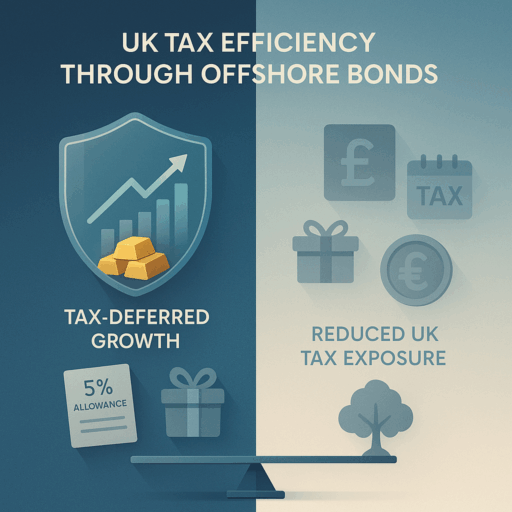
- Deferral of income and capital gains taxes (gross addition)
The investment growth within an offshore bond is not taxed annually in Great Britain. Income and gains accumulate tax deferred, allowing your portfolio to be constructed more efficiently. Taxes are only charged if you make taxable withdrawals or fully redeem the bond. - Structured, tax-friendly withdrawals (5% deduction)
You can withdraw up to 5% of your initial premium each year for 20 years – plus 5% of any additional premiums – without immediate UK income tax. Unused allowances roll over, providing flexibility for future planning or lump sum needs. - Strategic giving and trust planning
Offshore bonds can be assigned (gifted) without incurring UK income tax or capital gains tax to the original owner. This allows you to shift future tax liability to a spouse, child or trust – often someone in a lower tax bracket or outside the UK. - Mitigation of UK inheritance tax (IHT)
If you place an offshore bond in trust, it can be removed from your taxable estate. This helps reduce or eliminate exposure to IHT and smooths the transfer of wealth between generations, while avoiding probate delays. - Possible relief for higher rate taxpayers through top slicing
If a win pushes you into a higher UK tax bracket, relief from above you can spread the profit over the number of years you own the bond. This can lower the effective tax rate, keeping you within your usual tax bracket.
These features make offshore bonds powerful for anyone looking to minimize UK tax exposure, optimize tax timing and structure their assets for long-term planning.
What are the disadvantages of offshore bonds?
Many of the potential disadvantages of offshore bonds arise specifically from UK tax rules, regulatory considerations and reporting requirements.
- Winnings can push you into higher UK income tax brackets, even with a high exemption.
- The 5% annual tax-deferred fee can be restrictive; excess withdrawals will result in immediate UK tax.
- Only the period you spend as a non-resident reduces UK tax; while UK residents are fully taxable.
- Gifting the bond may expose the recipient to higher UK income tax.
- HMRC requires careful tracking of withdrawals, allocations and returns. Mistakes can lead to fines.
- Contributions are made from after-tax income, unlike pensions or ISAs.
In short
Offshore bonds can be a powerful tool for managing UK taxes, especially for expats and individuals with global financial planning needs.
Their ability to defer taxes, structure withdrawals and support estate tax strategies makes them attractive for long-term wealth management.
However, they also come with UK-specific tax rules and reporting requirements, so professional guidance is essential to ensure the benefits outweigh the disadvantages.
Frequently asked questions
Which bonds are tax free in Britain?
The only truly tax-free bonds for UK investors are ISA eligible bonds, where all income and gains are exempt from UK tax.
Most other bonds, including offshore bonds, are taxable. However, offshore bonds offer tax deferral, meaning taxes are only due when you take a taxable gain, and not annually.
What is the tax deduction for offshore bonds?
Offshore bonds allow you to withdraw 5% of the original premium (plus 5% of any additional premiums) each policy year for 20 years without immediate UK income tax.
Any unused allowances will roll over. Withdrawals in excess of the allowance result in a taxable gain.
What is the tax on offshore investments in Great Britain?
Gains on offshore bonds are taxed as UK income tax, not capital gains tax. The gain may push you into a higher tax bracket, but top-slicing relief can lower the effective rate.
What happens to an offshore bond after twenty years?
The 5% withdrawal fee ends once you have used the entire 100% of your original investment (usually after 20 years).
The bond can be continued, but withdrawals above the remaining amount will become taxable gains and may trigger UK income tax.
What happens to an offshore bond upon death?
Offshore bonds generally pass to beneficiaries without any immediate income tax being imposed.
However, the value of the bond will be included in the deceased’s estate for UK inheritance tax purposes unless it is placed in trust.
If the bond is held in trust, it can usually be assigned or continued by the trustees without delays to the probate.
Tormented by financial indecision?

Adam is an internationally recognized financial author with over 830 million answer views on Quora, a best-selling book on Amazon, and a contributor to Forbes.
#Benefits #Offshore #Bonds #Tax #Adam #Fayed