

Danielle KayeBusiness reporter
 Mike Callicrate
Beef prices in the US have become so high that it has become a political issue.
Even Donald Trump, who long ago declared inflation “dead,” is talking about it, as the issue threatens to undermine his promises to lower grocery prices for Americans.
This week he urged farmers on social media to cut prices for their livestock.
But his demand – and other proposals his government has put forward to tackle the problem – has sparked a backlash among farmers, who worry that some of his solutions will make it harder for them to make a living, while doing little damage to the supermarket.
The number of beef farmers and ranchers in the U.S. has steadily declined since 1980, reducing domestic supply and increasing prices while demand remains high.
The nation’s livestock population has fallen to the lowest level in nearly 75 years, while the U.S. has lost more than 150,000 cattle ranches since 2017 — a 17% decline, according to the Department of Agriculture.
Ranchers say they are under pressure from four decades of consolidation among the meat processors who buy their cattle, while high costs for key inputs such as fertilizer and equipment have added to the pressure.
The industry’s decline has worsened as several years of drought have forced ranchers to reduce their herds.
Christian Lovell, a cattle rancher in Illinois, says parts of his farm that were lush and grassy as a child have now dried up, limiting where his cows can graze.
“You put all this together and you have a recipe for a truly broken market,” said Lovell, who works with the advocacy group Farm Action.
Beef inflation
Retail prices for ground beef rose 12.9% in the 12 months through September, and those for beef steaks rose 16.6%, according to U.S. inflation data released Friday by the Bureau of Labor Statistics.
A pound of ground chuck now costs an average of $6.33 (£4.75), compared to $5.58 a year ago.
The increases are significantly higher than overall food inflation, which stood at 3.1%.
“Livestocks have been shrinking in recent years, but people still want that American beef — hence the high prices,” said Brenda Boetel, professor of agricultural economics at the University of Wisconsin, River Falls.
Derrell Peel, a professor of agricultural economics at Oklahoma State University, said he expected prices to remain high at least through the end of this decade, noting that it takes years to replenish herds.
The Trump administration’s “hands are tied” when it comes to interventions that will help lower prices, Peel added.

 Reuters
‘Chaos’ for American producers
The Agriculture Ministry this week unveiled what it called a “major package” aimed at boosting domestic beef production by opening more land for cattle grazing and supporting small meat processors.
That proposal came after Trump angered farmers when he proposed importing more beef from Argentina, potentially quadrupling purchases.
Eight House Republicans responded with a letter to the White House expressing concern about Trump’s import plans.
Even the National Cattlemen’s Beef Association, which has expressed support for Trump’s policies in the past, said the import plan “only creates chaos at a critical time of year for America’s cattle producers while doing nothing to reduce grocery store prices.”
Trump responded by assuring farmers that he was helping them in other ways, noting that tariffs limit imports from Brazil.
“It would be nice if they understood that, but they also need to lower their prices because the consumer is also a very big factor in my thinking,” Trump wrote.
But that failed to contain the furore.
Justin Tupper, president of the US Cattlemen’s Association, said he thought only the big four meatpackers would benefit from Trump’s import plan.
“I don’t see prices going down here at all,” Tupper said.
‘These are consolidated markets’
Some say the government could have an impact if it focused on how a handful of companies dominate the meat processing market.
Today, just four companies control more than 80% of the beef slaughter and packaging market.
“These are consolidated markets that are harassing farmers and consumers at the store,” said Austin Frerick, an agricultural and antitrust policy expert and fellow at Yale University.
The meatpacking companies – Tyson, JBS, Cargill and National Beef – have faced several lawsuits, including one filed by McDonald’s alleging they conspired to raise the price of beef.
Although Trump earlier this year rescinded a Biden-era order that directed agencies to tackle corporate consolidation across the food system, his administration has taken other steps to examine competition issues in the agricultural sector.
‘We are not going to rebuild this cow herd’
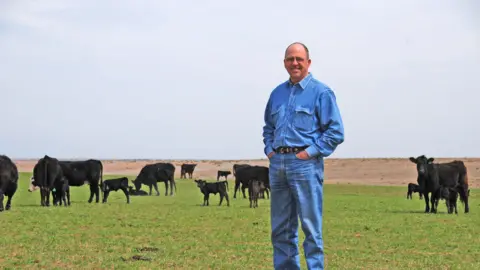
Mike Callicrate runs a cattle ranch in St Francis, Kansas. He said the only way he managed to stay in the industry was by cutting out the middleman and setting up his own stores to reach consumers directly.
But Callicrate acknowledged that most ranchers don’t have the money to make that transition. Many have left the industry and see no incentive to jump back in.
“We are not going to rebuild this cow herd – not until we address market concentration,” Callicrate said.
He said he supported the Agriculture Ministry’s plans to open more pasture for livestock to boost production and reduce retail prices.
“But unless we have a market,” he added, you are “a fool to get into the livestock business.”
 Bill Bullard
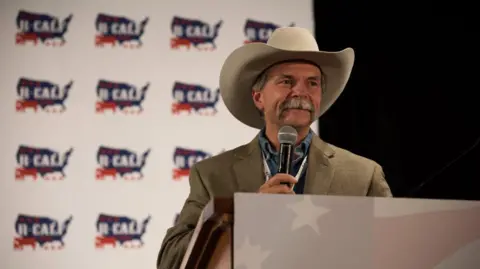
Bill Bullard was in the first wave of farmers pushed out when the meatpacking industry began to consolidate in the early 1980s.
He closed his 300-cow operation in South Dakota in 1985.
Mr. Bullard, who is now the CEO of R-CALF USA, a trade association for livestock producers, said farmers had only started receiving good prices for their livestock in the past year because supply fell to such low levels that prices paid by meat processors “just had to go up.”
Yet dependence on imports and the purchasing power of meatpackers persists, Bullard said, meaning farmers have “no confidence in the integrity of the market” and remain reluctant to grow their herds.
He said he had no confidence that the president’s ideas would solve the problems.
“He focuses on the symptoms and not the problems,” he said.
#Beef #prices #soaring #Trumps #plans #reduce