

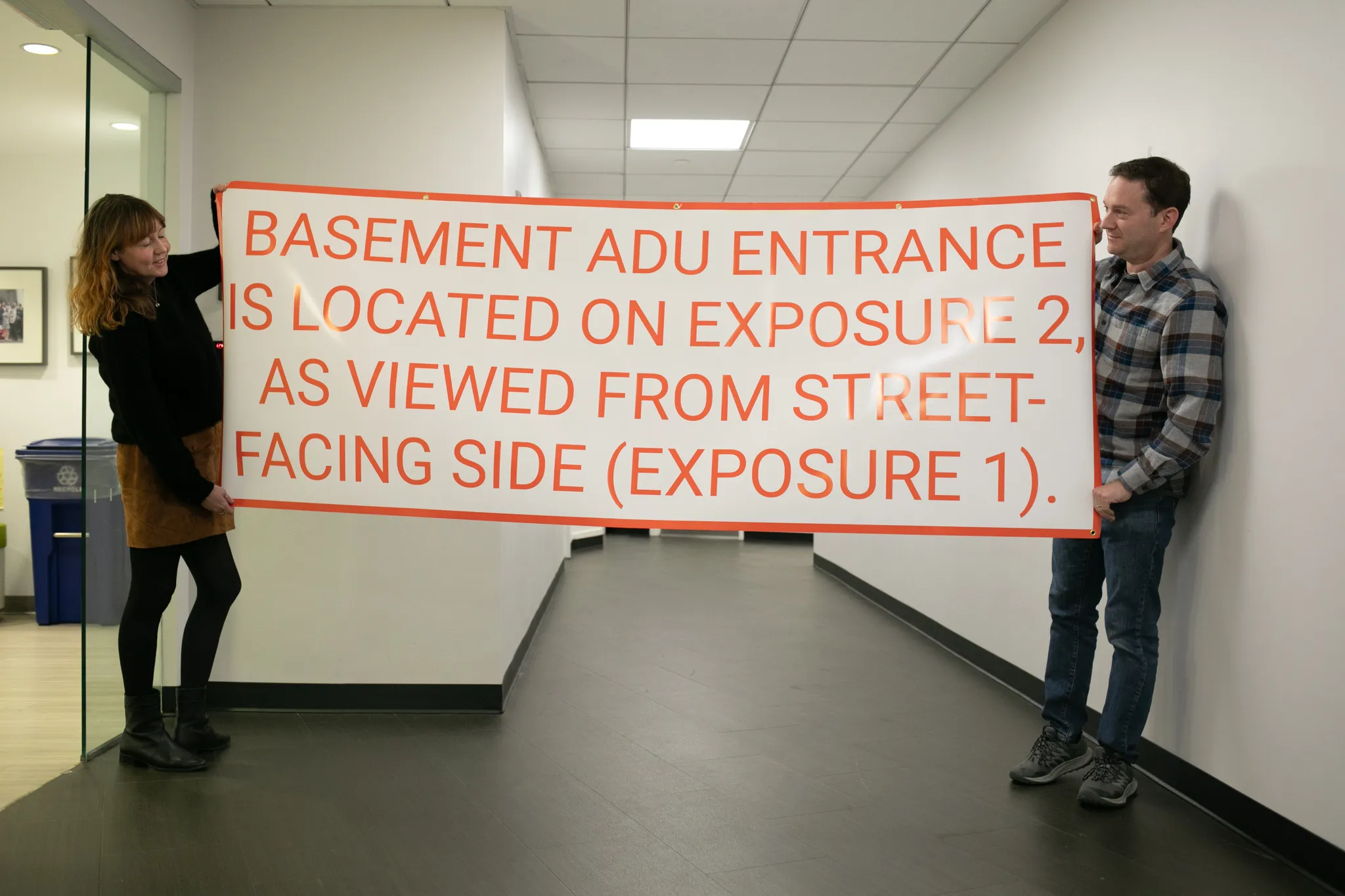
Citizens Housing & Planning Council staffers Sarah Watson and Howard Slatkin create a sign detailing the specifications in the Department of Building’s proposed rules for basement apartment conversions, December 3, 2025. Photo by Ben Fractenberg/THE CITY
This article was originally published on December 8 at 5pm EST by THE CITY
In an office building in midtown Manhattan, an 8-foot banner stretched the length of a fluorescent-lit hallway.
Two-inch-tall red letters indicated the location of an entrance to a basement apartment, as required outside each unit. That is as proposed lines from the Ministry of Buildings for a pilot program to legalize these illegal spaces.
The rules specify both the color and the 5-inch height of the letters on the sign.
The demand is “cartoonishly absurd,” said Howard Slatkin, executive director of the Citizens Housing and Planning Council, which commissioned the creation of the large banner.
It’s one of several measures in the Department of Buildings’ proposed rules that safe housing advocates say would create obstacles or make it untenable for homeowners to participate in the basement legalization pilot program.
These regulations, along with a related set from the Department of Housing Preservation and Development, also open renters to the possibility of losing their homes and homeowners to expensive penalties if they don’t complete the program, advocates and attorneys warn.

“These rules cannot be passed on a whim or the program will fail,” said Sylvia Morse, director of research and policy at the Pratt Center for Community Development. “If these rules are passed, they will not ensure a successful program.”
The program is designed to let homeowners in a number of designated districts to convert unauthorized spaces into upstairs apartments without stringent requirements under state multi-dwelling law — while allowing tenants to continue living there. Over a period of ten years, the owners must take a series of actions, such as installing sprinklers and obtaining exit permits, to ultimately obtain legal status for the apartment.
“This rule, as outlined here, would ensure that no one registers and comes out of the woodwork because it’s too risky,” Slatkin said. “They increase risks instead of mitigating them, which is the whole point of the program.”
Department of Buildings spokesman Andrew Rudansky said in a statement that the pilot program rules were “carefully considered, with a focus on providing a safe space for existing tenants to live while the landlord works to bring the apartment up to code,” and that the DOB would take feedback into account when revising the rules.
Basement apartments have long been an affordable, but potentially dangerous, housing option for many New Yorkers. The areas are susceptible to fires and floods – which then turned out to be fatal 11 people drowned during 2021’s Hurricane Ida. Then came the push to upgrade basements and move their occupants out of the shadows gained momentumbuilding on the sustainable work of the Basement Apartments Safe for Everyone (BASE) Coalition.
The new effort also builds on Mayor Eric Adams’ wishes recent zoning changes in the “City of Yes”.which allow for so-called accessory dwelling units (ADUs) in many neighborhoods, including basement apartments.
But delivering results can prove difficult, as an attempt at basement legalization in 2019 showed: no homeowners have gone all the way through the program.
Local officials have seen creating new apartments in basements and allowing existing illegal living spaces as important means of bringing needed housing to market amid a historical crisis.
A new report from the Center for New York City Neighborhoods highlights basements as particularly promising among possible accessory dwelling units, which also include loft apartments and backyard cottages. Brooklyn has the highest concentration of buildings where legal basement apartments could be located, followed by Queens and The Bronx, the report found.
“From an equity perspective, these are the types of ADUs that have the greatest potential to support homeowners and renters who may be in low- and moderate-income communities,” said Margaret Hanson, CNYCN program manager. “Tens of thousands of New Yorkers already live in basement apartments, and there is now a path to legalization.”
The sink
Hanson emphasized that the city’s implementation of regulations, guidelines and structures regarding ADUs will determine if and where such units will proliferate.
Eligible homeowners can apply to be part of the basement legalization pilot program until April 2029. But beyond the mass signage mandates, the proposed rules also provide other catch-22s for owners.
For example, basements that qualify for the pilot program must have a kitchen with a window, a sink with running water and gas or electricity.
“You can’t get a permit to install a full kitchen until you have legal status,” Slatkin said. “How are you supposed to put all that electrical and gas work into code if you can’t get a permit for it?”

The proposed rules indicate that illegal gas work, as an example of a situation that could pose a safety risk, could be grounds for an eviction notice, meaning tenants would be evicted.
The rules also do not provide a clear way for homeowners — who must admit to the city as part of the pilot application that they have an illegal apartment — to leave the program or refuse to participate without risk of fines or prosecution.
Land use attorney Rob Huberman, a partner at the Herrick Feinstein firm, called that “draconian.”
“There really is no amnesty and there is no exit,” he said. “It’s a do-at-your-risk deal. You’re overextending yourself by participating in the program.”
In a 2019 basement legalization pilot program focused on East New York, Brooklyn, only one homeowner out of hundreds interested was able to begin the necessary construction to make the apartment safe and legal. But now that work has been suspended and the homeowner is backing out due to an unrelated, unresolved violation, according to a new report of the Citizens Housing and Planning Council.
Other homeowners dropped out of the pilot program in East New York before construction could begin as expected costs piled up.
The challenging and costly nature of the undertaking could deter other homeowners from fully legalizing their own basement apartments in the new pilot program.
There are also questions about the fate of the current tenants of these illegal basement apartments if the homeowners decide to participate in the new program.
Separate rules proposed by HPD give tenants of such apartments in the pilot program the right to return if they have to leave during construction. But the proposed rules only apply to tenants who have lived in the space since April 2024, and owners would be required to give tenants 30 days’ notice before they have to vacate. If they don’t leave, they lose the right to return unless they ask their landlords for an extension.
Pratt’s Morse pointed out that a month is not enough time for renters who are likely low-income and already face obstacles in the housing market to find a new place to live.
“It’s important that there are steps in place to move the upgrade and construction process forward, but there’s not really any information here about the reasons for granting an extension,” she said. “How much leeway does the landlord have? Can they deny an extension request for any reason, or do they have to wait to grant one if someone can’t find a place to live?”
DOB and HPD will hold public hearings on the proposed rules Thursday And Fridaywhen the window for public comment closes.

Related stories
Email tips@brownstoner.com with further comments, questions or tips. Follow Brownstoner further X And Instagramand like us further Facebook.
#Basement #apartment #rules #marks #experts