

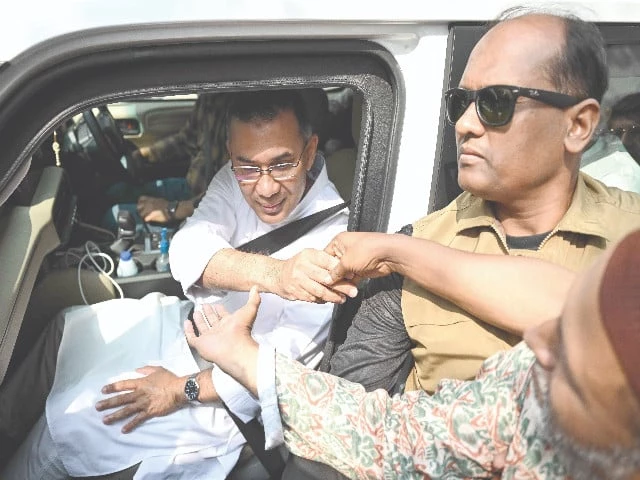
BNP Chairman Tarique Rahman greets his supporters as he leaves his home in Dhaka. Photo: AFP
DHAKA:
Bangladesh’s largest party conceded defeat on Saturday, paving the way for nationalist leader Tarique Rahman to become prime minister after a landslide election victory.
Election Commission figures showed Rahman’s Tarique Rahman-led Bangladesh Nationalist Party (BNP) had won 212 seats in Thursday’s polls, the first since a deadly uprising in 2024 toppled Sheikh Hasina’s long rule.
According to official results, the BNP alliance won 212 seats, compared to 77 for an alliance led by Jamaat-e-Islami.
Rahman, 60, returned to Bangladesh in December after 17 years in exile in Britain, marking a dramatic political comeback. He is expected to give a victory speech later Saturday.
He is the son of former President Ziaur Rahman, who was assassinated in 1981, and former Prime Minister Khaleda Zia, a dominant political figure for decades.
Interim leader Muhammad Yunus, who has led the country since the uprising, said Rahman would “help lead the country towards stability, inclusiveness and development.”
Jamaat-e-Islami chief Shafiqur Rahman had said on Friday that he would seek redress from the Election Commission over alleged “inconsistencies and fabrications” in the count.
But a day later he admitted defeat.
Read: Trump says change of power in Iran would be ‘the best’
“On any true democratic journey, the true test of leadership is not only how we campaign, but also how we respond to the judgment of the people,” he said in a statement.
“We recognize the overall outcome and we respect the rule of law.”
Hasina’s Awami League was not allowed to participate. Hasina, 78, who was sentenced to death in absentia for crimes against humanity, issued a statement from India denouncing “illegal and unconstitutional elections.”
The US Embassy congratulated Rahman and the BNP on what it called a “historic victory”, while India hailed his “decisive victory”, signaling a shift from previously strained ties.
China and Pakistan also congratulated the BNP, both of which deepened ties with Bangladesh after the 2024 uprising.
International observers called the vote credible. The European Union said the election had been “credible,” while the International Republican Institute said that while “the election administration was technically sound, the broader political environment remains fragile.”
Election Commissioner Md Anwarul Islam Sarker told AFP the vote was a success.
“It was by far the best election,” he said, noting that voting was canceled at only one of more than 42,000 polling stations.
“People had doubts whether successful elections could be held under these conditions, but we did it,” he said. “If someone still has problems, he can go to court.”
Also read: Europe calls for a US reset at security talks
Turnout was 59% in 299 of the 300 constituencies where voting took place, the commission said.
Only seven women were directly elected, although 50 additional parliamentary seats reserved for women will be filled through party lists.
Shafiqur Rahman highlighted his party’s gains after years of oppression under Hasina.
“With 77 seats, we have almost quadrupled our parliamentary presence and become one of the strongest opposition blocs in modern Bengali politics,” he said. “That’s not a setback. That’s a foundation.”
Voters also approved a referendum backing sweeping democratic reforms proposed by Yunus to overhaul what he called a “completely broken” system and prevent a return to one-party rule.
The proposals include term limits for the prime minister, the creation of an upper house, stronger presidential powers and greater judicial independence.
#Bangladeshs #Tarique #Rahman #set #Prime #Minister #Jamaat #admits #Express #Stand