

Gianni Versace. Terra Mater. Tribute to Magna Graecia Roots | Photo: © Giuseppe Asciutto | Courtesy of MARRC National Archaeological Museum of Reggio Calabria
The same Street that Gianni Versace described in this way, surrounded by a light that turns him purple, now shines among the colors and fabrics of one of its most illustrious inhabitants, 80 years after his birth.
Dazzling colors intertwined with an aesthetic that feeds on myth and the Greco-Roman world, between jellyfish and meander motifs, weaving at the National Archaeological Museum of Reggio Calabriaa tribute to the roots of Magna Graecia.
For the first time, the Riace Bronzes Museum welcomes a dialogue between archeology and fashion, with more than 400 pieces, including clothing, accessories, furniture from the Home Collection and archival materials, drawn from private collections, at the center of the exhibition Gianni Versace. Terra Mater. Tribute to Magna Graecia Rootspromoted by the museum under the direction of Fabrizio Sudano.
Gianni Versace. Terra Mater. Magna Graecia Roots tribute | Photo: © Giuseppe Asciutto | Courtesy of MARRC National Archaeological Museum of Reggio Calabria
The path, curated by Sabina Albano and Fabrizio Sudano, is underway until April 19returns to the public as a cultured and innovative interpreter of Gianni Versace, able to transform the culture of the past into a modern visual alphabet, while at the same time reconstructing the aesthetics of the designer in love with his roots. Roots that emerged on December 2, 1946 when Gianni Maria Versace was born at number 13 of via Tommaso Gulli where his mother Francesca led the Versace Atelier with twelve seamstresses.
In the exhibition, the precocious genius (and prescient talent) is all contained in the gaze of the portrait that opens the exhibition and that artist Natino Chirico dedicated to his friend Gianni, creating the work especially for the Reggio event.
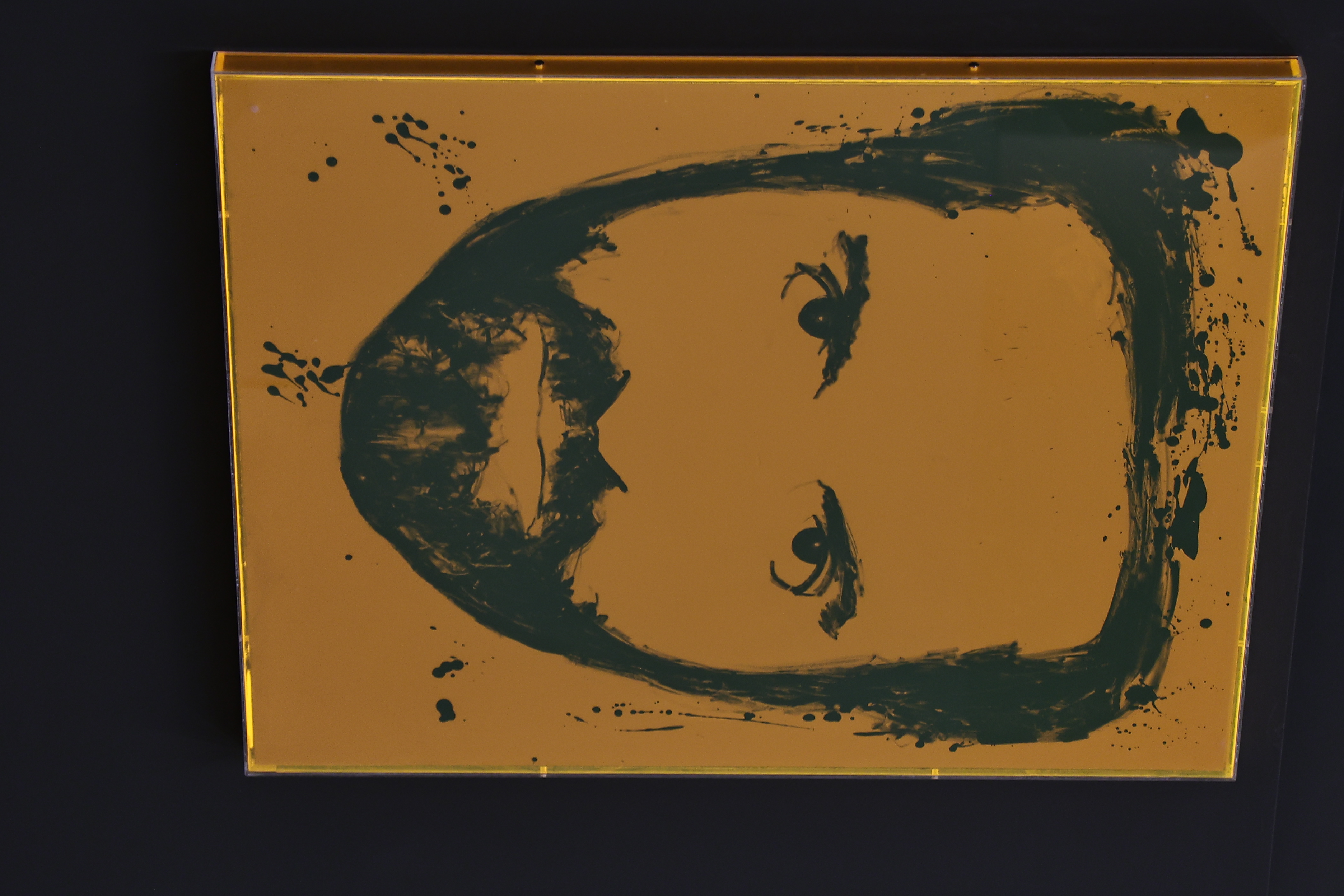
The portrait of Gianni Versace made by Natino Chirico | Gianni Versace. Terra Mater. Magna Graecia Roots tribute | Photo: © Giuseppe Asciutto | Courtesy of MARRC National Archaeological Museum of Reggio Calabria
“I preferred to approach this exhibition on my toes – explains Natino Chirico -. Through my work in which I also use methacrylate, I tried to convey, both in technique and in interpretation, that modernity that Gianni gave us thanks to a constant search for new materials and advanced techniques. Versace was at the forefront, he had brilliant intuitions, he loved his city, art, walks along the sea in winter. Even today he remains a point of reference for the new generations, who showing them the way, and transmitting to all of us the attitude to work and effort, but above all to humility.”
Essential documents about the Versace family, books, sketches, posters, catalogs and notes from the State Archives of Reggio Calabria document the construction of the designer’s creative language, allowing us to delve deeper into the genesis of his aesthetic project. As a child, Gianni used to take scraps of fabric from his mother’s workshop to sew his dolls, but in the late 1960s he worked as a designer and buyer for the same workshop, traveling with the help of his brother Santo to manage contracts with various companies. “Santo – Chirico underlines – played a fundamental role for the company, allowing it to become the financial giant it represents today.”
The move, in 1972, from Reggio Calabria to Milan, where his talent was immediately noticed, the first collections for Genny, Complice, Callaghan and Byblos, the invitation to the Victoria and Albert Museum in London, and then the creation of the costumes for Don Pasquale by Gaetano Donizetti at the Piccolo Teatro in Milan, and again the friendship with Elton John, Madonna, Lady D, the collaboration with the American photographer Richard Avedon, the Versus line Designed mainly by his sister Donatella, these are just a few steps in a dazzling career, a bit like her creations. This was followed by the final move to Miami, to Casa Casuarina, the large villa overlooking the ocean, where the designer tragically died on July 15, 1997.
Gianni Versace. Terra Mater. Magna Graecia Roots tribute | Photo: © Giuseppe Asciutto | Courtesy of MARRC National Archaeological Museum of Reggio Calabria
Despite having left his hometown at the age of 25, Versace wrote: “Reggio is the kingdom where the fairy tale of my life began: my mother’s tailor shop, the Haute Couture boutique.”
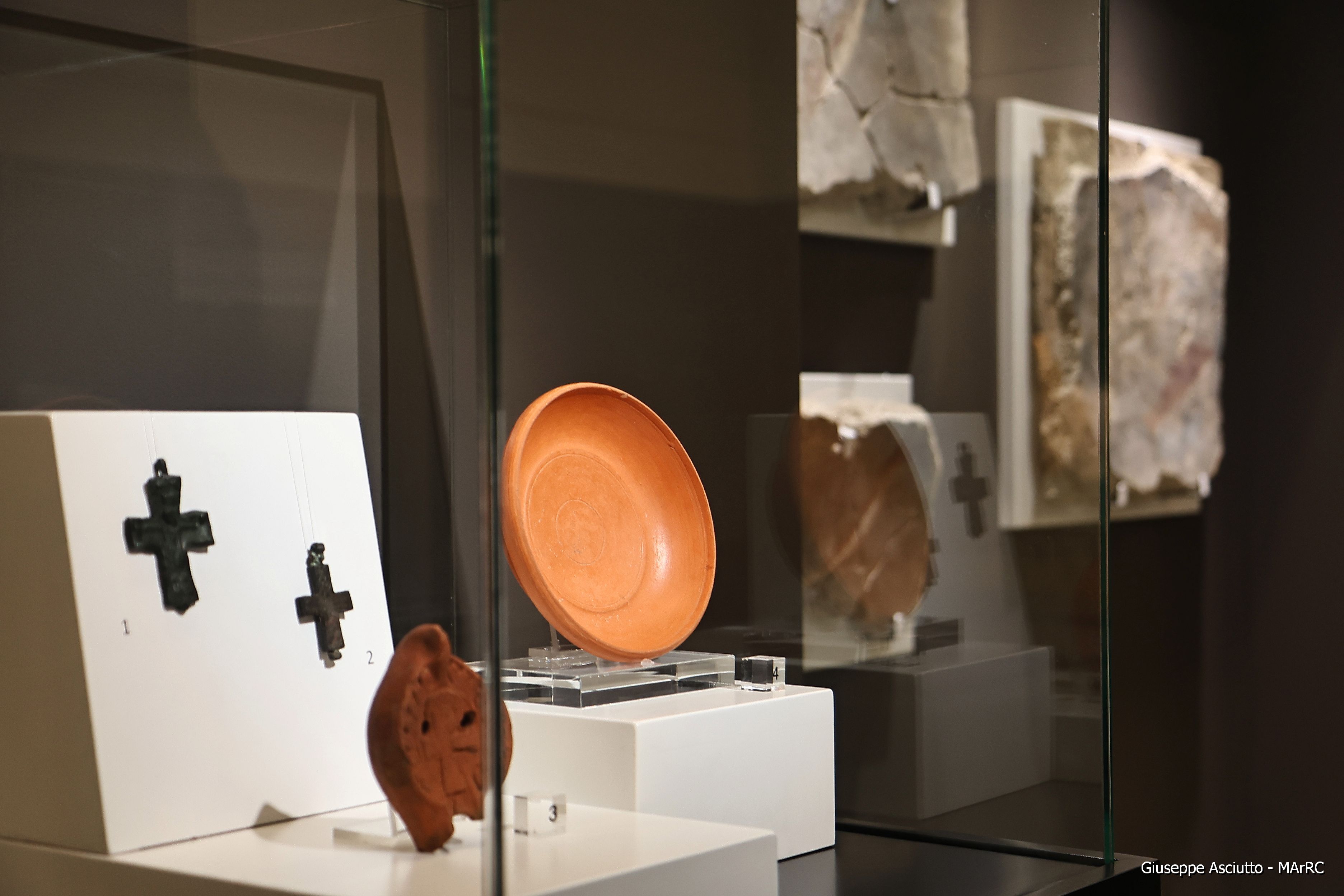
In the city on the Street he is also a regular visitor to the Archaeological Museum, where he especially admires the Philosopher’s Head and of course the Riace Bronzes, “undisputed rulers of that place”. And he wonders if the mystery that seemed to him as a child contained the sea “Were it not for the silent presence of those two warriors, beautiful with an almost fierce and superhuman beauty.” And here it is the mythical archeology of Magna Graecia and the protohistoric, Roman, Late Antique and Byzantine Calabria that weaves its way among the most famous creations of the mid-nineties, bronze mirrors decorated with palmette motifs and other typical elements of Magna Graecia craftsmanship that impose themselves among the refined bondage dresses, the PVC baby doll dresses, the silver mesh togas, in an immersive installation that promotes continuity between myth and modernity, between classicism and contemporary language.
The exhibited garments and accessories of the designer from Reggio Emilia are flanked by a careful selection of finds: herms, masks, satyr heads, silver fibulae, necklaces with pendants made between the 5th and 8th centuries BC in a mix of visual suggestions that reveal their references to antiquity. The stucco plaque of the Church of Santa Maria Theotokos of Terreti (RC), dating from the 11th century AD, which is visible to the public again after more than 15 years, intersects the fresco fragments with fish figures from the Roman baths of Reggio Calabria, from the 1st-2nd century AD, which have been returned to visitors after careful restoration, and also a female terracotta statuette, with a long robe and cloak, from Rosarno (RC). Exceptionally exhibited in Reggio, to underline the synergistic collaboration between places and cultural institutions, are the finds of the National Archaeological Museum of Siritide in Policoro (MT). Among these are an antefix with the face of Medusa and a red-figure Pelike, both from the 4th century BC
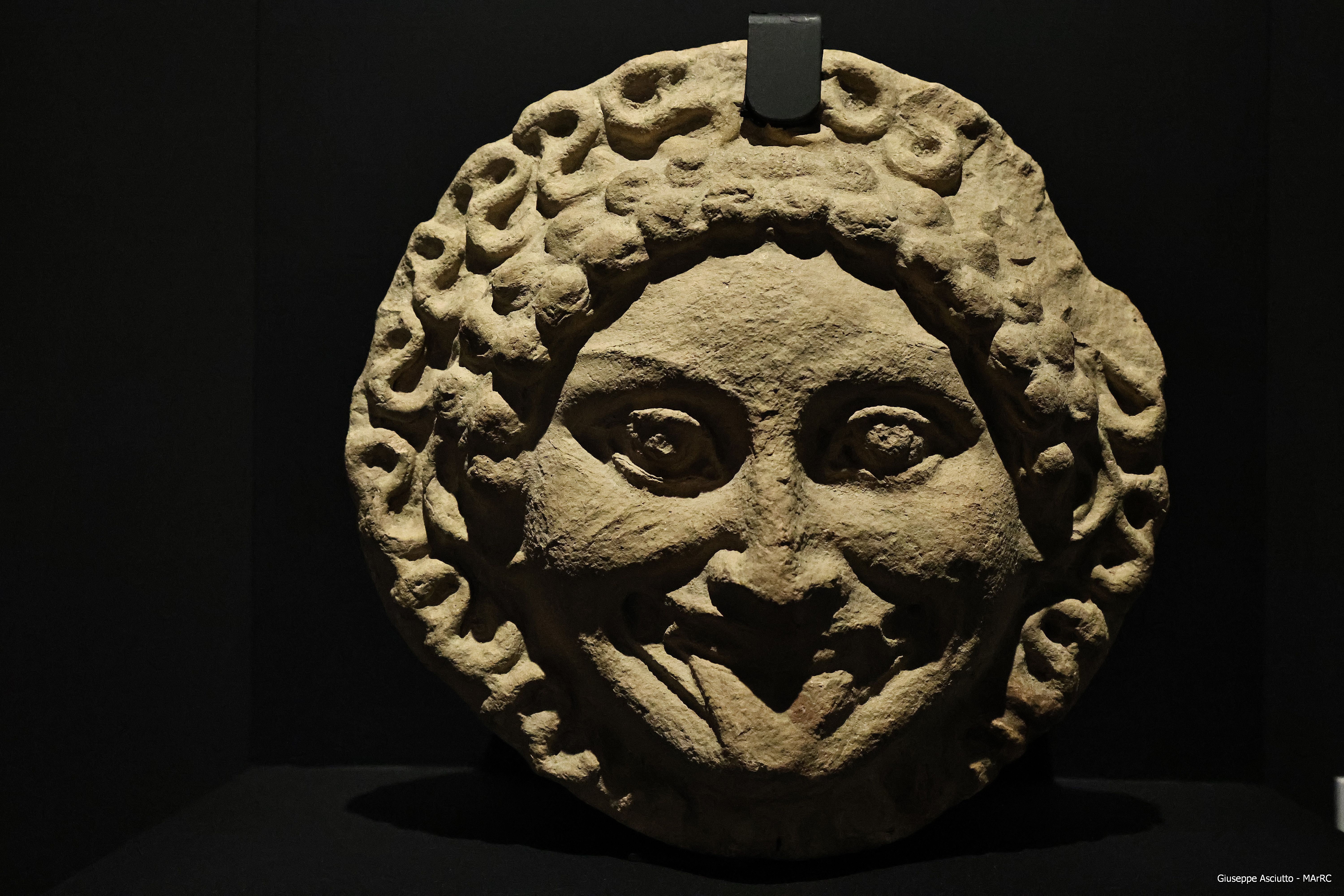
Antefix configured as a Gorgon head from Cirò Marina, Temple of Apollo Aleo. Late 6th century BC | Gianni Versace. Terra Mater. Magna Graecia Roots tribute | Photo: © Giuseppe Asciutto | Courtesy of MARRC National Archaeological Museum of Reggio Calabria
“With this exhibition – explains Fabrizio Sudano, director of the National Archaeological Museum of Reggio Calabria and curator – we wanted to return Gianni Versace to his roots, restoring the profound dialogue that his creative vision has always had with the history and cultural identity of Calabria. The power of this exhibition lies in showing how classicism is not an immobile heritage, but rather an inexhaustible reserve of meanings that continues to inspire contemporary art and creativity.”
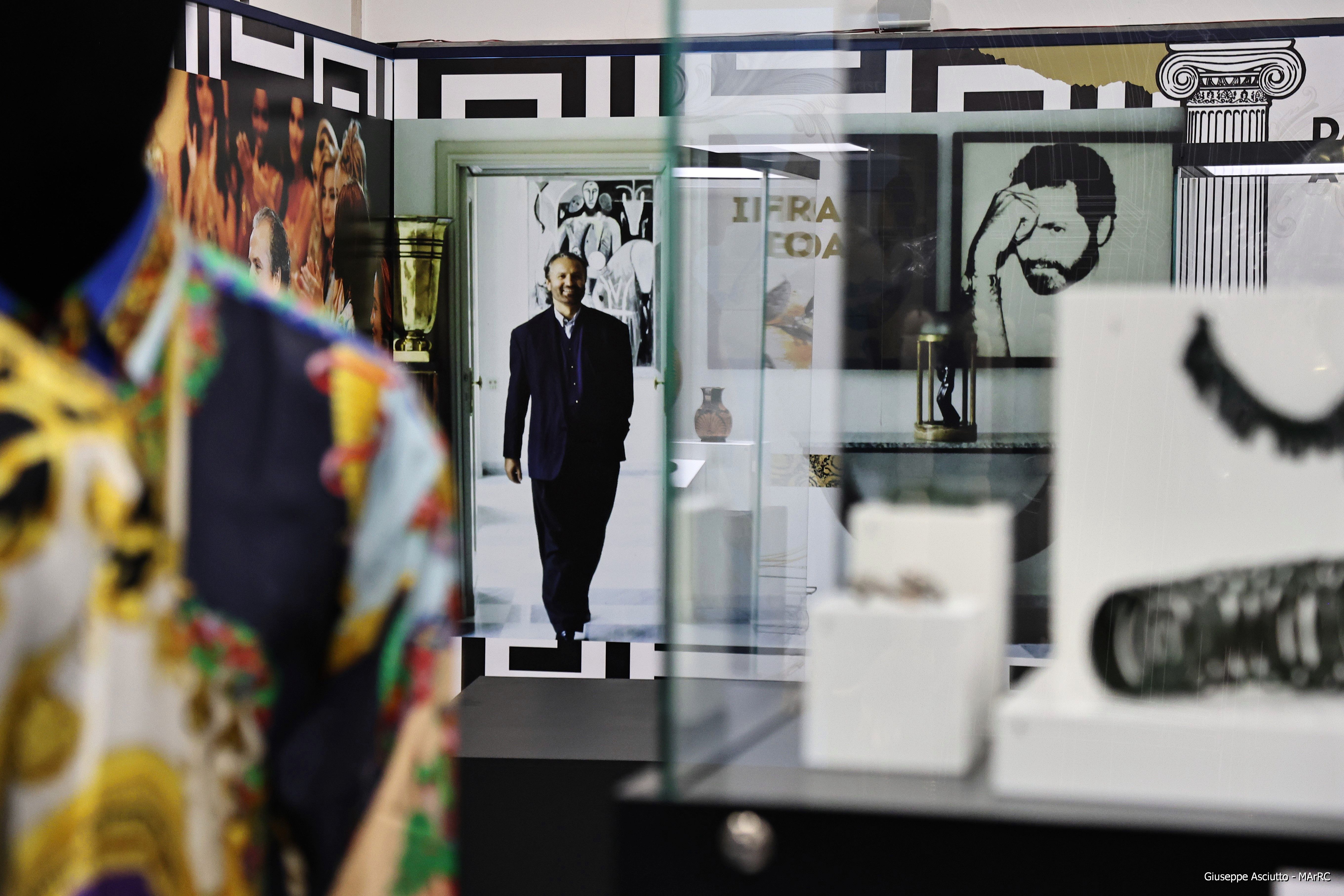
Most of the objects on display belong to the private collection of Antonio Caravano, but also to the entire home collection – from chairs to cushions, from lamps to decorated plates – and to the fashion archive of Franco Jacassi, such as the series of buttons, but also the Tonino Serranò collection. The wooden sculpture by master Marcos Marin, from the series ‘Paraphrase Project’, introduces guests of the MARRC to Piazza Orsi. Roberto Orlandi’s photographs are also effective, telling the story of the beginnings, collaborations, covers and prominent models of the 1990s in Versace clothing. Finally, the two portraits of Helmut Newton and Alice Springs are emblematic and complementary to the designer.
Gianni Versace. Terra Mater. Magna Graecia Roots tribute | Photo: © Giuseppe Asciutto | Courtesy of MARRC National Archaeological Museum of Reggio Calabria
“Creating this exhibition project at the museum – says curator Sabina Albano – means returning Versace to the place of its memory and its deepest roots, where direct observation of the archaeological finds has contributed to the formation of an imagination capable of translating classicism into a contemporary expressive code.” In the spaces of the MARRC that temporarily housed the city’s Art High School in the 1960s, the triumph of metals, silks, buttons, blazers and headgear gives way to the medusa, the beautiful, powerful, ambiguous image that has become the symbol of the Maison. In the Versace logo, classicism is not an aesthetic quote, but a cultural identity rooted in the ancient Mediterranean, reread as a contemporary symbol of seduction and power.
“Medusa made everyone who looked at her fall in love and there was no turning back. I hoped my clothes had the same power” wrote the stylist.
In addition to the exhibition at the MARRC, Reggio Calabria will host the new Museum of Mediterranean Cultures, designed by star architect Zaha Hadid and currently under construction, which will bear the designer’s name.
“The work that characterizes the future of our city – Mayor Giuseppe Falcomatà announced a few days ago – whose construction site has progressed step by step in recent months, will be inextricably linked to the world-famous artist from Reggio who managed to translate the greatness of our three-thousand-year history into images and symbols.”
#MARRC #Gianni #Versace #Magna #Graecia #genius #roots #Reggio #Calabria #Arte.it