

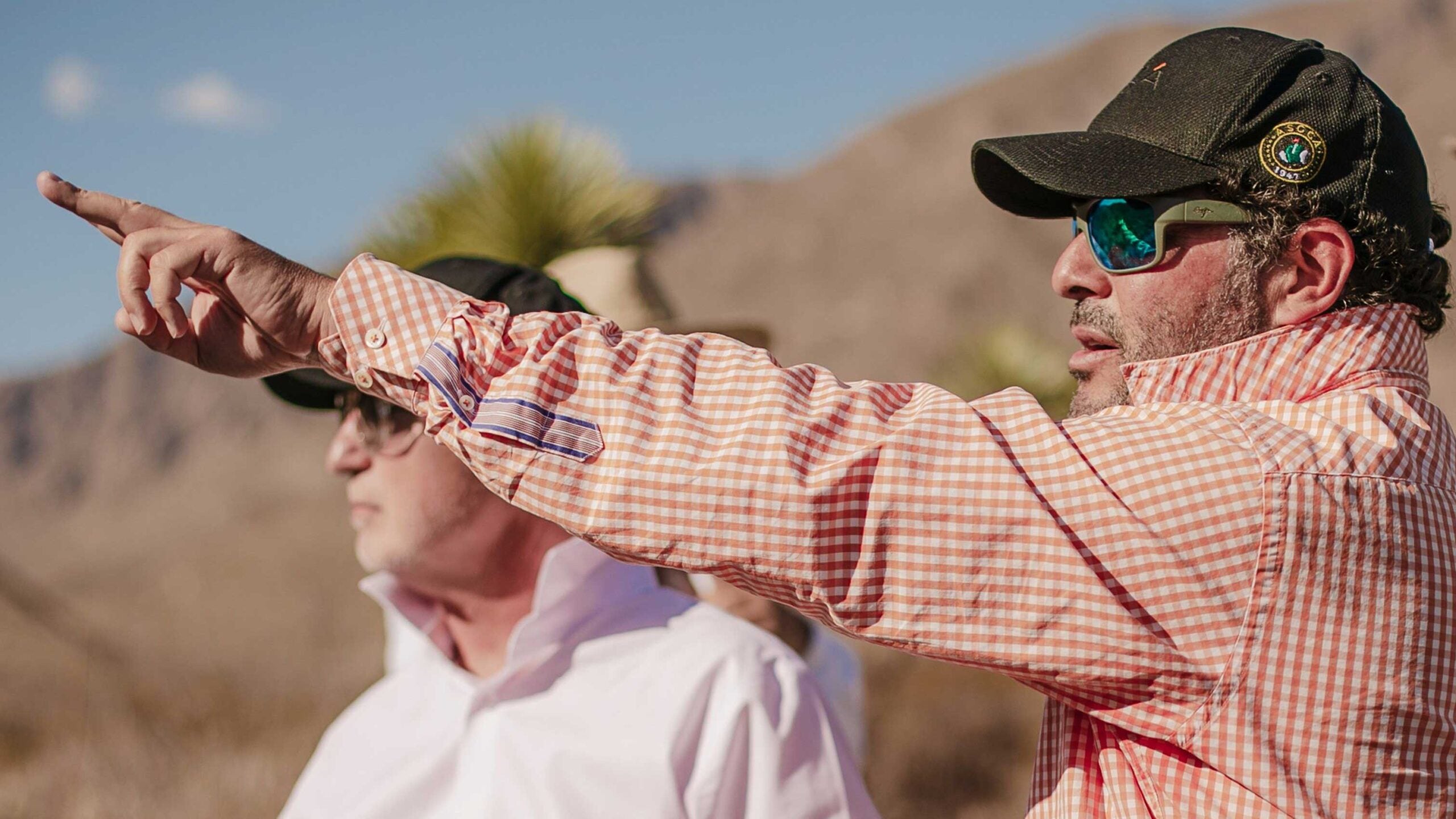
Agustín Pizá doesn’t watch the news. To maintain his peace of mind, the golf course architect largely ignores the incessant stream of headlines and instead keeps up by stealing glances on select social feeds. Sports are an exception.
“I follow them because they focus on success stories,” Pizá told GOLF.com by phone.
However, on rare occasions, events impose themselves. Last Sunday morning was one of them.
Pizá was in Puerto Vallarta, where he has an office and an apartment, concluding a work trip that included visits to two ongoing projects. Since there was an afternoon flight scheduled, he was in no hurry. He got out of bed and opened the curtains. Less than 600 feet away, columns of black smoke darkened the sky above the city.
“At first I thought it was an accident,” he says. “But it almost seemed like a war zone.”
His news blackout was about to end. Pizá scanned his phone, which was buzzing with worried messages from family and friends, then fiddled with the TV remote.
“I do that so rarely that it took me a while to find the channel,” he said.
The story came into focus. A military operation had killed the country’s most wanted drug lord, prompting cartel reprisals. Buses and businesses were set on fire. Clashes broke out between security forces and suspected gang members. Dozens of deaths were reported. The city was placed in lockdown. Pizá’s flight was cancelled.
That was difficult. It was the least of his worries.
“This is truly a once-in-a-lifetime incident for Puerto Vallarta,” he said. “Anyone who’s been here knows it’s one of the coolest, safest and friendliest places you can go. But it’s a shame because ultimately Mexico lives off tourism.”
For Puerto Vallarta, the stakes are particularly high. The metropolitan area has a population of approximately 500,000 and has been an important international destination since the 1960s. Tourism is the economic engine of the region, and golf is one of the engines.
The stretch of coastline along Banderas Bay, north towards Punta Mita, is a mosaic of jungle, mountains and ocean, a varied landscape that Pizá sees as a uniquely attractive canvas for golf. The region’s portfolio ranges from the moody mountain corridors of Vista Vallarta Club de Golf to the coastal town that hosts the PGA Tour’s VidantaWorld Mexico Open, just across the river in Nayarit.
For Pizá, the connection is both personal and professional. Born and raised in Tijuana and now based in San Diego with his wife and three children, he has crossed boundaries in both life and work. He opened his office in Puerto Vallarta in 2006 in conjunction with an assignment as project manager on the Bahía Course, a Jack Nicklaus Signature design in Punta Mita. The office now employs eight people and serves as a hub for projects in Mexico, Latin America and Europe. Pizá’s San Diego office handles projects throughout the United States.
In industrial circles, Pizá is considered a creative thinker inclined towards unconventional concepts. One of his more out-of-the-box projects is the Butterfly Effect, a 24-hole layout in the making in the Coahuila Desert, divided into four six-hole loops that can be played independently. He rose to prominence among casual golf fans with the launch of TGL, the technology-driven league founded by Tiger Woods and Rory McIlroy.
In that virtual arena, his holes stand out because of their individuality. One is modeled after a cenote, a water-filled limestone cave; the fairway is a tapered, concave platform. Another, called ‘Temple’, is similar to what you would get if Alister MacKenzie had worked with the Aztecs. If you’ve seen the likes of Justin Thomas or Rickie Fowler trying to find their way in these fantastical environments, you’ve seen Pizá’s imagination at work.
On Monday, with parts of the city still closed and its Puerto Vallarta office closed, TGL provided a welcome outlet. Pizá stayed inside and watched as the simulator competition was televised, watching players take on challenges he helped create.
“If it wasn’t for TGL,” he said, “I’m not sure what I would do.”
By Tuesday, authorities had lifted restrictions, the airport had reopened and his flight had been rebooked. The smoke had cleared. At least in Puerto Vallarta, the immediate crisis seemed under control.
Pizá makes sure not to deny what happened. He realizes how shocking it must look from a distance, and he knows there will be short-term consequences for the locals whose livelihoods depend on visitors.
“I’m thinking of restaurateurs, hotel staff and caddies,” he said. “I’m sure they will feel it.”
At the same time, Pizá resists general conclusions. When such conflicts erupt, he said, tourists are usually not the intended targets. The violence is usually a show of force between authorities and criminal groups before it subsides. Yet images travel, especially violent images. Context, on the other hand, travels slowly.
Pizá tries to offer that to anyone who will listen. When friends ask whether Mexico is dangerous, he often answers with a question of his own.
“Are you going to buy guns or drugs?” he said. “If not, everything will be fine.”
Risk, he said, is not unique to any one country. When bad things happen, they are more often the exception than the rule. But he also knows that perceptions can be stubborn, and that perceptions matter.
“I don’t want to downplay what happened,” he said. “But Puerto Vallarta will recover much faster than people expect.”
On Tuesday, when his flight was rebooked, Pizá already saw a city getting back on its feet. His office in Puerto Vallarta was open again, and although he had given his staff the option to stay home, they all came in.
Nearby, at the Marina Vallarta Golf Club, a public dock tucked along the bay, the fairways told a similar story. Pizá came by and had a chat with the general manager. They had already done two hundred rounds that day and handed out free margaritas.
His journey home was uneventful. The airport was busy but orderly. His afternoon flight took off on schedule and when he landed in San Diego, passengers cheered.
Pizá said he was also happy to be home. He would stop by the office and then on to his family. But his thoughts were already wandering south.
“I’ll be back in Puerto Vallarta in three weeks,” he said. “I can’t wait.”
#cartel #violence #raged #Mexico #golf #designer #chaos