

The imposing statue was only attributed to the master from 2001 onwards thanks to the scholar Silvia Danesi Squarzina and her then student Irene Baldriga, who recognized in the statue the first version of another Christ, which was commissioned by Michelangelo Buonarroti by Metello Vari for the church of Santa Maria sopra Minerva in Rome. From November 13 to April 30, thanks to the Federico II Foundation, the Risen Giustiniani will continue to seduce the Sicilian public with its history and attribution, which have always aroused fervent interest among scholars. Because maybe that imperfection that damn Buonarroti makes Christ incredibly human. That black “vein” in the face, a natural defect of the marble, appeared to the artist as a serious imperfection that led him to leave the work unfinished. Michelangelo gave the statue to Metello Vari, who placed it in the garden of his residence in Rome. Over the years, any documentary trace of the statue was lost until, in 1607, some letters confirmed its presence on the art market. In 1638, the Marquis Vincenzo Giustiniani purchased the unfinished marble which, according to a highly accredited statement, was completed by a sculptor he trusted, attributed to the young Gian Lorenzo Bernini. Today the work, which arrived in Palermo from Osaka, is kept in the Chapel of Christ Carrying the Cross of the Shrine of the Volto Santo in Bassano Romano, in the province of Viterbo.
The Christ Carrying the Cross Giustiniani
“Through a donation – explains Duverly Berckus Goma, monastic superior of the San Vincenzo Bassano Monastery – which took place in the years immediately after the Second World War, the Benedictine Congregation Silvestrina received five hectares of land in the town of Bassano Romano, on the top of a hill where an abandoned church stood. When the monks started the repair work on the church, a marble statue of a naked Christ appeared from the bramble forest placed on an aedicula above the main altar. The brambles had hidden it from view for centuries. Subsequently, documents emerged from the archives of Palazzo Giustiniani in Rome, including the inventory of the art collection of Vincenzo Giustiniani, which led to the hypothesis of the attribution to Michelangelo, which became certain in the early 2000s, when a cleaning operation revealed the black veining on the front of the statue, which corresponds to that described by Ulisse. Aldrovandi in 1556.
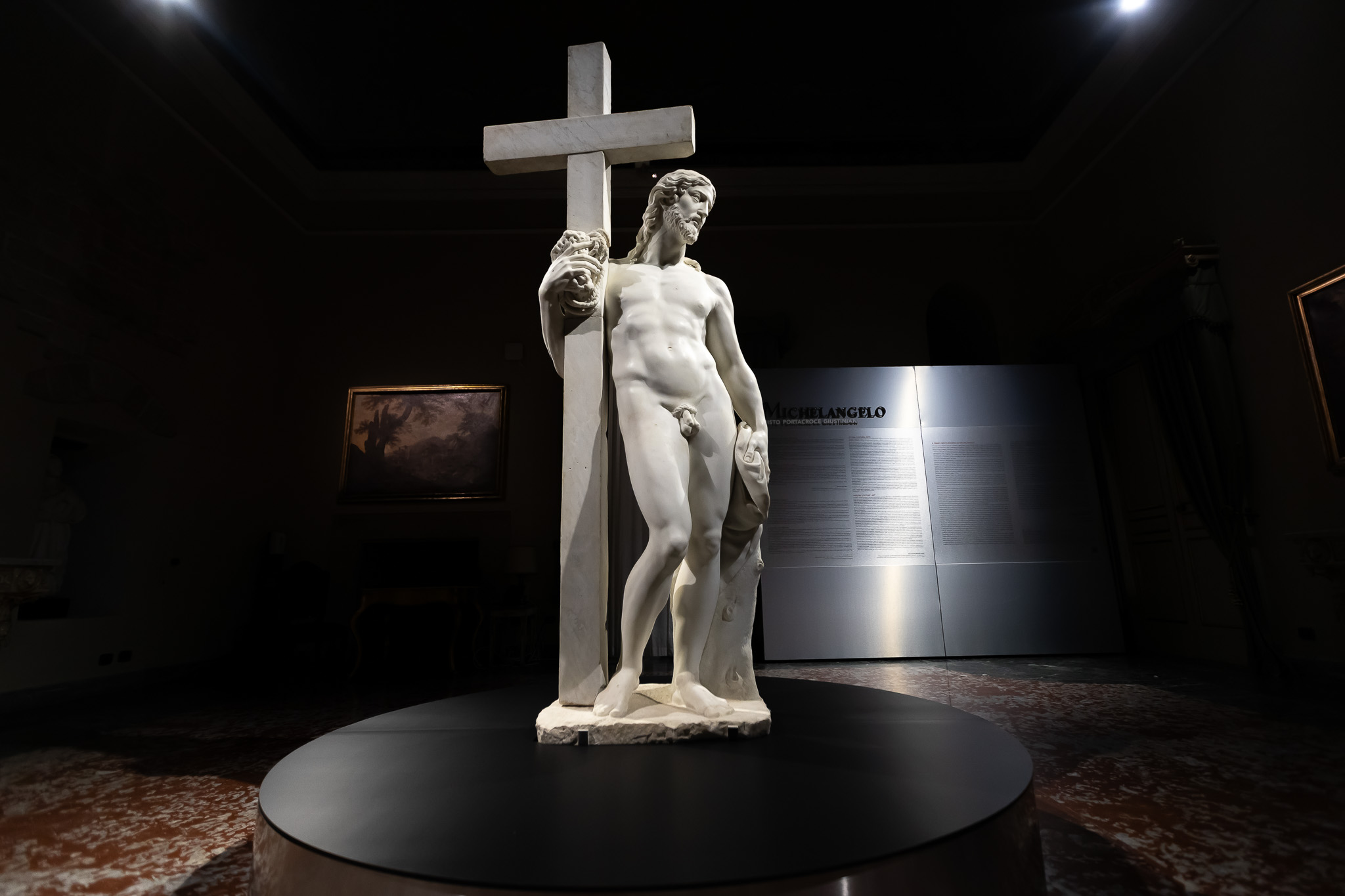
The Christ Carrying the Cross Giustiniani
In Palermo, the visitors’ enjoyment is enhanced by an ad hoc setup and by ERCO’s lighting design project.
Conceived, organized and curated by the Federico II Foundation, in collaboration with the Sicilian Regional Assembly, the San Vincenzo Martire Monastery – Silvestrini Benedictine Monks, the Ministry for the Protection of Cultural Heritage, the Superintendent of Archaeology, Fine Arts and Landscape for the Province of Viterbo and South Etruria, the exhibition can be visited from Thursday to Monday.
“Sicily – declares Gaetano Galvagno, President of the Federico II Foundation – welcomes this masterpiece by Michelangelo and does so with a representative work of Renaissance sculpture. At the same time, the Risen Christ fully describes the profound link between Italian cultural history and universal spirituality.”
#Michelangelo #Norman #Palace #Palermo #Arte.it