

When they debuted in the 1990s, GM’s 4L60E and 4L80E transmissions reveal some of their differences – and similarities – right in their names. The “4” and “L” refer to the number of gears and the longitudinal orientation of the unit itself respectively, while the “e” means that they are electronically controlled. The “60” and “80” refer to the gross vehicle weight. (We’ve previously discussed GVWRs in our quick guide for RV and truck owners.)
The 4L60E can be used in a vehicle with a GVWR up to 6,000 pounds, and the 4L80E increases its limit to 8,000 pounds. The naming strategy isn’t universal, however, as the namesake 4L85e variant can handle a GVWR of up to 16,500 pounds.
Another fundamental difference stems from the applications in which the two transmissions were used. The 4L60E was typically a top choice for small-block Chevy engines at the time, and it carried over to runs with the Gen III and Gen IV LS V8s. Yes, a variant was used on some trucks, but that was more of a role for the 4L80E, which actually premiered on GM’s C/K series trucks from 1991. Today, both transmissions are popular for aftermarket swaps, and the following details about their differences can tell you why.
Physical differences between the 4L60E and 4L80E
Physically, swappers should keep in mind that the 4L80E – specifically and originally designed for trucks – is the larger and heavier of the two transmissions. It is approximately 26.4 inches long and weighs 236 pounds. while the 4L60E is 23.5 inches and 150 pounds. This would obviously make a big difference in your next build, and so would the fact that the gearboxes have different bolt patterns for attaching to engines. The smaller transmission has a 16-bolt setup, while the larger uses 17 bolts. They also have different shaped transmission fluid pans. On the 4L60E, the pan is shaped like a rectangle; the 4L80E’s pan looks like an oval.
Remember how that “e” meant that both transmissions relied on electronic controls? Well, it is, but even those controls have differences. The 4L60E has only one speed sensor and the 4L80E has a few. The wiring harnesses of the two transmissions are also incompatible, although rats may enjoy chewing on both.
Finally, the crux of the matter is a significant difference in the gear ratios. The four forward gears for the 4L60E, going from first to fourth, have ratios of 1:3.059, 1:1.625, 1:1.00 and 1:0.0696. The 4L80E’s ratios, on the other hand, are 1:2.482, 1:1.482, 1:1.00, and 1:0.750.
Origin stories of the 4L60E and 4L80E
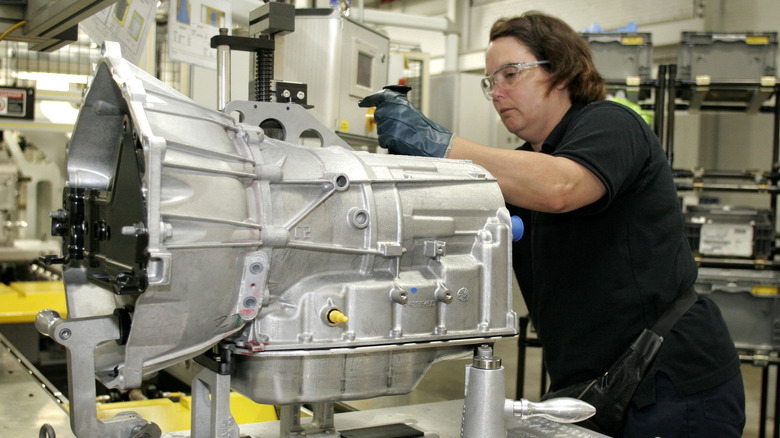
The GM 4L60E and 4L80E transmissions ultimately go back to GM’s famous Turbo Hydra-Matic family. This family was introduced by Oldsmobile in 1940 and became the first modern automatic transmission. More specifically, the 4L80E is an evolution of the TH400 three-speed automatic. Major upgrades to the newer transmission include an additional forward gear with overdrive for improved efficiency, electronic controls and a lock-up torque converter – which transfers engine power to the driveshaft and plays a crucial role in how your automatic transmission knows when to shift.
It’s also worth pointing out that the 4L80E has a built-in bell housing. This is a protective metal cover that bolts onto the transmission in a specific pattern. This can limit the number of swaps as it only ties directly to engines with the same pattern. The same setup was also used for early 4L60E transmissions.
The 4L60E was originally intended as a replacement for the lightweight variant of the TH400, the TH350. That particular gearbox was followed by the TH700R4, which improved performance and efficiency with overdrive and a different first gear ratio. The transmission was then renamed 4L60 without major changes in 1990, before welcoming electronic controls in 1993. In 1997, a removable bell housing with a different bolt pattern debuted. Both the 4L60E and 4L80E were replaced by the six-speed 6L80E in 2006.
#4L60E #4L80E #Transmissions #Differences #Jalopnik