

It’s the end of February and everyone was thinking about Valentine’s Day. People bought sweets, cards, flowers, jewelry and clothes and went out to eat at restaurants.
The National Retail Federation estimates that consumers will spend a record $29.1 billion on Valentine’s Day this year. This allows companies that provide these products and services to make appropriate investments.
Moreover, they often have market leadership and scale thanks to industry consolidation. Consequently, they return huge amounts of cash to investors through dividends and buy back shares.
This article examines three dividend growth stocks for February 2026, focusing on companies with higher sales during Valentine’s Day.
Dividend Growth Stocks for February 2026
Tootsie Roll Industries (TR)
Tootsie Roll Industries, Inc. has its origins in the late 1890s, when the eponymous product, the Tootsie Roll, was first created. Today, the company sells a wider variety of candy and gum products. Other well-known brands are DOTS, Junior Mints, Andes, Charms, Blow-Pops, Sugar Daddy and Dubble Bubble.
With over 50 years of dividend increases, Tootsie Roll makes the list of Dividend kings.
Tootsie Roll reported third quarter 2025 results on October 22, 2025. Net sales increased 3% to $230.6 million for the quarter, compared to $223.9 million in the prior year. During the same period, net profit rose to $35.7 million, up from $32.8 million. Diluted earnings per share increased 9% to $0.49 per share, from $0.45 year-over-year, due to higher sales volumes and lower share counts.
Although volumes and revenue declined in 2024, margins were higher due to lower freight costs and higher prices. Tariffs and inflation, especially for cocoa and chocolate, will impact input costs and margins in 2025. Inflation is a concern, and input costs for labor, ingredients, freight and delivery, fuel, packaging materials, energy and production supplies have increased. The company has raised prices in response to the recovery of margins.
Tootsie Roll should achieve average earnings per share growth of 3% through 2030, mainly through small sales growth driven by incremental product innovation and price increases. Influences on earnings per share growth include commodity and freight inflation on the negative side, and volume and price increases and operational efficiency on the positive side.
The regular cash dividend was last increased in 2016 and is currently $0.36 per share. The payout ratio is only ~29% and there is room for an increase. The company issues a 3% stock dividend every year in addition to the regular dividend, which gives an effective yield of ~4% if an investor sells the stock dividend. stock dividend annual.
Mondelez International (MDLZ)
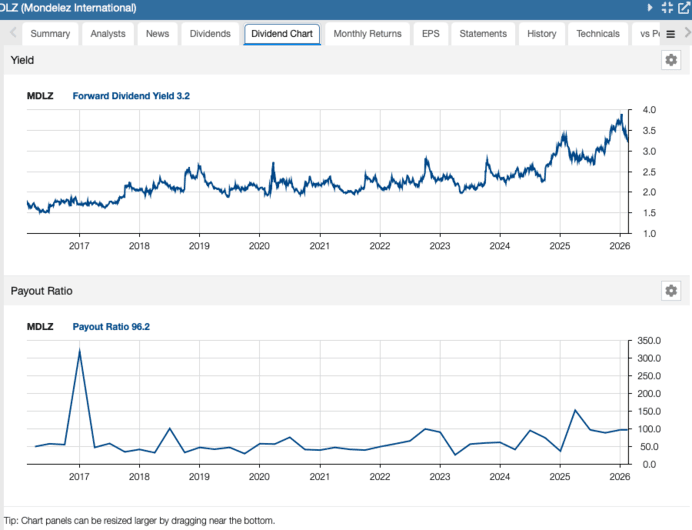
Mondelez produces and distributes snacks in more than 150 countries and generates annual sales of ~$38 billion. Sales in 2025 came from Europe (39%), North America (28%), Asia, the Middle East and Africa (21%) and Latin America (13%).
As cocoa cost headwinds continue to impact Mondelez’s profitability, the company is doing what it can control – improved volumes, brand investments, structural cost savings and disciplined capital allocation – to create multi-year shareholder value as cocoa prices normalize over time.
Mondelez reported its fourth quarter 2025 results on 02/03/2026. For the quarter, organic net sales growth was 4.4%, with prices up 8.5%, offset by volume/mix of -4.1%. Net sales increased 9.3% year over year to $10.5 billion. Organic net sales growth of 8.3% in Europe was the strongest, followed by 7.5% in Asia, the Middle East and Africa, and 4.4% in Latin America. In North America, interest rates were negative: -0.5%.
Adjusted gross profit increased 5.8% to $3.2 billion, along with an adjusted gross profit margin that decreased 1.0% to 30.5%. Adjusted earnings rose 7.2% to $929 million, while adjusted earnings per share rose 10.8% to $0.72.
For the full year, organic net sales growth was 4.3%, while prices increased 8.0%, offset by volume/mix of -3.7%. Net sales increased 5.8% year over year to $38.5 billion. Organic net sales growth of 8.6% in Europe was the strongest, followed by 5.7% in Asia, the Middle East and Africa, and 4.6% in Latin America, while it was negative at -1.9% in North America. Free cash flow this year was $3.2 billion.
Mondelez initiated its 2026 guidance as follows: organic net sales growth of 0-2% and adjusted EPS growth of 0.5% at constant exchange rates, while the company expects to generate free cash flow of ~$3 billion.
In the long term, MDLZ must continue to innovate, invest in its brands and expand its offering. We estimate five-year earnings per share growth of 7.5%, assuming emerging markets will typically achieve relatively higher growth than developed markets, and estimate dividend growth at 3.0% per year for a payout ratio more in line with historical levels of ~50%. It’s Mondelez’s turn list of dividend candidates.
The Hershey Company (HSY)
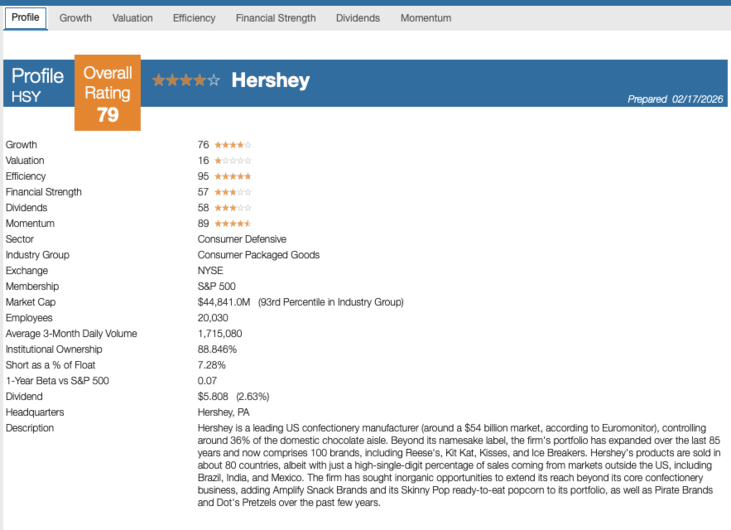
Founded in 1894, The Hershey Company is a manufacturer of chocolate and confectionery products that sells major brands such as Hershey’s, Reese’s, Kisses, Cadbury, Ice Breakers, Kit Kat, Almond Joy, Jolly Rancher, Twizzlers, Heath and Milk Duds. Hershey is primarily active in North America, but also has international operations.
On February 5, 2026, Hershey reported results for the fourth quarter of 2025. The North American confectionery segment (80% of sales) grew its sales by 5% compared to the previous year’s quarter, thanks to price increases. Earnings per share fell 36%, from $2.67 to $1.71, but exceeded analyst consensus by $0.31, mainly due to an effective hedging strategy, which partially offset the effect of exceptionally high cocoa prices.
In 2025, Hershey faced extremely strong headwinds from skyrocketing cocoa prices, which put pressure on the chocolate maker’s profit margins. However, cocoa prices have fallen sharply in recent months. As a result, Hershey gave positive guidance for 2026. The company expects revenue growth of 4% to 5% and adjusted earnings per share of $8.20 to $8.52.
Hershey’s earnings per share growth is the result of several factors. The first is organic sales growth, which Hershey has achieved despite the public becoming more aware of healthy eating habits.
The company has also been able to improve its margins over the past decade. Hershey owns well-known brands, so price increases have not had a negative impact on increasing the volume of its products. Hershey is suitable for almost any environment. Hershey posted low profits last year due to skyrocketing cocoa prices, but we view these headwinds as temporary and expect earnings growth of 33% this year and average annual earnings per share growth of 6% after this year.
Hershey’s dividend payout ratio peaked last year due to lower profits and exceptionally high cocoa prices, but we expect the payout ratio to normalize in the coming years. Plus, Hershey is ordinary has increased its dividend down 6% this year, showing confidence in a strong recovery.
Related article on Hershey on Dividend Power
Disclosure: The author has no positions in the stocks mentioned.
Related articles about dividend power
Here are my recommendations:
Branches
- Simply Investing Report and Analysis Platform or the Course can teach you how to invest in stocks. Try it for free for 14 days.
- Free Dividend Kings Spreadsheet from Sure Dividend, complete with Buy/Hold/Sell recommendations, dividend history and much more. It’s an excellent resource for do-it-yourself dividend growth investors and retirees.
- Stock Robber is the leading investment research platform with all the fundamental metrics, screens and analysis tools you need. Try it for free for 14 days.
Get one free e-book, “Become a Better Investor: 5 Fundamental Metrics You Need to Know!” Join thousands of other readers!
*This post contains affiliate links, which means I will earn a commission for any purchases you make on the affiliate’s website through these links. This will not incur any additional costs for you. Read my disclosure for more information.
Bob Ciura
Bob Ciura is Chairman of Content at Sure Dividend. Bob has been working at Sure Dividend since October 2016. He oversees all content for Sure Dividend and its partner sites. Before joining Sure Dividend, Bob was an independent equity analyst. Bob earned a bachelor’s degree in Finance from DePaul University, and an MBA with a concentration in Investments from the University of Notre Dame.
#Dividend #Growth #Stocks #February