

The World Table Tennis Championships first took place in 1926 in London, England, when seven men’s teams participated in the competition.
Gradually, the number of teams (and individuals) participating in the World Championships increased to such a large number that since the year 2000 the championship has been split into two separate competitions.
Team events are now held in even years, while individual events (singles and doubles) are held in odd years.
So 2026 is the year the team events will be contested, and London, England will host the event April 28-May 10, 2026.
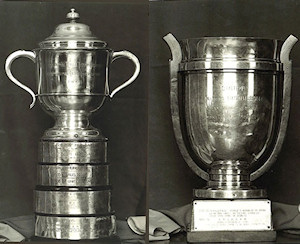 Team event cups
courtesy of the ITTF
The events of the 2026 World Table Tennis Championships are…
The Swaythling Cup was donated in 1926 by Lady Baroness Swaythling, mother of Ivor Montagu, while the Corbillon Cup was donated in 1933 by Marcel Corbillon, President of the French TTA, for the first women’s team event at the 1934 World Championships.
However, the original Corbillon Cup disappeared just after World War II, so the German Table Tennis Federation paid for an exact replica in 1949 (the German women’s team won the cup at the 1939 World Championships – the last time it was played before the outbreak of World War II).
- Tables, Net and Post – DHS
- Balls – Butterfly R40+ 3 star (white)
- Floors – TIBHAR GRIP Europe
The 2026 edition of the World Team Championships has expanded to 64 teams in both the men’s and women’s events – an increase from 40 teams in recent championships.
This increase was agreed as table tennis is expanding globally and therefore giving more national associations the opportunity to participate in the sport’s most prestigious competition.
So how will it work?
To accommodate these extra teams, a new system has been agreed.
Preliminary round
First…
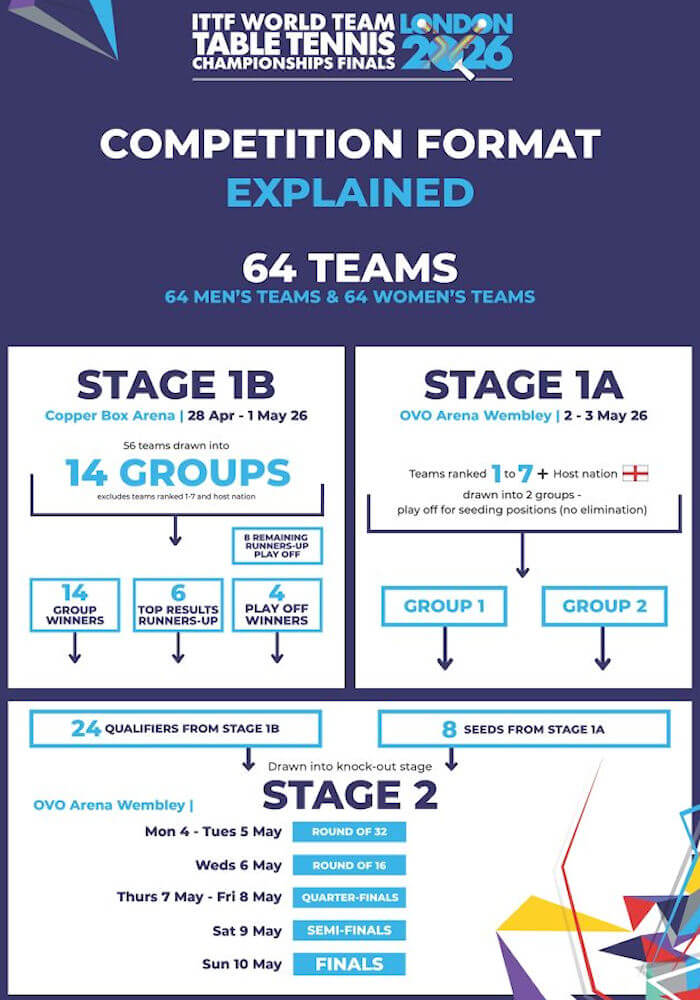
The top seven ranked teams in the world rankings, plus the host team (England), will be divided into two groups of four.
Each team plays against the other three teams in their group.
All eight teams advance to the main tournament, but these matches determine the seeding for the main tournament.
Secondly…
The remaining 56 teams are divided into 14 groups of four, but only the best performing teams advance to the main tournament.
All 14 group winners will advance directly, plus the top six second-placed teams (based on their match records).
The remaining eight second-place teams will face a preliminary knockout round (four matches), with only the four winners advancing to the 32-team main draw.
Main table…
The main tournament is played as a knockout competition.
Teams that played against each other in the groups will no longer meet in the first round of the main tournament.
Here’s a diagram with the details…
GENTLEMEN
Algeria, Angola, Argentina, Australia, Austria, Bahrain, Belgium, Benin, Brazil, Cameroon, Canada, Chile, China, Chinese Taipei, Ivory Coast, Croatia, Cuba, Czech Republic, Denmark, Ecuador, Egypt, England, Fiji Islands, France, Germany, Greece, Guatemala, Hong Kong China, Hungary, India, Iran, Japan, Kazakhstan, Madagascar, Malaysia, Mexico, Moldova, Mongolia, Morocco, New Caledonia, New Zealand, Nigeria, North Korea, Peru, Poland, Portugal, Puerto Rico, Qatar, Romania, Serbia, Singapore, Slovakia, Slovenia, South Africa, South Korea, Spain, Sweden, Tahiti, Thailand, Togo, Tunisia, Turkey, United States, Uzbekistan.
WOMEN
Algeria, Angola, Argentina, Australia, Austria, Brazil, Canada, Chile, China, Chinese Taipei, Congo, Cook Islands, Croatia, Cuba, Czech Republic, Ecuador, Egypt, England, Ethiopia, France, Germany, Ghana, Guatemala, Hong Kong China, Hungary, India, Iran, Italy, Japan, Kazakhstan, Luxembourg, Macau China, Madagascar, Malaysia, Mexico, Mongolia, Nauru, Netherlands, New Zealand, Nigeria, North Korea, Poland, Portugal, Puerto Rico, Romania, Serbia, Singapore, Slovakia, South Africa, Southern Republic, Spain, Sri Lanka, Sweden, Syria, Tahiti, Thailand, Tunisia, Turkey, Uganda, Ukraine, United States, Uzbekistan, Venezuela, Wales.
#World #Team #Table #Tennis #Championships