

At the end of September we reported on the first teaser for Capricorn Group’s debut road car, a project that promised to combine racing technology with coachbuilt exclusivity. The veil on the Capricorn 01 Zagato has now been lifted, and this production-spec coupe, limited to just 19 examples, delivers exactly what this mysterious teaser hinted at: a 900-horsepower, manual-only hypercar designed with LMP1 DNA and racing-related hardware, now wrapped in classic Zagato styling. This is a clean slate collaboration that could mark the beginning of a new line for the century-old Italian design house of coachbuilding and German engineering.
Founded in 1933, Capricorn has long been a quiet force behind Formula 1 cars, Le Mans race cars and even space programs. The company has built a reputation on supplying carbon fiber monocoques, engine parts and precision pistons to top teams. The 01 Zagato is the culmination of that engineering expertise, a statement of what happens when a supplier with racing DNA decides to build a road car on its own terms.
The heart of the 01 Zagato is formed by a cylinder capacity of 5.2 liters supercharged The in-house developed V8 produced more than 900 hp and 737 Nm of torque. Power goes to the rear wheels via a five-speed manual transmission with doglegs from CIMA, a conscious choice that puts involvement above excess. Capricorn engineers claim that fewer gears mean more control and a more direct relationship between throttle and torque delivery, especially when you push the car to its limits on the race track. It reaches 100 km/h in less than 3.0 seconds and the top speed is limited to 360 km/h.
“The Capricorn 01 Zagato produces over 900 hp, so it packs significant horsepower, but the key factor is that this comes with an ultra-lightweight engineering approach. As a result, the Capricorn 01 Zagato is a ‘pure, analog racing hypercar’. It’s not about chasing higher and higher numbers of extreme horsepower, or about bragging rights. Instead, we’ve focused on achieving a perfect power-to-weight ratio and delivering an engaging, uncompromising driving experience. The car is designed for driving pleasure, not for setting records,” said Capricorn founder and CEO Robertino Wild.
The chassis follows pure motorsport logic. Drawing directly from motorsport engineering, Capricorn built the 01 around an entire carbon fiber structure, including the monocoque, subframes, crash members and all exterior panels. With a dry weight of less than 2,650 pounds, it is lighter than most modern hypercars and delivers a power-to-weight ratio (0.35 hp/lb) that is in the same league as the Gordon Murray T.50 (0.30 hp/lb) or Pagani Huayra R (0.37 hp/lb).
The suspension features a pushrod setup with double wishbones and Bilstein dampers, which can be switched between Comfort, Sport and Track modes via the three-spoke steering wheel. Steering feedback, often diluted in modern performance cars, is maintained by a custom electrical assist system that disconnects at speed, creating a direct, mechanical connection between the driver and the front wheels. Braking performance is courtesy of Brembo carbon-ceramic discs and six-piston calipers. Capricorn’s own 21-inch wheels, available in lightweight aluminum or full carbon fiber, highlight the company’s vertical integration, which extends from chassis engineering to component manufacturing.
Visually, the car bears the unmistakable character of Zagato, with distinctive design details such as the double bubble roof. Founded in Milan in 1919, Zagato remains one of the few remaining independent coachbuilders in the world. The portfolio includes icons such as the Aston Martin V12 Zagato, Alfa Romeo TZ and Ferrari 575 GTZ. The Capricorn 01, Zagato’s first-ever hypercar, continues that legacy with a sleek, aerodynamic shape that strikes a balance between aggression and elegance.
“Until now, however, Zagato has never designed a hypercar. I am very happy that the first ever hypercar with a Zagato-designed body was created in collaboration with my dear friend Robertino Wild and his highly experienced technical team at Capricorn. And I am also proud that, by combining Italian design flair with German engineering discipline and adhering to the vision that Robertino and I share of what a real car is, driver should have brought a unique and highly collectible proposition to the market.” – Zagato President, Andrea Michele Zagato.
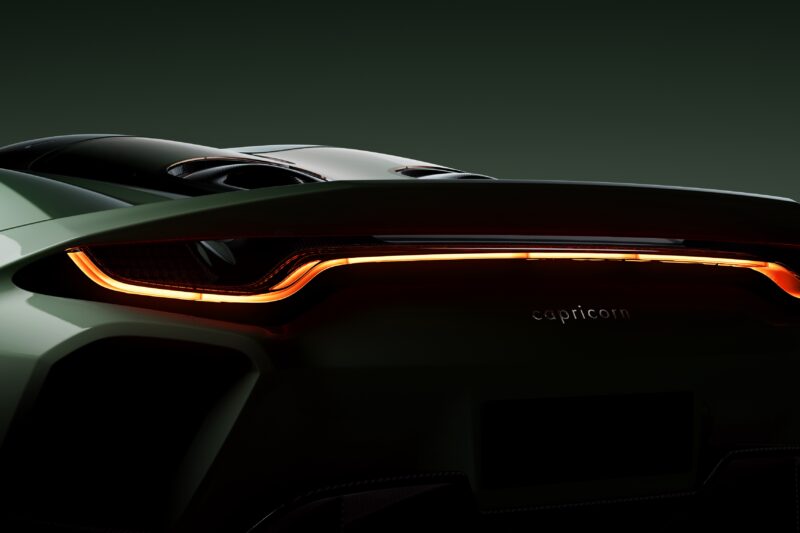
The overall design aesthetic is not only timeless, but also functional and built around airflow and weight optimization. A perfect example of this is the gull-wing doors, which not only add visual drama, but when closed are also shaped to introduce air into the engine. Airflow management and a substantial diffuser eliminate the need for an elaborate aero package and wing to achieve the necessary downforce.
It’s also worth recalling that earlier this year, in May, we reviewed two of Zagato’s most distinctive modern models, the BMW 4-Series Cabriolet-based Bovensiepen and the one-off Alfa Romeo 8C DoppiaCoda unveiled at Villa d’Este, along with the AGTZ Twin-Tail #2 that was part of Christian von’s personal collection Koenigsegg, reaffirming Zagato’s relevance in the modern world. era of coachbuilding.
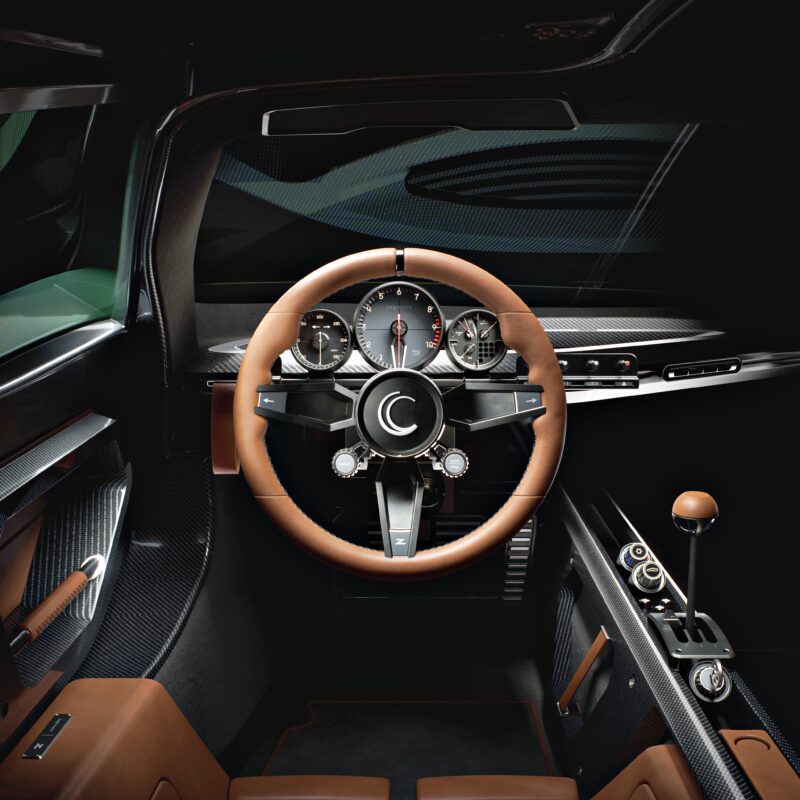
As for the 01 Zagato, each of the 19 cars is individually bespoke, and owners can specify any body color or opt for a fully exposed carbon finish, even down to a custom weave. The sporty yet luxurious cockpit can be upholstered in Connolly leather or Alcantara, accented by titanium, aluminum or carbon fiber details. In an age of digital cockpits, you get old-fashioned analog gauges with a central tachometer and switches and buttons that provide tactility. Furthermore, the level of customization offered resonates with Zagato’s historic bodywork line, now featuring Capricorn’s precision manufacturing techniques.
Prices start at €2.95 million (~$3.4 million) before taxes. Sales will be handled exclusively by Belgium’s Louyet Group, a luxury car retailer with close ties to Rolls-Royce, McLaren and Pininfarina. Louyet’s new business unit Capricorn has already won contracts with established customers throughout Europe.
The 01 Zagato is homologated for Europe, the UK, Switzerland, Japan, Mexico, Canada and the Middle East, but notably not for the US, meaning collectors there must import under the Show or Display exemption. Each car has a two-year warranty and a four-year service plan, with maintenance handled exclusively at Capricorn’s Düsseldorf facility. Nearly all parts are produced in-house, ensuring long-term component availability and quality control that is rare in boutique manufacturing.

Production will begin in early 2026 to coincide with the expansion of Capricorn’s Nürburgring complex to 18,000 square meters. The company plans to build future projects in production runs of up to 200 cars per year and has hinted at also taking on custom orders for private customers and entering into limited series collaborations with other OEMs.
For Capricorn, this collaboration marks the beginning of a new chapter, a redefinition of what a hypercar can be when it is designed by people who build the parts Formula 1 teams rely on. As for Zagato, which has now entered the world of hypercars, it is yet another reminder that its age-old design philosophy still has the power to shape the future of performance, one hand-built car at a time.
Images: Zagato, Capricorn group
#Zagatos #hypercar #limited #manual #Capricorn