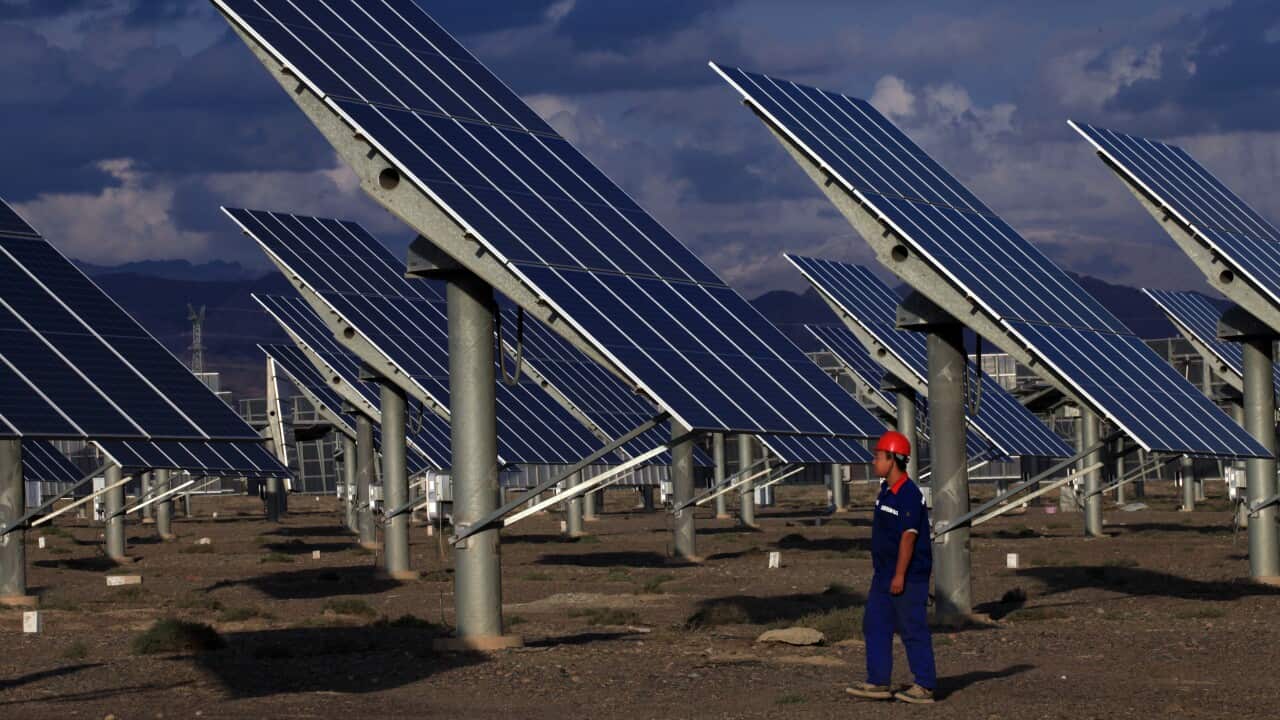
‘You don’t have the freedom to leave’: the human cost of Australia’s solar explosion

‘You don’t have the freedom to leave’: the human cost of Australia’s solar explosion

5 minutes, 34 seconds Read

Australia is a global leader when it comes to solar energy adoption.
More than 4.3 million homes and small businesses have installed rooftop solar panels, and approximately 1,000 new systems are installed every day.
Without a domestic supply chain, Australia imports about 90 percent of its solar panels from China.
Ramila Chanisheff, president of the Australian Uyghur Tangritagh Women’s Association, says her people are being forced to make them.

“We know that solar energy is one of the largest industries complicit in Uyghur forced labor,” she told SBS News.

Reports of forced Uighur labor

In what was officially described as an effort to combat extremism, about a million members of the predominantly Muslim Uyghur minority were sent to so-called re-education centers between 2017 and 2019.

Evidence and testimony from ex-detainees alleged torture and political indoctrination, forced sterilization and drugging, as well as food deprivation to punish those who showed resistance.

An official Chinese government report published in November 2020 documented the “placement” of 2.6 million minority citizens in farms and factories in the Xinjiang Uyghur Autonomous Region and across the country through state-sponsored initiatives.
Chanisheff said there was credible evidence from Uighur people who say their relatives have been taken to forced labor camps.
“All these Uyghurs are forced to work in East Turkistan or Xinjiang, or are trafficked to mainland China to do the work,” she said.
The Chinese government says the labor programs are voluntary anti-poverty initiatives designed to provide opportunities for the “graduates” of the “re-education camps.”
Chanisheff says there is nothing voluntary about it.
“Once you’re in, you don’t have the freedom to leave,” she said.
“They are being coerced, coerced. If they don’t say yes, they could disappear themselves or their relatives could be held by the state for ransom.
“This is state-sanctioned forced labor. The conditions are harsh, you work extremely long hours, you are indoctrinated.

‘Is it a prison? Don’t know. Is it a concentration camp? That’s what I would say.’

Then-US Secretary of State Mike Pompeo declared China’s abuses against the Uyghurs a genocide in 2021.
Other countries, including Canada, the United Kingdom, France and Denmark, have passed non-binding motions claiming the same thing.
China strongly denied Pompeo’s statement at the time.
A 2022 report from the Office of the United Nations High Commissioner for Human Rights found that “serious human rights violations” had been committed against the Uyghurs.
The federal government said it was “deeply concerned” by the findings.
A spokesperson for China’s Foreign Ministry said at the time that the UN assessment was a “patchwork of false information that serves as political tools for the US and other Western countries to strategically use Xinjiang to contain China.”
Members of the diaspora and researchers uncovering the alleged abuses say they have been targeted and even threatened by Chinese authorities
With a report from Britain about a research project at Hallam University in Sheffield that was suspended by the university earlier this year (it resumed in October) after pressure from Chinese authorities, Chanisheff says the government is working very hard to silence its critics.

“Without independent investigations, we will only see in the diaspora what China wants us to see,” she said.

Why aren’t Australian companies investing in solar energy production here?

Australia has invested billions in solar energy and green manufacturing, and the Australian Renewable Energy Agency is currently funding feasibility studies for new domestic polysilicon production facilities. Polysilicon is an important material in solar panels.
But for now, with a few minor exceptions, Australia still imports most solar panels from China.

Fuzz Kitto is co-founder of Be Slavery Free, an Australian coalition of organizations committed to raising awareness and ending modern slavery.

He told SBS News that investors in the energy sector feel they have no choice but to invest in companies rooted in or linked to the Xinjiang region – despite alleged human rights abuses taking place there.
“Even though experts say there is enough outside that region to meet the United States, Europe and leading countries’ needs for solar-generated electricity, there is certainly no transparency about where it comes from.”
Solar panels are made of solar-grade polysilicon, which is made from quartz sand.
China produces about 95 percent of the global supply of polysilicon, much of which is made in factories linked to forced Uyghur labor.
According to the Australian Mining Review, Australia is the largest exporter of quartz sand in the Asia-Pacific region, with the majority of our exports going to Chinese markets.
Kitto says we should make polysilicon here.

“I think one of the biggest problems is that people think there are no alternatives,” he said.

“To produce polysilicone you need cheap electricity and sand of that quality.
“We have sand of that quality in Australia. In fact, we export sand to China for making polysilicone, which is just incredible.

“We don’t understand why we don’t produce them in Australia.”

Limited anti-slavery law enforcement

In 2021, former US President Joe Biden passed the Uyghur Forced Labor Prevention Act, banning the importation of dozens of publicly blacklisted companies.
Under the Australian Criminal Code, slavery is a crime and the offenses have universal jurisdiction – meaning the law applies even if the crime occurs outside Australia.
Fuzz Kitto says that without enforcement mechanisms, the laws are not as strong as those in the US.

“Australia’s Modern Slavery Act is currently weak. It is being reformed, but we have also lobbied for an Australian import ban on forced labor, which is outside the scope of the current reform process.”

In addition to allegations of forced labor, experts say lax national environmental standards allow companies in China to drill into natural resources and supply their factories with cheap coal.
As a result, solar panels made in the Uyghur region reportedly have a larger carbon footprint than solar panels produced elsewhere in the world.
The Attorney General’s Department told SBS News in a statement that Australia is committed to ensuring supply chains do not promote, condone or financially support modern slavery.
It added that the government is currently consulting on the enforcement of the Modern Slavery Act.
With the global supply of solar energy strongly linked to forced Uyghur labour, human rights groups are urging the Australian government and companies to be transparent about where they source solar energy components.
While solar energy from China is the cheapest option, Chanisheff says the clean energy transition should not put profits before people.
“Companies that market these solar panels are there to make a profit, so they are not held accountable,” she said.
“It seems money trumps human rights, and we are not doing enough to prevent products made by forced labor from entering this country.”

#dont #freedom #leave #human #cost #Australias #solar #explosion

Similar Posts

Leave a Reply

Your email address will not be published. Required fields are marked *