Worth up to 0,000 and hidden in chocolate boxes: a look into Australia’s illegal pet trade

Worth up to $100,000 and hidden in chocolate boxes: a look into Australia’s illegal pet trade

3 minutes, 34 seconds Read

Thousands of shipments of rare animals and animal products are stopped at the Australian border every year, and some come with a six-figure price tag.
The Australian Border Force (ABF) has intercepted around 4,000 illegal shipments in a year, including live animals in cruel conditions.
In Australia, wildlife is protected under the Environment Protection and Biodiversity Conservation Act, and there are strict penalties, including fines and up to five years’ imprisonment, for anyone caught importing or exporting a regulated species without a permit.
But the illegal wildlife trade remains a major problem.

Katie Smith, research project manager at the University of Adelaide’s wildlife crime research centre, told SBS News that Australia’s geographical location, with its extensive coastline, makes it difficult to police the trade.

Smith said the wildlife black market mainly takes place online through e-commerce platforms, with rare reptiles among the most sought after animals.

Who is behind this black market?

Some of the largest consumer markets for reptiles and their products are the United States, Germany and Japan.
Researchers say their interest in Australia stems from the fact that it is a country with rare wildlife, and that rarity is a draw to the wildlife black market.
According to the ABF, native Australian reptiles are worth up to $100,000 on the black market.
Smith said reptiles are vulnerable because there are as many as 1,000 species found only in Australia.
“We see that the demand for these species over time is actually determined by their rarity,” she said.
“It makes them highly sought after when they are rarer and unfortunately makes this a major factor in their risk of extinction.”

The illegal pet trade can also introduce invasive species and spread disease, she added.

The trade in native animals also causes cultural damage.
First Nations Australians relate to wildlife as cultural totems and as features of Dreamtime stories and links to Country.

Indigenous leaders across the country are lobbying for the management of conservation programs, combining indigenous knowledge with modern conservation methods.

Hidden in clothes, boxes

Sebastian Chekunov, wildlife crime research leader at the hub, told SBS News that smugglers have also tried to send animals out of the country in luggage, hidden in clothing and in boxes of chocolate.
A common destination for smugglers is Hong Kong.
“Hong Kong does have a market for exotic pets, so sometimes the smuggled reptiles are sold domestically there, but it is also a global trade and transportation hub and a gateway to mainland China,” he said.
“Hong Kong is often the first step and just one node in the network.”

Animal products are also traded in Australia.

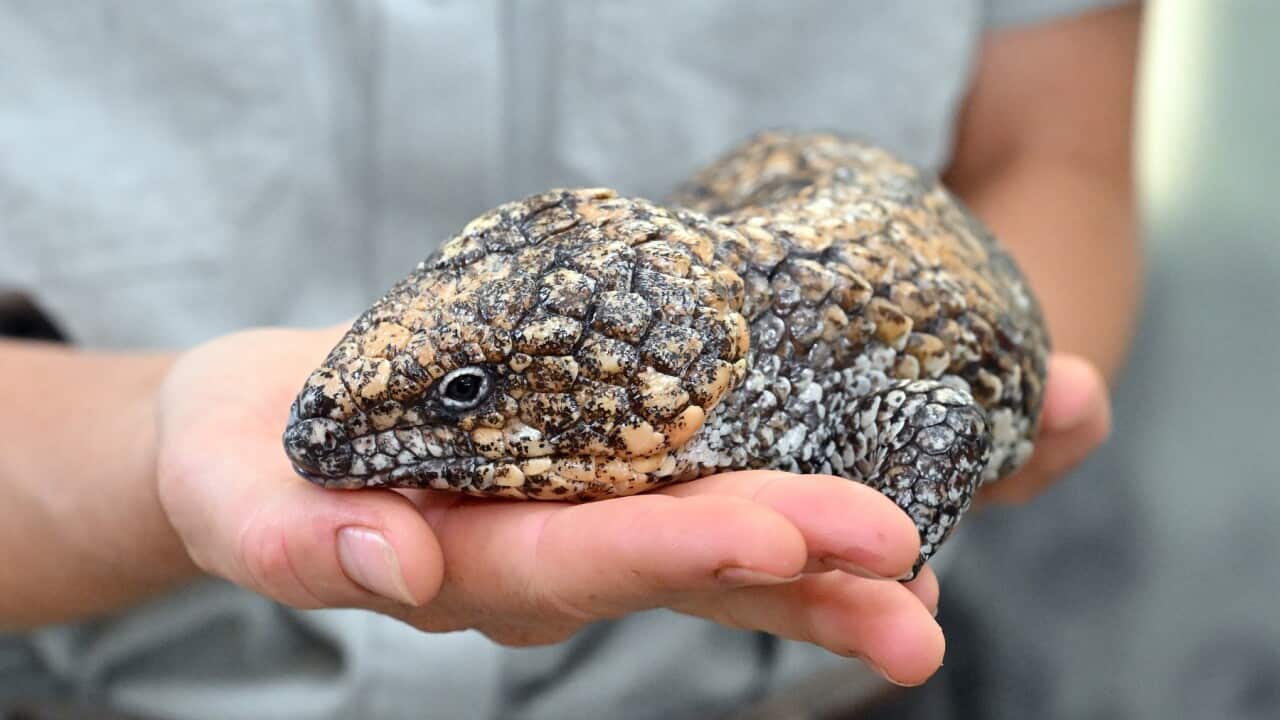
The exotic appeal of shingleback lizards is a driving force in black market demand. Source: MONKEY / Mick Tsikas

Last year, about 3,000 bird eggs of a suspected endangered species were seized from a man in Tasmania.

Charlotte Lassaline, a PhD candidate at the University of Adelaide, told SBS News that demand for spiders, scorpions, ants, stick insects and snails has increased.
Her research has identified more than 580 species of invertebrates that are traded.
“That’s a very large number and this includes many endangered Australian species, including the Flinders Ranges scorpion,” she said.
“This is a restricted-range species, meaning it only comes from a small area in South Australia.

“Yet it is widely trafficked across Australia for the pet trade, and this is deeply concerning for their small populations.”

Sharks and shark fin materials are also among the most coveted products imported to Asia from Australia and New Zealand.

Efforts to tackle the black market

This month, global stakeholders will meet at the 20th meeting of the Conference of Parties in Uzbekistan to discuss possible changes to international wildlife trade rules.
Professor Phil Cassey, director of the Wildlife Crime Hub, said there are 51 proposals on the table for this meeting, including Australia’s proposal to add two reptiles to the list of protected species.
“So there are two that have been listed by the Australian parties, the Mount Elliott leaf-tailed gecko and the ringed sparse-tailed gecko, to be placed on what is known as CITES Appendix Two,” he said.
“This means no imports to other countries or no exports from Australia will be permitted without a permit, and it allows for border seizures of these species outside Australia.”

#Worth #hidden #chocolate #boxes #Australias #illegal #pet #trade

Similar Posts

Leave a Reply

Your email address will not be published. Required fields are marked *