

Whirlpool Corporation (WHR) cut its dividend due to the impact of a prolonged recession on the housing market, poor results, debt burden, tariffs and trade uncertainty. Weak financial results, lower sales and longer-than-expected earnings have taken their toll on the company. The company’s dividend has been steady since the first quarter of 2022 and was finally cut this year.
The share price has fallen dramatically since early May 2021. Investors sold this dividend share due to concerns about weak demand from a suppressed housing market, poor top and bottom line results, tariffs, debt and a possible dividend cut. Depending on home repairs, rates and future operational and financial results, a further reduction may occur.
Partner
Stock Robber is an award-winning one investment research platform.
- The site has more than 8,500 stocks, 4,000 ETFs and 40,000 mutual funds.
- Access to more than 650 statistics, financial data, market news, stock and fund ratings, fair value, margin of safety, etc.
- Includes broker integration, portfolio tracking, rebalancing, watchlists, alerts, future income forecasts, etc.
Click here to try Stock Rover for free (Free 14 day trial).
Overview of Whirlpool Corporation
Whirlpool Corporation was founded in 1911 and is headquartered in Benton Harbor, MI. It is a global manufacturer of home appliances, specializing in washing machines, dryers, refrigerators, freezers, cookers and mixers. The company operates in four segments: Major Domestic Appliances North America (62% of sales), Major Domestic Appliances Latin America (62% of sales), Major Domestic Appliances Asia (11% of sales) and Small Domestic Appliances Global (6% of sales). It owns many well-known brands such as Whirlpool, Maytag, Amana, Jenn-Air, KitchenAid and others.
Total revenue was $16,607 million in 2024 and $15,522 million in the last twelve months.
Announcement of dividend cut
During the second quarter of 2025, on Monday, July 28, Whirlpool Inc. (WHR) cut its dividend. The company’s quarterly dividend was $1.75 per share before the announcement. The dividend is now $0.90 per common share, down 48.6%. In the announcement on July 28, the company stated:
“We will recommend an annual dividend payout rate of $3.60 per share, which will create balance sheet capacity. The dividend will be approved quarterly by the board of directors.”
Later, in the second quarter earnings call transcriptsaid the CFO,
“Finally, we are committed to returning cash to shareholders by financing a healthy dividend. We believe our business is well positioned for growth. However, the volatile macro environment and long-suppressed housing cycle have impacted our short-term results. After careful consideration with a focus on our long-term value creation, we recommend that we adjust the annual dividend rate to be adjusted to $3.60 per share from the third quarter. While this decision has not been taken lightly, it is critical to ensure that we create sufficient capacity on our balance sheet for future investments in the US and that we remain focused on debt repayment. As a reminder, the dividend is approved quarterly by the Board of Directors.”
Effect of the change
By cutting the dividend by almost 49%, Whirlpool wanted to reduce its quarterly and annual dividend payments and increase its financial flexibility. The company is experiencing lower sales and profits due to a prolonged recession in the housing market. Additionally, tariffs, inflation and broader economic uncertainty impacted results. Another consideration is that the balance sheet is leveraged with low interest coverage.
The company’s dividend rate has been constant since the first quarter of 2022 and thus did not experience a series of increases. The company was not a dividend growth stock. The result is that less free cash flow (“FCF”) is required to pay dividends, allowing the company to maintain liquidity, reduce debt and invest in growth.
Challenges
Whirlpool faces a challenging business environment due to a weak housing market. Tariffs and trade uncertainties result in higher input costs and negatively impact profitability. Consumers are also under pressure from inflation and have pulled back on spending. In addition, the balance sheet has been put under pressure and interest coverage has decreased.
Housing cycle
Home sales have fallen significantly and the industry is in a prolonged downturn. Total sales are near a 25-year low due to high prices exceeding income gains, years of less construction and higher interest rates after a period of low interest rates. As a result, homes are staying on the market longer and prices are falling in some states, especially in Florida, Texas and Arizona.
Tariffs and trade uncertainty
Rates are another big problem for Whirlpool. The company operates manufacturing facilities worldwide and likely imports products from other countries into the United States. Tariffs are direct costs for importers and will be passed on to consumers.
Inflation and consumers
Inflation affects both Whirlpool’s input costs and consumers. Customers are spending less because incomes are not keeping pace with inflation. As a result, they may postpone home renovations and appliance purchases.
Debt and leverage
Whirlpool is a leveraged company with net debt of over $7.25 billion. It currently has an interest cover of about 2.67 times and a leverage ratio of about 5.06 times. Furthermore, the country has a non-investment-grade credit rating of BB+/Ba1, after being downgraded in May 2025. This suggests that the credit rating agencies expect weak demand and revenues due to a depressed housing market, rates and debt payments.
Dividend safety
Due to weaker sales and earnings per share (“EPS”), Whirlpool’s dividend safety numbers were poor. Earnings per share have been negative for four of the past ten years and three of the past five years. They peaked at $28.36 in 2021 and were down ($2.63) in 2024. Consensus estimates indicate $6.42 per share in 2025.
As shown in the chart below from StockRover*, the dividend yield rose rapidly to almost 9.2% in May 2025. Although the critical 10% threshold has not yet been crossed, high values are associated with companies experiencing operational and financial problems. It was also much higher than the four-year average of 5.6%. After a dividend cut of approximately 49%, the forward dividend yield is now around 4.95%. The quarterly price is $0.90 per share. However, its returns are still significantly greater than the S&P 500 average.

The annual dividend now requires approximately $201.6 million ($3.60 annual dividend x 56 million shares), compared to $384 million in 2024. The lower rate will improve the situation. payout ratiowhich was negative in some years and reached more than 100% before the cut, indicating that profits did not cover the dividend. Additionally, free cash flow was down to $384 million in 2024, after peaking at $1,651 million in 2021. We expect the annual difference in cash flow requirements to increase liquidity and allow Whirlpool to pay down debt while investing in growth.
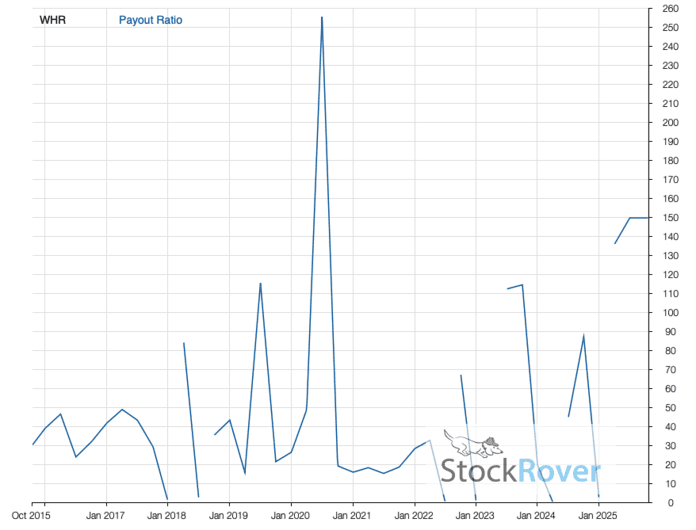
Although the dividend is now in a better position and more secure, the company’s dividend is still not entirely safe, as evidenced by its weak credit rating. A further decline in demand, a depressed housing market, persistent inflation or higher rates and trade uncertainty could result in another dividend cut.
Next, we believe that equity is at risk due to another dividend cut unless the housing market recovers and results improve.
Final thoughts on Whirlpool’s (WHR) dividend cut.
A suppressed housing market for longer than expected has had a negative impact on sales and profitability. In addition, high interest rates, low new home construction, inflation and a stressed consumer have contributed to poor results. As a result, lower revenues for a longer than expected period, debt burden and low interest coverage have caused problems for Whirlpool. Tariffs and trade uncertainty have further complicated matters in 2025. The collective effect resulted in declining dividend safety ratings. As a result, Whirlpool cut its dividend. However, we believe the company is at risk of another significant decline.
Related articles about dividend power
Here are my recommendations:
Branches
- Simply Investing Report and Analysis Platform or the Course can teach you how to invest in stocks. Try it for free for 14 days.
- Free Dividend Kings Spreadsheet from Sure Dividend, complete with Buy/Hold/Sell recommendations, dividend history and much more. It’s an excellent resource for do-it-yourself dividend growth investors and retirees.
- Stock Robber is the leading investment research platform with all the fundamental metrics, screens and analysis tools you need. Try it for free for 14 days.
Get one free e-book, “Become a Better Investor: 5 Fundamental Metrics You Need to Know!” Join thousands of other readers!
*This post contains affiliate links, which means I will earn a commission for any purchases you make on the affiliate’s website through these links. This will not incur any additional costs for you. Read my disclosure for more information.
Prakash Kolli is the founder of the Dividend Power site. He is a self-taught investor, analyst and writer on the topics of dividend growth stocks and financial independence. His writings can be found on Seeking Alpha, InvestorPlace, Business Insider, Nasdaq, TalkMarkets, ValueWalk, The Money Show, Forbes, Yahoo Finance and leading financial sites. He is also part of the Portfolio Insight and Sure Dividend teams. He recently ranked in the top 1.0% and 100 (73 out of more than 13,450) financial bloggers, as tracked by TipRanks (an independent analyst tracking site) for his articles on Seeking Alpha.
#Whirlpool #dividend #cut #due #ongoing #recession #housing #market