

- At home
- Opinions about news
- January 16, 2026 – Where will ICICI Bank’s share price be in the next three years?
January 16, 2026
ICICI Bank shares have given decent returns to investors over the past year. The shares, which ended trading at Rs 1,249.1 on January 16, 2025, are currently trading at Rs 1,412 on January 16, 2026, giving a yield of 13%.
The returns on the stock are more or less in line with the bank’s financial performance over recent quarters, which has been stable.
This editorial examines the potential future prospects of ICICI Bank over the next three years. This editorial is not a stock recommendation.
About ICICI Bank
ICICI Bank is one of India’s largest private sector banks.
The bank offers personal banking such as savings accounts, loans, credit cards and deposits; business solutions, including trade finance and treasury; plus asset management, insurance and venture capital subsidiaries.
Digital innovations such as mobile banking and internet banking stand out, in addition to international activities in the UK, US, Canada and Singapore.
These are the key growth drivers for ICICI Bank
Strong credit growth in all segments
ICICI Bank has historically expanded its retail, commercial and corporate lending portfolios, and this trend continues against the backdrop of economic momentum. There will likely be growth in retail lending (home, personal loans, credit cards), commercial banking and corporate lending.Subsidiary Performance
The bank owns significant stakes in ICICI Prudential (insurance), ICICI Lombard (general insurance) and ICICI Securities, which act as a “hidden asset” that grows along with the parent bank.Some of these subsidiaries operate in fast-growing industries. Good performance from these companies could increase the value of ICICI Bank’s assets.
Loan mix
The bank is shifting its focus to business banking and SME loans, which offer higher margins than traditional corporate loans.
Stable asset quality
ICICI Bank has a clean balance sheet, with net NPAs (bad loans) of less than 0.5%. Low NPAs will allow the bank to allocate capital more efficiently to productive lending, thereby boosting overall growth.
Low interest rate regime
The bank is also likely to benefit from a low interest rate regime. The RBI had cut interest rates four times in FY25. It is unlikely that we will see a sudden increase in interest rates anytime soon.
When the policy rate is low, borrowing costs for customers fall – especially for home loans, business loans and consumer loans. This usually increases the demand for loans. Higher credit growth is likely to benefit ICICI Bank’s net interest income (NII).
Challenges that ICICI Bank might face
The challenges faced by ICICI Bank are typical of all banking stocks and are largely sector-driven.
Credit and asset quality risk
The core business of ICICI Bank is lending. If borrowers struggle to repay – due to economic slowdown, inflation or rising unemployment – non-performing assets (NPAs) may increase, forcing the bank to set aside more provisions and hurting profitability.Regulatory and compliance risk
Banking in India is highly regulated. Changes in regulations around capital adequacy, credit standards, KYC (Know Your Customer), data protection and consumer rights could increase costs or limit growth strategies.
Operational and cybersecurity risks
As the bank embraces digital banking, it is also confronted with:
- Cyber attacks, data breaches, fraud attempts or system failures, which can lead to financial losses and reputational damage.
- Internal operational risks (failure of systems, processes or staff errors) that could impact service, security or compliance.
Competitive pressure
ICICI Bank competes with other major private and public sector banks. Fintech companies and neobanks can offer low-cost digital services. Intense competition can put pressure on interest rates, fee income and customer acquisition costs.
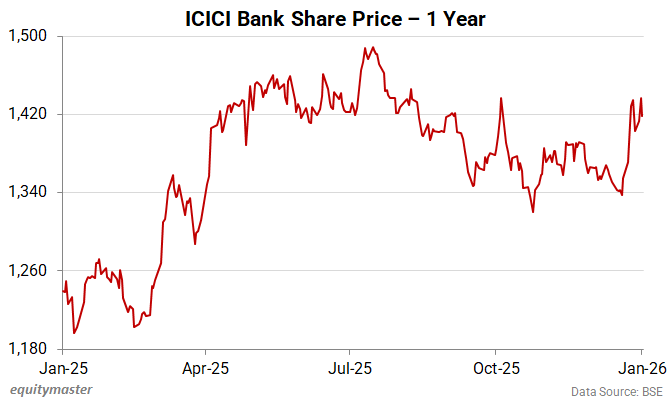
In the last five trading sessions, ICICI Bank shares have fallen from Rs 1,425 to Rs 1,412.
The stock touched its 52-week high of Rs 1,494.1 on July 31, 2025 and a 52-week low of Rs 1,187 on January 23, 2025.
For more information, refer to ICICI Bank’s factsheet and latest quarterly results.
What can you expect from ICICI Bank in the next three years?
Recent quarters of financial performance have shown decent earnings increases (9-15% in recent periods) rather than outliers. ICICI Bank has good asset quality, strong capital ratios and growing loans/deposits – classic signs of a mature bank.
That often means reliable performance rather than rapid stock movements.
In short, there is a good chance that ICICI Bank stock is likely to “travel along” with steady growth. It’s a large-cap private banking stock that’s expected to deliver respectable but not blockbuster returns unless something material changes in macro trends or earnings momentum.
Investors should evaluate the company’s fundamentals, corporate governance and stock valuations as key factors when conducting due diligence before making investment decisions.
Disclaimer: This article is for informational purposes only. It is not a stock recommendation and should not be treated as such. Read more about our referral services here…
#ICICI #Banks #share #price #years