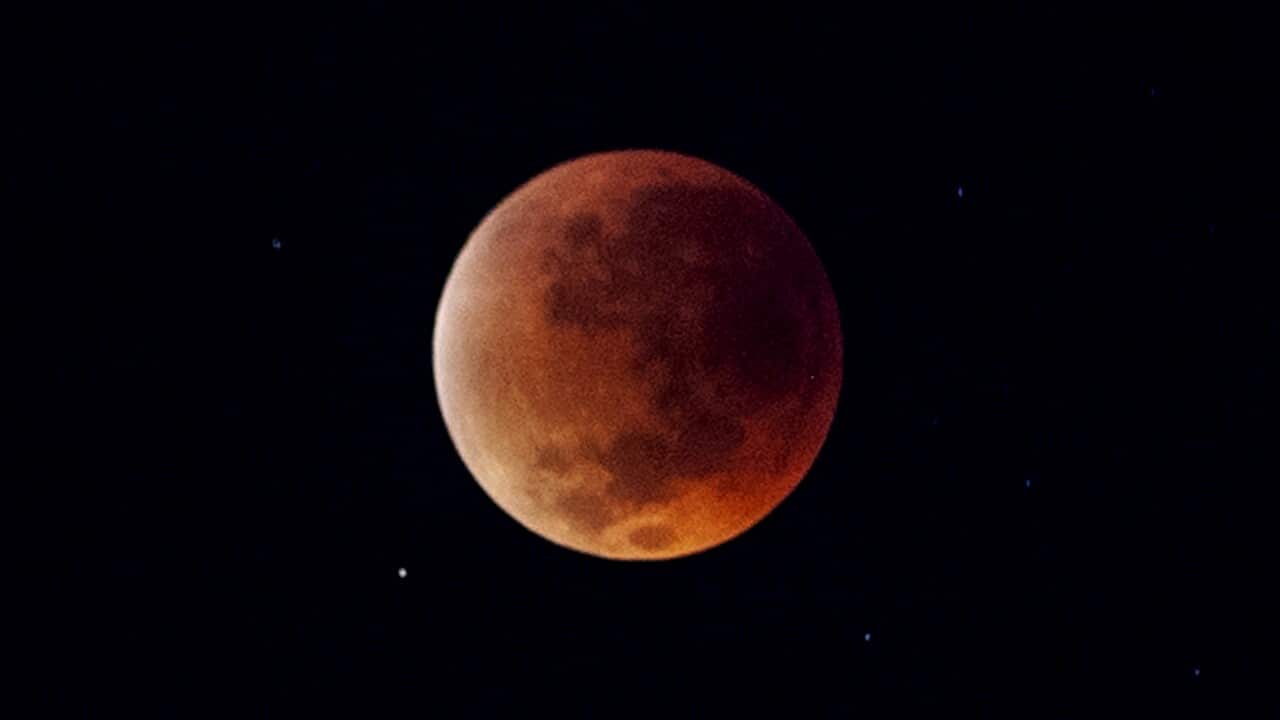

Stargazers across Australia will stay up late this Tuesday as the full moon turns red in a rare, “must-see” lunar eclipse.
On Tuesday evening, the moon will slowly slide into Earth’s shadow and glow deep red during a total lunar eclipse – the only ‘blood moon’ visible from Australia in 2026.
The transformation will be visible in every state and territory across the country, although the long-awaited phase of totality (lasting 58 minutes) will occur at slightly different times depending on time zones, according to Jonti Horner, professor of astrophysics at the University of Southern Queensland.
Unlike many celestial events that require special glasses or expensive equipment, this one asks you to simply step outside and look up.
What causes a lunar eclipse?
A lunar eclipse occurs when the Earth passes directly between the Sun and the Moon, casting a gigantic shadow over the Moon’s surface and turning the Moon a deep reddish orange during totality. This alignment can only occur during a full moon phase.
According to the National Aeronautics and Space Administration (NASA), there are three major phases:
Penumbral phase: The moon enters the Earth’s outer shadow (penumbra) and begins to darken, although this subtle shadow is difficult to notice.
Partial solar eclipse: The moon moves into the Earth’s inner shadow (umbra) and a dark “bite” becomes visible on the moon’s disk.
Total solar eclipse: The entire moon is contained within the umbra, gaining its copper-red hue as sunlight filters through Earth’s atmosphere before reaching the moon’s surface.
How can I view it?
The total lunar eclipse will be visible across Australia, with times varying by city: Sydney, Melbourne, Brisbane and Adelaide will see the total eclipse.
The partial eclipse will begin at 8:50 PM AEDT in Sydney and Melbourne, and at 7:50 PM in Brisbane and 8:20 PM in Adelaide.
The total solar eclipse, when the moon is completely in the Earth’s shadow, will begin at 10.04pm in Sydney and Melbourne, 9.04pm in Brisbane and 9.34pm in Adelaide.
“Only as you approach the time of totality will the rest of the visible moon dim enough that you can see the red color,” Horner told SBS News.
The moon begins to leave the Earth’s shadow at 11:02 PM in Sydney and Melbourne, 10:02 PM in Brisbane and 10:32 PM in Adelaide, making it a total of 58 minutes.
Perth will also capture a significant portion of the event, with the total solar eclipse starting at 7:04 PM and ending at 8:02 PM.
Why is it called a blood moon?
The term blood moon comes from the reddish hue the moon takes on during totality. Instead of going completely dark, the moon reflects sunlight that has passed through Earth’s atmosphere.
As blue wavelengths spread out, longer red wavelengths bend into Earth’s shadow, illuminating the moon’s surface in shades from rusty orange to deep crimson.
“What we see from Earth is that the moon takes on a kind of blood-red color, which becomes significantly fainter and that’s what we get as a blood moon,” Horner explains.
What else can I see on the night of the solar eclipse?
As Earth’s shadow darkens the moon, the sky around it becomes richer and deeper: familiar constellations can appear brighter and more detailed than usual, according to NASA.
Horner said the Milky Way may stand out more, especially in areas with dark skies.
Planets and fainter stars also become easier to see without the glare of a full moon.
How to best see the solar eclipse
To make the most of this beautiful event, find an open spot with a clear view of the sky.
Get away from bright city lights if you can.
If you’re shooting, use a tripod and longer exposure times to capture those deep red tones.
But while many people like to experiment with binoculars, cameras or telescopes, Horner said, for him the most memorable way to experience a total lunar eclipse is simply by looking with the naked eye.
“For me, it has to be with the naked eye. Go out with the people you care for and share this beautiful experience. Look up at the sky and see the moon grow eerie,” he said.
When is the next blood moon?
Tuesday’s total lunar eclipse is the only one visible from Australia in 2026 and is part of a rare global event. The next total lunar eclipse anywhere on Earth won’t occur until 2028.
For the latest news from SBS News, download our app And subscribe to our newsletter
#Australians #view #spooky #blood #moon