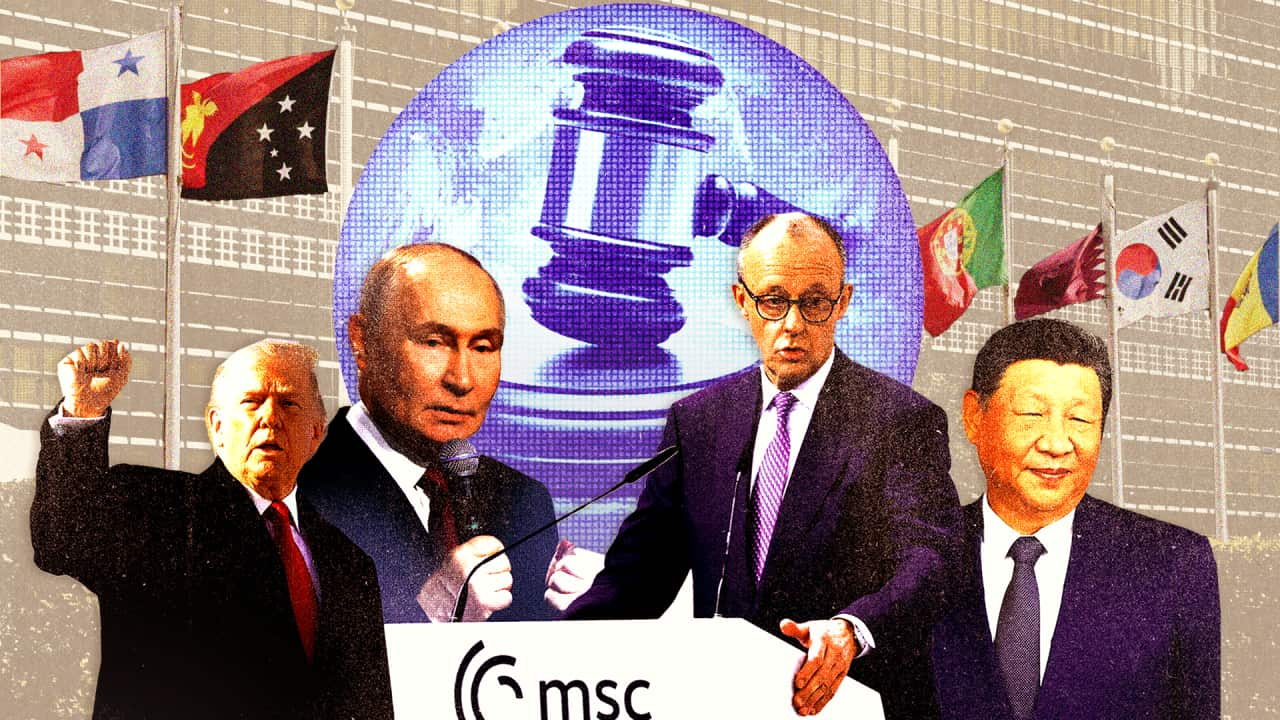

When German Chancellor Friedrich Merz declared that the rules-based international order “no longer exists,” he joined a growing chorus of world leaders issuing similar warnings.
In his opening speech at the Munich Security Conference last weekend, Merz told other world leaders that “our freedom is not guaranteed” and that the world had returned to an era of “great power politics”.
His comments echoed those of Canadian Prime Minister Mark Carney, who weeks earlier told the World Economic Forum in Davos that the world was “in the midst of a rupture, not a transition.”
Carney warned that middle powers such as Australia and Canada needed to work more closely together because “if we’re not at the table, we’re on the menu”.
“Stop invoking a rules-based international order as if it still functions as advertised. Call it what it is: a system of intensifying great power rivalry, with the most powerful pursuing their interests and using economic integration as coercion,” Carney said.
While neither leader mentioned U.S. President Donald Trump by name, both speeches came amid a widening rift between the United States and its Western allies.
Trump’s aggressive rhetoric over the annexation of Greenland – a territory of Denmark – along with his use of tariffs and criticism of the North Atlantic Treaty Organization alliance have shaken confidence in the post-World War II world order.
As Trump spent a new threat to Iran this weekthat an agreement on nuclear energy must be reached within ten days, he raised the risk of acting contrary to the wishes of the UN Security Council, of which the US is a permanent member.
SBS News spoke to two geopolitical experts who had differing opinions on whether Merz and Carney accurately described the demise of the rules-based order or exaggerated the crisis.
What is the rules-based order and is it being challenged?
The rules-based order refers to the international system in which countries interact with each other according to agreed rules, norms, and multilateral institutions, rather than through force or coercion.
The system, established after World War II and led by the United States, promotes free trade, security cooperation and state sovereignty.
Tom Chodor, senior lecturer in politics and international relations at Monash University, told SBS News that the US has historically supported the system through what he described as a “hegemonic approach”.
“Hegemony is a basis for a rules-based order, because you need one state that is more powerful than all the others, but willing to compromise and make concessions,” he said.
While authoritarian states have long challenged the system, especially by the Eastern Bloc during the Cold War, Chodor argues that it is now the US that is overturning the order.
“It imposes its will on other countries and doesn’t offer them much in return if they agree to do what the US wants them to do,” he said.
Trump has withdrawn from dozens of international organizations and agreements, questioned the purpose of the United Nations and a US-led Peace Council established to implement a peace plan for Gaza.
The US has also expanded its military presence near the Middle East in recent weeks, raising the prospect of new attacks on Iran following last year’s attack on Iranian nuclear facilities – a move that some experts say violates international law.
Professor Donald Rothwell of the Australian National University said Trump was not authorized by the UN to attack Iran last year, breaching his charter and also breaching the clause on the right to self-defence.
Russia’s invasion of Ukraine has also called into question the rules-based order’s core principles of sovereignty and territorial integrity.
Meanwhile, the rise of China and its growing global influence have disrupted the post-Cold War era in which the US was the sole superpower.
While middle powers could try to maintain the rules-based order without the US, Chodor said it becomes much more difficult when major powers actively undermine these efforts.
He cited a proposed plan from the International Maritime Organization that would require shipping companies to pay a tax on carbon dioxide emissions.
Although most countries supported the regulation, a final vote scheduled for last October was postponed for a year due to pressure from the US, including threats of tariffs, sanctions and visa restrictions against countries that supported the measures.
“You can negotiate nice rules among yourselves, but if the most powerful country attacks those rules, the system you are negotiating cannot function,” Chodor said.
Chodor said Australia was particularly exposed to a US “shakedown” through security arrangements such as AUKUS, under which Australia would acquire nuclear-powered attack submarines through the trilateral partnership with the US and the UK.
“If the US suddenly decides that it wants us to pay $15 billion to the shipping industry… we really have no choice but to say yes, because without that our ability to project force collapses,” he said.
He said the alliance also made Australia less likely to speak out against the US if it undermined the rules-based order, damaging Australia’s credibility with other countries.
‘More robust, more durable’
Not everyone agrees that the system is in decline.
Dr. John Blaxland, professor of international security and intelligence studies and director of the North America Liaison Office at the Australian National University, told SBS News that the rules-based order was more robust than believed.
He said countries continued to follow rules regarding trade resolution, international transactions and maritime regulation.
“These are things you can mock, you can say ‘it’s all over,’” he said.
‘They’re still functioning. We all have a stake in seeing this continue, even the United States.
“The rules-based order is in fact more robust, more enduring, and more profound than people are willing to give it credit for.”
Unless a global conflict occurred, Blaxland believed that a completely fractured multipolar world was unlikely to emerge, noting that countries are more interconnected than ever before.
He noted that the rise of China, a counterweight to American dominance, had occurred during the era of globalization and was underpinned by the rules-based order.
“The country has benefited enormously from that order and has shown no signs of wanting to overturn it,” he said.
A day after Merz’s speech, Blaxland noted that US Secretary of State Marco Rubio’s speech at the Munich conference struck a much more conciliatory tone towards Europe than Trump’s earlier rhetoric.
Rubio said Europe and the US “belong together” and reassured allies that it was “neither our goal nor our desire” to end the transatlantic partnership.
“We do not need to abandon the system of international cooperation we created, and we do not need to dismantle the global institutions of the old order that we built together. But these must be reformed. These must be rebuilt,” Rubio said.
Blaxland described the speech as a “circuit breaker” and could be a sign of the recovery of American and European relations.
For the latest news from SBS News, download our app And subscribe to our newsletter.
#rulesbased #order #Trump #threaten