

Dave Weisberger, former chairman and co-founder of CoinRoutes and now president of BetterTrade.digital, delivered a sharp critique of popular XRP price targets while laying out a structurally bullish – yet methodical – thesis for Bitcoin’s long-term value. In a November 10 video, Weisberger argued that Bitcoin’s investment case rests on verifiable scarcity and a distributed network with unparalleled uptime, while XRP’s path to sustainable advantage must be supported by tangible network revenue accruing to the token.
Weisberger framed investor behavior in basic principles: People buy assets because they expect them to rise and because they have a thesis about why they should do so. For Bitcoin, he said, this statement is the reemergence of “sound money” in a digital age. He positioned Bitcoin as the successor to gold, which according to him lost its monetary anchor after 1913 and finally in 1971.
“The idea of gold, where you have to trust the people who have what they say they have […] There is a lot of trust in the system,” he said. In contrast, “the idea of Bitcoin, which is maintained by a network of node operators that is incredibly large, global and distributed, […] it is demonstrably scarce. At the same time, it is programmatically scarce.”
Weisberger also highlighted Bitcoin’s open participation model, drawing a line between permissionless validation and the industrial reality of block production. “There are no barriers to entry […] If you want to run a node, you can,” he said, noting the economies of scale for miners. That, he claimed, sets Bitcoin apart from other crypto assets.
Why XRP price targets of $1,000 are ‘delusional’
Regarding XRP, he asserted that non-Bitcoin tokens must answer an equity question: How does the network generate revenue, and how does value flow back to token holders? “Your path to value should be the same as with stocks,” he said. The mechanism could include direct profit sharing, fees or required token usage, but “there has to be a reason.”
He warned that large financial institutions in systems that offer commoditized, switchable utilities could migrate as costs rise, naturally limiting fees and, by extension, token value. That switching dynamic, he suggested, limits the ceiling for XRP even under generous adoption scenarios.
Weisberger was explicit that he is not anti-XRP. Disclosing the position, he called the asset “potentially a good investment” with the opportunity to “appreciate a few times from here.” But he rejected extreme price claims as mathematically incoherent.
“What drives me crazy is these idiots talking about this in terms of $10,000 or $1,000 prices,” he said, contrasting XRP’s offering with Bitcoin’s. “There are literally 5,000 times more XRP tokens than Bitcoin […] if you think it will flip Bitcoin, say $21.” On four-figure goals: “$1,000, yes […] absurd on its face and clearly uncountable or beyond arithmetic.”
He also reiterated a divide that Ripple itself said it drew in its early years: “Ripple and XRP are not the same. One is a token. One represents an operating company.” While he praised Ripple’s move into prime brokerage — “a brilliant move,” in his words — he described the strategic goal as balance sheet strength and funding income, and not necessarily a continued token price increase.
“They need the XRP on their balance sheet to be robust because that’s what gives them their advantage,” he said, describing prime brokerage as a leveraged business augmented by software. He claimed that Ripple has been collecting components – “They bought Hidden Road. They bought Custodians. They bought other components.” – to build “what could be a very interesting company,” drawing an analogy to profit centers at Goldman Sachs and Morgan Stanley.
However, for the market price of
My take on XRP versus Bitcoin… Instead of focusing on one clip, this goes through logic. pic.twitter.com/xK27a3djs9
— Dave W (@daveweisberger1) November 10, 2025
Price spikes, he added, could even be counterproductive to the network economy. “If the price of XRP rises too much, they, like everyone else, will be somewhat forced to switch […] they won’t continue to subsidize it for long.” According to him, the sustainable equilibrium is one in which the ledger operates cost-effectively and any token appreciation is justified by usage-driven cash flows, not hype.
At the time of writing, XRP was trading at $2.44.
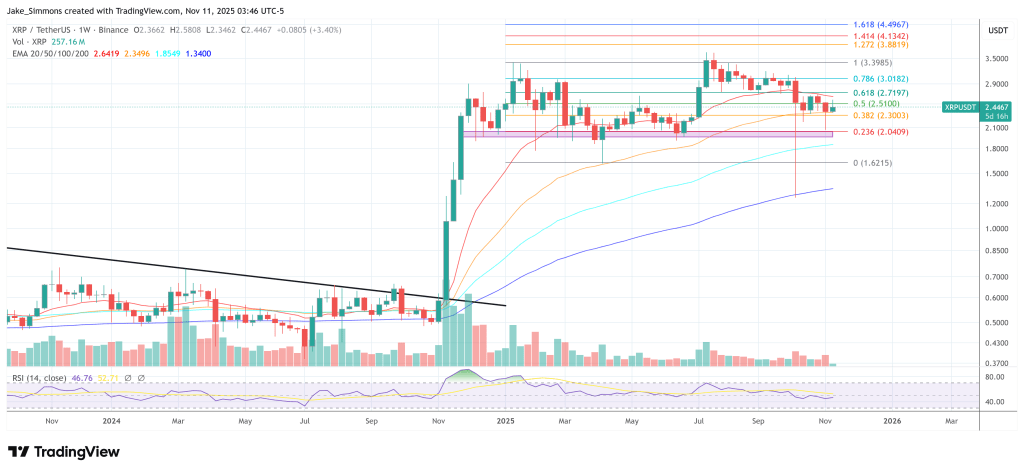
Featured image created with DALL.E, chart from TradingView.com

Editing process for bitcoinist is focused on providing thoroughly researched, accurate, and unbiased content. We maintain strict sourcing standards and every page is carefully reviewed by our team of top technology experts and seasoned editors. This process ensures the integrity, relevance and value of our content to our readers.
#Weisberger #torches #XRP #fantasy #delusional