

In 1970, men earned nearly six doctorates for every degree a woman earned.
Today that ratio has been reversed.
Women now earn the majority of college degrees at every level: associate’s, bachelor’s, master’s, and doctoral. As of 2020, women receive 61% of associate degrees, 58% of bachelor’s degrees, 61% of master’s degrees, and 55% of doctoral degrees in the United States.
This is no small demographic shift. It is a structural transformation of higher education that has taken place over the past five decades.
While men continue to dominate certain STEM fields such as engineering and computer science, women have surpassed men in higher education overall, including in advanced graduate programs that were once almost exclusively male.
How did this reversal come about? And what does this mean for the future of education, the workforce and economic opportunities?
Percentage of university degrees obtained by gender
This graph shows the percentage of college degrees awarded to women from 1970 to the present, based on data from Table 318.10 from the 2023 Digest of Education Statistics.
The number of women receiving degrees surpassed men for associate degrees in the late 1970s, for bachelor’s and master’s degrees in the early 1980s, and for doctorates in 2005.
Women now earn the majority of all college degrees. As of 2020, women earn 61% of Associate degrees, 58% of Bachelor’s degrees, 61% of Master’s degrees, and 55% of Doctoral degrees.

In 1970, there were about six men for every woman with a doctorate degree. Today, the ratio has fallen to below 1.0 (about 0.8), meaning more women earn PhDs than men. For Associate degrees the ratio is 0.6, for Bachelor degrees 0.7 and for Master degrees 0.6. These figures show that college degree recipients have a significant majority of women.

Growth in the number of university degree recipients
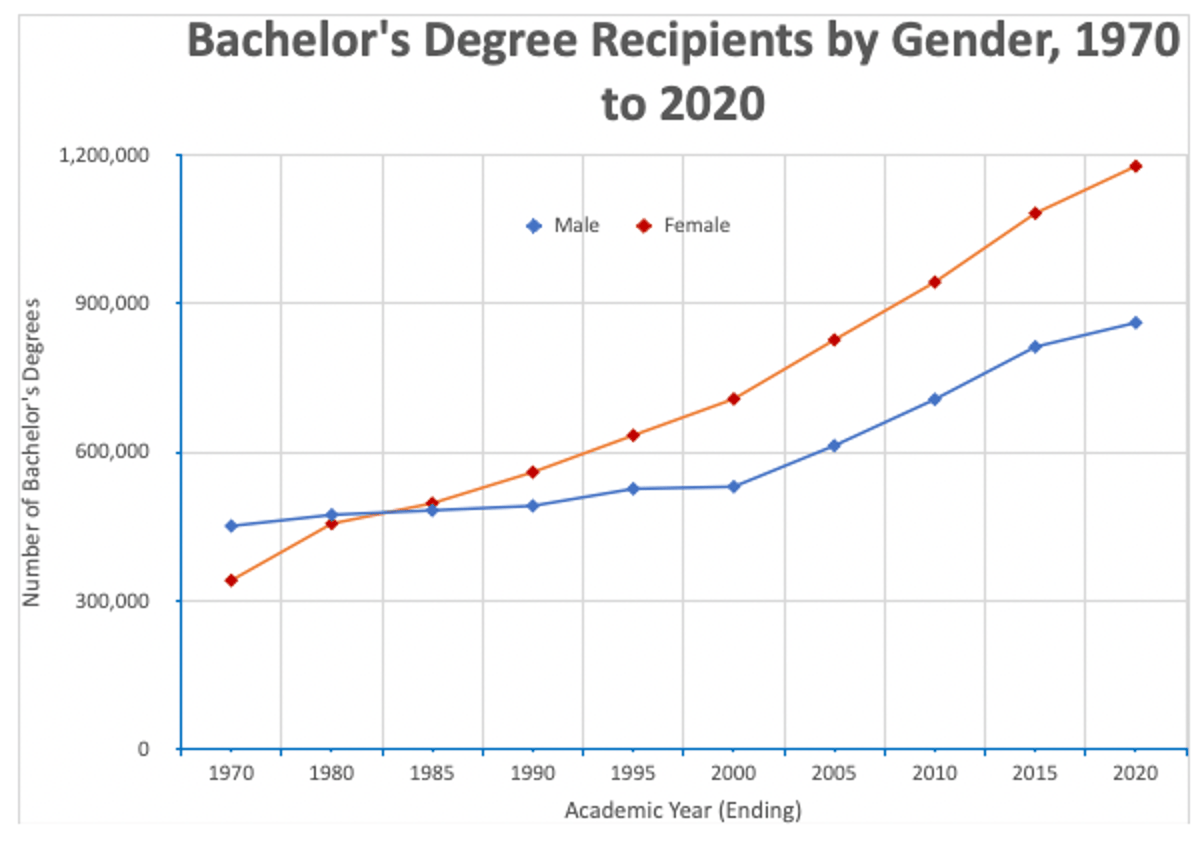
The number of male and female students has grown significantly over the past fifty years, but the number of female degree holders grew faster. The number of men obtaining a university degree grew from 753,000 in 1970 to 1,666,000 in 2020.
At the same time, the number of women earning a university degree annually grew from 518,000 to 2,426,000.
This graph shows the number of male and female bachelor’s degrees awarded per year. You can see that women surpassed men in 1985 and this has been steadily increasing since then.
The STEM Gap
These trends were not uniform across all areas, especially STEM.
This graph shows that while the number of STEM degrees for both men and women has increased, the number of degrees for women has not overtaken the number of degrees for men, as both have increased at about the same rate. The difference was fairly constant over time. The chart is based on data from Table 318.45 from the Digest of Education Statistics, 2023.

This graph shows the percentage of STEM degrees awarded to women. The percentage increased from 30.8% in 2012-2013 to 35.5% in 2022-2023. This is a small increase, although the trend is reinforced by the narrower range of the Y-axis in the chart.

Fields with high and low percentages of female diploma recipients
This data is based on the bachelor’s degree subset of data from Table 318.30 from the Digest of Education Statistics, 2022.
Some fields of study have a high percentage of female bachelor’s degrees. These include:
Women also tend to represent a high percentage of undergraduate students in the humanities:
- Library Science (91%)
- Education (83%)
- English language and literature (73%)
- Foreign languages, literature and linguistics (71%)
- Legal professions (71%)
- Liberal arts and humanities (64%)
- Visual and performing arts (63%).
Women also represent a slight majority of law enforcement undergraduate students (52%).
Women represent a lower percentage of bachelor’s degree recipients in STEM fields, including engineering (23%), computer science (22%), and mathematics (42%). They also represent a low percentage of undergraduate majors in history (42%), philosophy (34%), and transportation (13%).
Causes of the increase in the number of university degrees
The percentage of college degrees earned by women has changed dramatically over the past fifty years as legal barriers have fallen, economic incentives have increased, academic preparation has skewed in favor of female students, and cultural expectations have shifted.
The shift in the number of college degree recipients is most visible in doctoral programs, where women earned fewer than 10% of doctorates in 1970 and will receive the majority of doctorates (55%) in 2020.
Passage of Title IX of the Education Amendments of 1972 on June 23, 1972 abolished restrictions on women’s enrollment in selective colleges and professional schools. Title IX made it illegal for federally funded educational institutions to discriminate on the basis of sex.
This opened the doors to graduate programs, law schools, and medical schools that had previously been almost exclusively male. This change gave women access to professional careers that were previously closed to them.
Secondary schools were also forced to provide girls with equal academic opportunities, resulting in more and more girls entering preparatory education. Girls generally earn higher grades in high school than boys and are more likely to graduate, making them more likely to enroll and graduate from college.
The financial impact was also a strong incentive. The wage premium from a college education was higher for women than for men. A college degree helps women achieve financial independence.
Jobs traditionally held by women, such as nursing and teaching, required bachelor’s and master’s degrees and more rigorous training.
The transition from a housewife-centric society to a dual-income society has further reinforced these trends. The widespread availability of contraception allowed women to delay marriage and childbirth, giving them the time needed to complete rigorous professional training. As a result, the college degree evolved from a luxury to a fundamental requirement for women’s financial independence and professional identity.
Final thoughts
Over the past fifty years, the gender gap in higher education has not only narrowed, but also reversed. Women now earn the majority of college degrees at every levelincluding doctoral programs that were once male-dominated. This transformation reflects changes in legislation, the labor market, academic preparation and cultural expectations.
But the shift is not uniform. Men remain overrepresented in certain STEM fields, while women dominate the healthcare professions and many humanities disciplines.
Understanding these trends is essential for policymakers, educators and employers. Higher education determines workforce composition, earnings potential and long-term economic growth.
#surprising #gender #shift #American #universities