

In his house in Jalalabad, about 50 kilometers away from the epicenter, Dr. Sahak and his wife leave their bedroom to find their eight children in the hallway.
“I immediately thought of Herat,” the Afghan doctor told me in his late 40s, referring to the earthquakes that destroyed the western province of the country in 2023. “I could see that the impact would also be enormous.”
A resident of the Jalalabad area, he knew first-hand what this new disaster would mean for the northeast of the country, where extensive families all live under the same roof on remote, difficult to reach locations.
Within a few seconds, their houses would crumble from mud and loose stones. Roads would disappear under the rubble. Families would be buried alive while they slept.
The first calls
Dr. Sahak, who leads the local world health organization (WHO) Emergency Office, immediately turned to his Health Cluster WhatsApp group, a thread that connects hospitals, clinics and aid organizations in the region.
Reports started within Asadabad, the capital of the neighboring Kunar province, the most difficult affected area along the Pakistani border. The earthquake was very strong there, the most important hospital in the city told him. Some residents would probably be injured.
By 1 am the calls became more urgent: “We have received several injuries from different areas and the situation is not good. Give us support if possible!”
Racing on the monsoon
Dr. Sahak asked his WHO team to meet him in the warehouse of the organization in Jalalabad. While he and his colleagues drove through the dark, the rain began to fall – the monsoon who would complicate everything, from helicopter landings to ambulance runs, in the first hours of the reaction.
The auxiliary pipeline clicked in place soon. A truck was loaded with medical supplies at Who’s Depot and then transferred to Jalalabad airport, five kilometers away, before a helicopter from the Ministry of Defense to Pallets to the Nurgal District – the Epicenter of the earthquake, halfway asadabad and Jalalabad.
“Fortunately we were able to reach the most affected area quickly,” said Dr. Sahak.
© Who
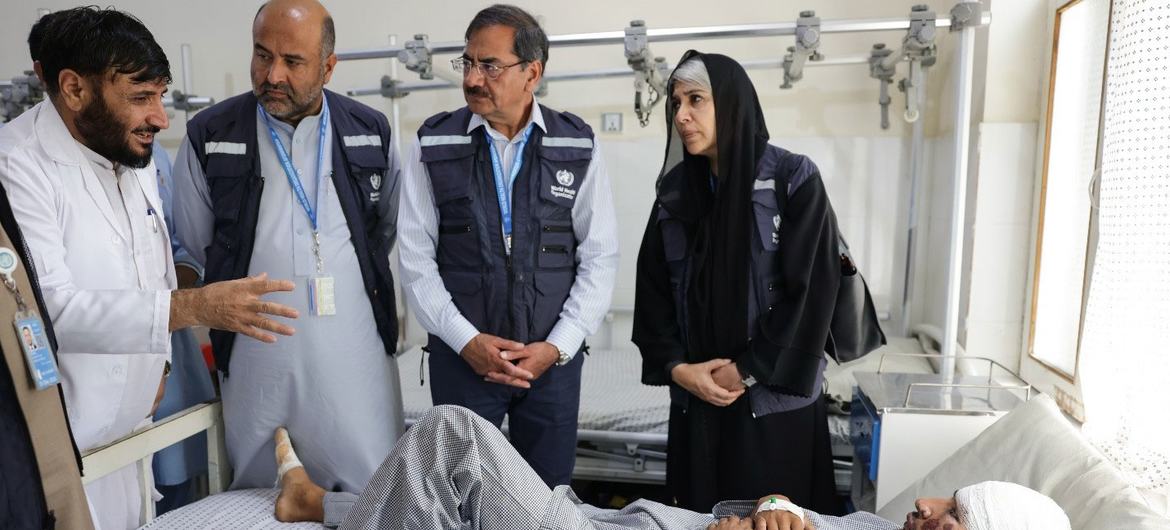
On September 2, 2025, Dr. visited Abdul Mateen Sahak and his WHO team a hospital in the province of Kunar to check the health services in emergency aid for people affected by the earthquake.
In the Nurgal district
His first field team came down to only four people: himself, a technical adviser, a focal point for emergencies and a security assistant.
Within a few hours they moved together in Afghan partners from two local NGOs, a force of 18 doctors, nurses and pharmacists – “six of them were female doctors and midwives,” he said. That first day, who managed to avoid 23 tons of medicine to the Nurgal district.
In the meantime, the victim figures continued to climb. “There was news that 500, maybe 600 people died. Thousands of injuries and thousands of houses were destroyed,” Dr. Sahak himself.
Five days later, the official toll is far -reaching: more than 2,200 dead, 3,640 injured and 6,700 houses damaged.
He and his team reached the Nurgal district on board an armored vehicle on Monday afternoon. “Many roads were closed because large stones fell from the mountains,” he said. On the lanes that remained open, crowds delayed the traffic – thousands of civilians who ran inside, most of them on foot, to help the victims.
“Where is my baby?”
Once there was Dr. Sahak, an experienced humanitarian employee, not prepared for the scale of destruction. “We saw bodies on the street. They waited for people to come in to bury them,” he said. Volunteers Reders flowed from neighboring districts to remove debris, wear the wounded and tend to the dead.
Among the survivors was a 60-year-old man named Mohammed, whose house was destroyed.
I couldn’t bear to look this man in the eyes. He was torn apart
“He had a total of 30 family members who lived with him … 22 of them had died in the earthquake,” said Dr. Sahak. “This was shocking to me. I couldn’t bear to look this man in my eyes. He torn.”
In the local clinic, walls were cracked by the vibrations, medical staff treated a rapidly growing number of patients under tents who were thrown outside.
Dr. Sahak met a woman with multiple injuries – pelvic fracture, head trauma, broken ribs. She struggled to breathe and could not stop crying. “She just kept saying:” Where is my baby! I need my baby! Please bring me my baby! “He remembered. Then he was silent. “No, no, she lost her baby. All her family.”
© Who
On September 2, 2025, Dr. visited Abdul Mateen Sahak and his WHO team The Regional Hospital of Asadabad, in the province of Kunar, to check the health services in emergency aid for people affected by the earthquake.
Women on the front line
In a country where strict gender rules regulate public life, the earthquake broke short barriers.
“In the first few days everyone – men and women – had saved people,” said Dr. Sahak. Female doctors and midwives can still work in Afghanistan, but only if they are accompanied by a male family member of hospitals. He also saw no female patients who were denied care.
In the first few days everyone – men and women – were saving people
The deeper crisis, he added, is the exodus of female professionals since the return of the Taliban in 2021. “Most specialized doctors, especially the women, have left the country … We have trouble finding professional staff.”
The impact reached his own house. His eldest daughter had been in Kabul in her fifth year of the medical school when the new authorities blocked women from higher education.
“Now she is unfortunately home,” he said. “She can’t do anything; there is no chance for her to complete her education.”
The fear of a family
From the start, the WHO task was to run clinics by offering technical guidance, medical supplies and clear instructions. It also meant offering encouraging words to the medical staff. “We told them,” You are heroes! ” Sahak himself.
As he encouraged local doctors, his family was back in Jalalabad after the news. He had spent a career with the running of hospitals and leading emergency reactions in Afghanistan, but this disaster came too close to home.
That first night, when he finally returned to his wife and children, it was his 85-year-old mother who first greeted him. “She hugged me for more than 10 minutes,” he said.
She reproduced him softly and tried to make him promise that he would not go back to the affected areas. But in the poor eastern districts of Nurgal, Chawkay, Dara-I-Nur and Alingar, tens of thousands of people trusted the WHO to survive. The next morning he was back on the path.
© Who
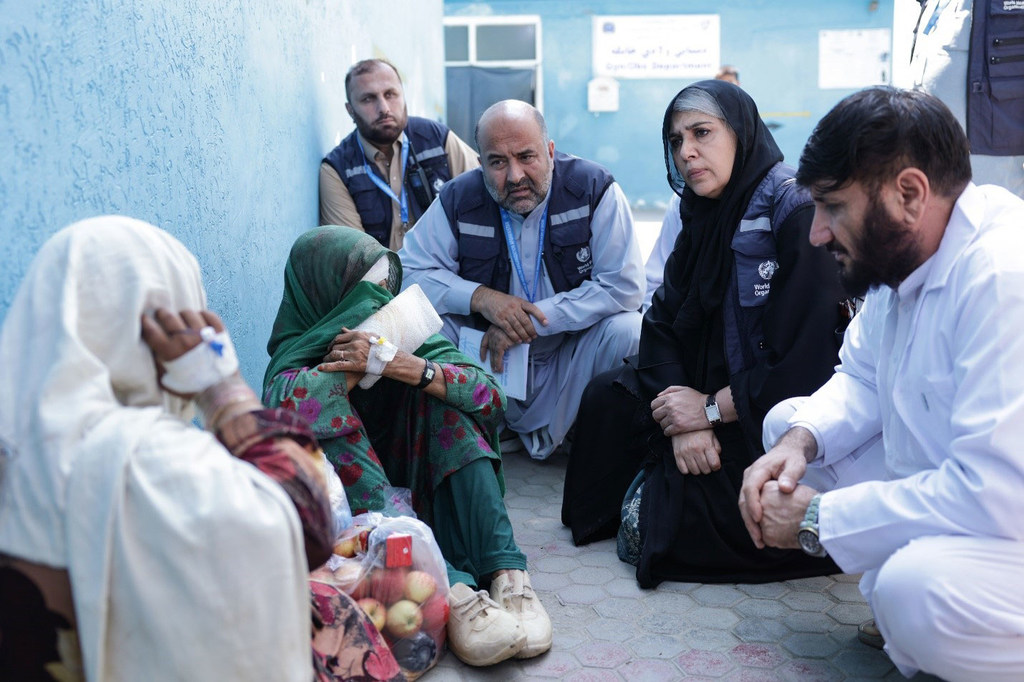
On September 2, 2025, Dr. Abdul Mateen Sahak and his WHO team Two women, in the regional hospital of Asadabad, in the province of Kunar, who had lost all their family members in the earthquake, on August 31, 2025.
Ledger of life and death
By Friday afternoon, when I spoke with him, the figures told Dr. Sahak the story of the emergency situation: 46 tons supplied medical supplies; More than 15,000 bottles of lactate, glucose and sodium chloride divided – intravenous liquids for trauma and dehydration; And 17 those supervision teams have used to follow the spread of diseases, which the agency will soon expect due to the destruction of drinking water sources and sanitation systems.
Who has asked $ 4 million to deliver life -saving health interventions and to expand mobile health services. About 800 critical patients had already been taken to the hospital in Jalalabad. Others were taken to the regional hospital in Asadabad, that Dr. Sahak and his team visited on Tuesday.
The words of a mother
In addition to the health facility, they saw two survivors who were driven along a wall by the sun in a narrow strip of shade – an older woman and her daughter, both recently fired, both alone.
They lived, but their remaining 13 family members were dead
“They lived, but their remaining 13 family members were dead,” said Dr. Sahak. There was no one anymore to collect them. The daughter seemed destroyed in her twenties: “She couldn’t speak.” Tears flowed over her face.
Dr. Sahak, moved by their plight, asked the hospital to keep them in a bed for a week or two. The director agreed. That night, at home, he told the stage to his family. “They all cried and they couldn’t even eat,” he said. By that time, even his mother no longer begged him to stay.
“Please go there and support people,” she told him.
#night #shakes #mountains #doctor #front #line #Afghanistan #earthquake