

The year of the splitter has come and gone. Actually, those of us who follow these things closely know that both 2023 and 2024 were considered the years of the split, and then in March we determined that 2025 would be the year of the big change. While major league pitchers had a 3.3% splitter rate in 2025, the highest since the pitch tracking era began in 2008, that represented a jump of just 0.21 percentage points from 2024. It’s a difference of less than one splitter per team every three games. Although the numbers are still rising, the big increases occurred in 2023 and 2024, with the pace slowing this year.
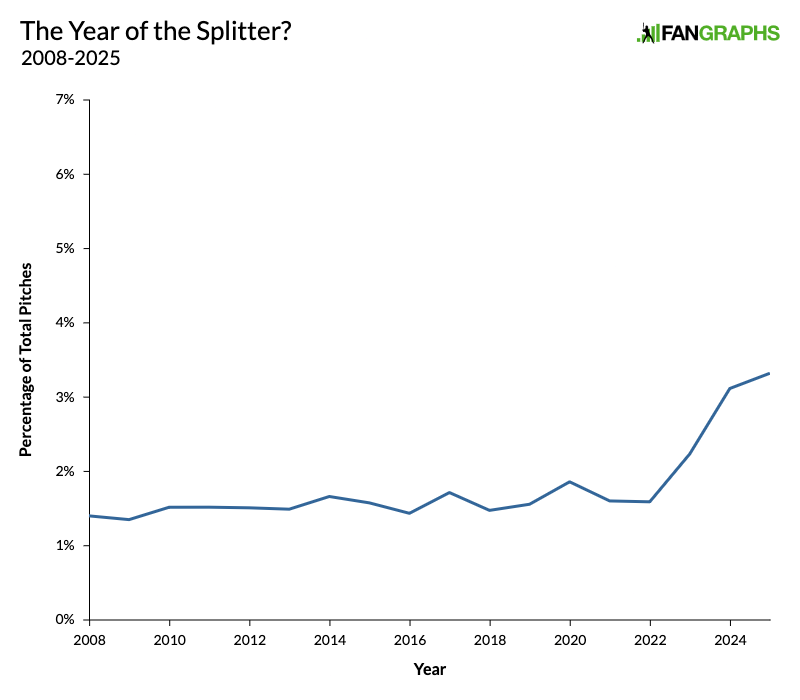
That graph makes it official. This is not the year of the splitter. But now let me add another line to that graph. That was the regular season. We’re in the middle of the playoffs, so let’s include the postseason. If you saw that first graph and wondered why I left all that empty space at the top, now you know.
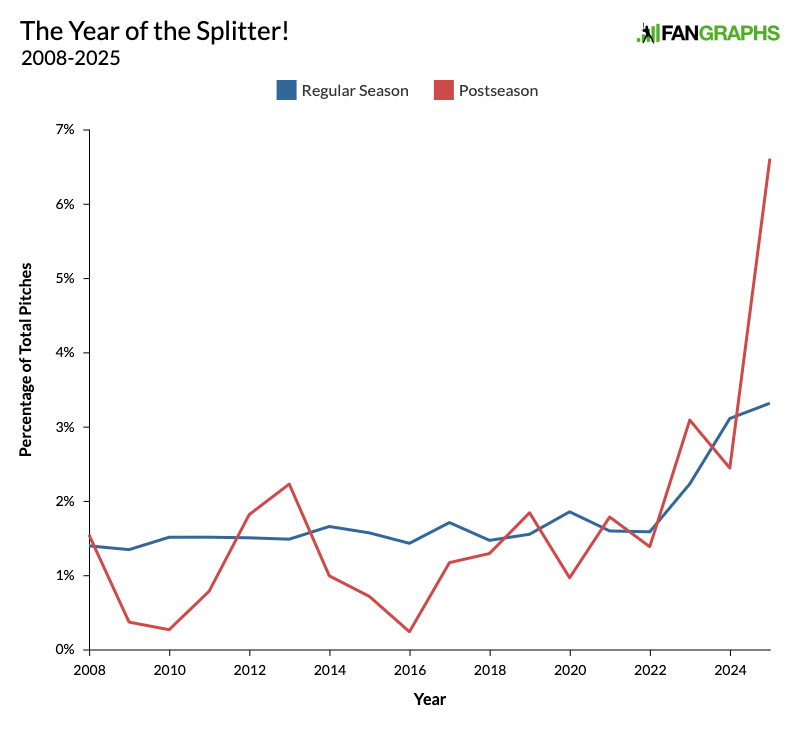
That’s more like it. A splitter explosion occurred in October 2025. The red line will always be more volatile than the blue line because the postseason is such a small sample size, yet the playoffs have seen a 6.6% splitter rate. That’s not only the highest we’ve ever seen. It is twice the rate for any regular season or postseason in the past 23 years. Maybe 2025 was the year of the kick-change, but October 2025 will most certainly be the month of the splitter. The playoffs aren’t even over yet and we’ve already seen more splitters in October than the 2023 and 2024 postseasons combined.
When asked why it is the month of the splitter, there is not one big answer. Instead, we have many small answers. It starts with the teams that made the postseason. Overall, they were pretty splitter-happy. Eight of the twelve playoff teams were in the top half of the league in splitter usage, and four of them were in the top 10. Together, they threw splitters 4% of the time, compared to 3.1% of the time for the teams that did not make the playoffs. The Blue Jays led the league with a splitter rate of 9.3% and the Dodgers were third at 7.1%, and their deep runs mean we may be able to push that 6.6% figure even further during the World Series. Additionally, nine of the twelve teams that made the playoffs increased their splitter percentage during the postseason. The Blue Jays are up to 16% splitters in the playoffs. Nearly one in every six pitches a Blue Jay threw in October was a splitter!
The same story applies to individual players. So far, 38 different players who threw a splitter during the regular season have thrown during the playoffs, but they have thrown much more often. During the regular season, these 38 pitchers combined to throw 18.3% of the pitches for their respective teams. During the postseason, these pitchers have thrown 36.2% of pitches. If you throw a splitter, your workload in the playoffs is effectively doubled! We had Kevin Gausman pitching on his side day, and Bryce Molenaar pitching on short rest. We had Roki Sasaki emerging as a closing closer, and Eduard Bazardo pitching in seemingly every single game.
Furthermore, at least some of those 38 players appear to have been chosen because they throw a splitter. I say that because as a group they throw splitters more often than during the regular season. Once you prorate the number of pitches they threw based on their regular season splitter percentages, you would expect those players to combine for a 16.7% splitter percentage in the playoffs. Instead, they combined for a splitter rate of 18.3%. The Tigers had the second-biggest jump in splitter percentage and are all at the top of the leaderboard. Rafael Montero, Kyle Finnegan, Casey MizeAnd Troy Melton all rose by at least 17 percentage points. The Blue Jays and Dodgers are right behind them, with entries from Sasaki, Jeff Hoffman, Trey YesavageGausman, and Shohei Ohtani rounds out the top 10.
All of this makes sense when you look at the postseason offenses. Yankees and Guardians hitters saw splitters 4.2% of the time during the regular season, which tied for the highest mark in baseball. Teams clearly thought they could attack them that way during the regular season, so of course the Tigers increased their splitter percentage during the playoffs against Cleveland. The Yankees had a .251 wOBA against splitters and a .342 wOBA against all other pitches. That 91-point differential was the fourth-highest in baseball. The Mariners had the seventh-highest gap, after which both the Yankees and Mariners faced off against the Blue Jays, the most splitter-happy team in the league. No wonder Toronto has pushed its splitter rate even higher! The Brewers had a 69-run lead, the ninth-highest in the league, and they were up against the Dodgers’ pitching staff, which had a 7.1% splitter rate in the regular season, the third-highest in baseball.
As for the World Series, we’ll definitely see a lot of splitters because of the pitching staff in question. Both the Blue Jays and Dodgers hit splitters exceptionally well this season, but declined sharply in October. The Blue Jays had a .345 wOBA against splitters and had a run value of 2.3 runs per 100 pitches. Both numbers were the best in baseball. Toronto was also the only team with a better wOBA against splitters than non-splitters. The Dodgers’ .298 wOBA against splitters was the fifth-best in baseball, and their run value of 1.2 per 100 ranked fourth. However, in the playoffs, both teams have posted a negative run value against the field with a combined wOBA of .170. Split-tober will likely continue.
#month #splitter