

As you may know, pickup trucks are designed to be easier to use than cars. While trucks can handle the everyday tasks, you wouldn’t normally expect a sedan to be able to tow 25,000 pounds of cargo. You wouldn’t expect a sports car to go off-road either, unless it’s a Lamborghini Huracan Sterrato or Porsche 911 Dakar. The use case is different and so manufacturers design their motors accordingly. Trucks (pickups or otherwise) are all about torque, which isn’t necessarily the case with cars. That explains why many pickup trucks and SUVs have the option of a diesel engine, while new cars (at least sold in the US) run almost exclusively on gasoline.
Essentially, truck engines are designed to handle a different type of abuse than a sports car. If only we had a reference engine to shed more light on the subject – something used in both a sports car and a pickup.
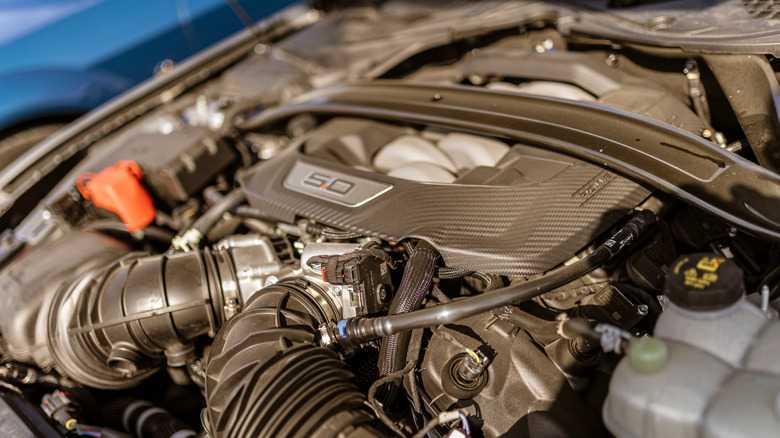
Enter the Ford Coyote V8. You’ll find the engine not only in America’s favorite pickup, but also in the world’s best-selling performance coupe, the Ford Mustang. However, if you didn’t know, the F-150 Coyote is not the same as the Mustang Coyote. The differences are certainly not subtle and, as mentioned earlier, exist mainly to meet the respective requirements of a pick-up and a sports coupe.
Is your Coyote a muscle car engine or a truck engine?
Let’s take the Gen 2 Coyote V8 (2015-2017) as an example. Looking at the power and torque specs, the F-150 Coyote makes 395 horsepower to the Mustang Coyote’s 435 horses, with both engines producing exactly 400 pound-feet of torque. However, the F-150’s V8 is tuned to produce maximum torque at 3,850 rpm, compared to the Mustang’s 4,250 rpm. As for peak power, the Stang’s 435 hp comes in at 6,500 rpm, while the F-150 revs at 5,750. And that’s just the spec sheet.
Underneath, things look more interesting. Although the pistons, connecting rods and crankshaft are the same, the F-150’s V8 uses cast iron exhaust manifolds, unlike the Mustang’s stainless steel components. The truck engine also has longer intake runners, with some sources claiming that the intake manifold sits a little bit higher than the Mustang’s, which has shorter intake runners. Because the F-150’s Coyote is torque biased, the camshafts, especially on the intake side, have a shorter lifespan. That means the valves close earlier, increasing cylinder pressure, which contributes to the engine’s low-speed torque. The Mustang, on the other hand, has long-life intake cams for better high-rpm performance.
Compression-wise, the truck engine runs 10.5:1 versus the pony car’s 11:1. Even their firing orders are different, with the F-150 using a 1-3-7-2-6-5-4-8 sequence, as opposed to the Stang’s 1-5-4-8-6-3-7-2. Other differences include the pony car getting an air collector and side-mounted oil coolers. The F-150’s timing cover has fewer ribs and both engines place the alternator in different locations. Gen 3 and Gen 4 Coyote V8 engines also have their differences depending on whether it’s a truck application or something a little more punchy.
#main #differences #pickup #trucks #car #engines