

Coconut is no longer just seen as a plantation crop. It is positioned as a complete agro-industrial ecosystem connecting farms, processing units and global markets. | Photo credit: MUSTAFAH KK
A major announcement in the budget is the Coconut Promotion Scheme, which was unveiled on February 1. The program focuses on replacing old and unproductive coconut trees with high-yielding varieties. In many coconut growing areas, aging palms have led to stagnant production and rising costs. The rejuvenation is therefore expected to deliver rapid productivity gains in the medium term. Farmers can receive financial assistance of around ₹37,500 per hectare for crop improvements. Additional grants cover up to 50 percent of pest and nutrient management costs.
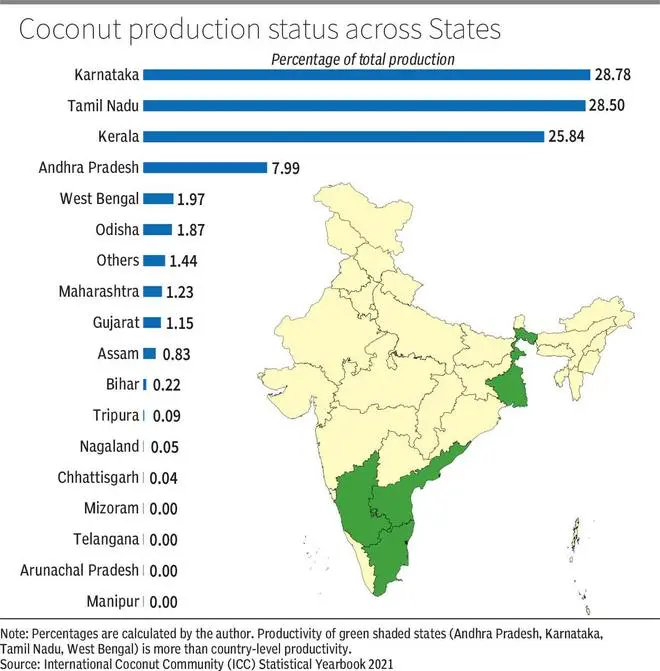
Production data indicate a strong regional concentration. Karnataka, Tamil Nadu and Kerala together account for more than 80 percent of India’s coconut production (see figure). Andhra Pradesh and West Bengal are also major contributors. The green shaded states (Andhra Pradesh, Karnataka, Tamil Nadu, West Bengal) record productivity levels higher than the national average. Higher productivity means faster income gains. It also strengthens India’s position in the global coconut markets. Thus, these four states can gain a clear advantage by taking advantage of the replanting and technological support announced in the budget.
Value addition
In addition to cultivation, the Budget places a strong emphasis on processing and value addition. Subsidies of up to 33.3 per cent, subject to a maximum of ₹50 lakh, are available for setting up units that produce virgin coconut oil, desiccated coconut powder and tender coconut water.
Demand for these products continues to rise, driven by health consciousness and export opportunities. The policy support is expected to attract new private investment in the sector.
In addition, the coir industry has received targeted support through the Mahila Coir Yojana. Rural women artisans are eligible for a 75 percent subsidy on motorized equipment, along with training assistance. New coconut production and processing units will also receive infrastructure support. This is likely to improve scale, quality and market access.
Outlook for FY27
Taken together, the budget measures indicate a clear shift in approach. Coconut is no longer just seen as a plantation crop. It is positioned as a complete agro-industrial ecosystem connecting farms, processing units and global markets.
The 2026-2027 financial year offers strong growth opportunities for farmers, processors and rural entrepreneurs. For the broader economy, the coconut sector could quietly emerge as a stable and resilient contributor in the coming year.
The writer is an Assistant Professor of Economics at Thiagarajar School of Management and is associated with SEBI as a Security Market Trainer
Published on February 17, 2026
#coconut #sector #receiving #policy #boost