

Since its discovery in Arezzo on November 15, 1553, the Chimera of Arezzo, which belonged to the future Grand Duke of Tuscany Cosimo I de’ Medici, immediately became one of the most emblematic and precious pieces of the Medici collection. But above all, it embodied one of the central points of the policies of the Duke of Florence and became a symbol of Tuscany’s continuity with the great Etruscan civilization. The bronze, which contains the power of a beast with the body of a lion, flaming mane, a goat’s head on the back and a snake-shaped tail, benefits from a new immersive look with a strong visual impact, thanks to the intervention entrusted to the Florentine architecture studio Guicciardini & Magni, which created it together with the museum’s technical office and curators.
The dramatic tension of Bellerophon’s wounded body gives way to an inscription on the right forelimb: tinścvil (“holy”), a consecration term originally referring to Tinia, the Etruscan Jupiter, which reveals the nature of a votive offering of the statue, probably placed by devotees in a sanctuary in ancient Arezzo, along with other bronze statuettes.”The Chimera – said the General Director of the Museums Massimo Osanna – is one of the most recognizable symbols of Etruscan art and the cultural heritage of our country. Giving it back a space designed to welcome it and tell it in new languages means putting the quality of the museum experience, the accessibility of the contents and the attention to the public at the center.”
Hall of the Chimera | Photo: © Mario Ciampi
The new layout offers visitors the opportunity to experience a personal and evocative relationship with the work that is a symbol of the museum and of the history of state collections, and also embodies its role as a symbol of Italian cultural unity. Its conservation actually took place in what was founded in 1870 as the Museum of the Capital of Italy – then located in Florence – the first national archaeological museum of the united Italy.
From the center of the space, rising from the monumental base designed by Goppion SpA, to enhance its plastic power and narrative tension, the mythical Chimera appears to float in a theatrical space, providing visitors with a contemplative experience, also thanks to the four benches surrounding the statue. To enhance the solemn appearance, the scenographic curtain is comparable to a curtain on which the shadow of the Chimera is projected. In a hanging display case are three small Etruscan bronze statues depicting a griffin, the Etruscan god Tinia (Jupiter) and a young sacrifice. They come from the same context in which the Chimera was found, creating a delicate dialogue between the works and their history.
The Iarussi Studio in Florence entrusts the anatomical details and the most dramatic features of the statue to the play of light and shadow, restoring the vitality and historical depth of the myth in which it is shrouded. The new route is enriched by an illustrative device with a renewed design that marks the beginning of the museum’s new graphic identity, curated by the Rovai-Weber studio.
“We therefore keep the promise – said Daniele Federico Maras, director of the museum – of a project already started by my predecessor Mario Iozzo and made possible by the generous financing of the American spouses Laura and Jack Winchester, friends of the city of Florence and its Archaeological Museum”.
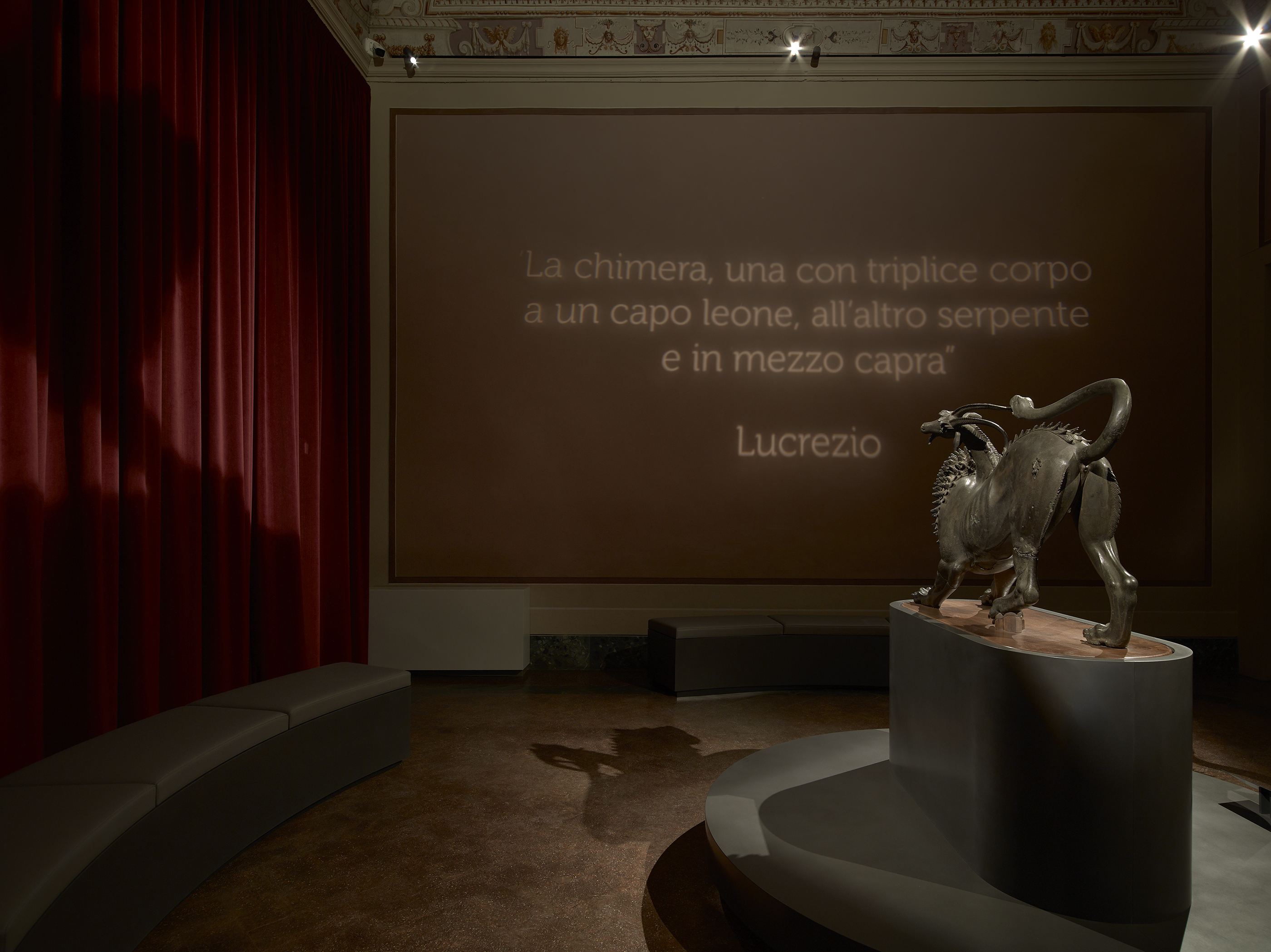
Hall of the Chimera | Photo: © Mario Ciampi
After this phase, the Florentine Museum’s commitment to renewal will continue with the renovation of the nearby rooms of Etruscan sculptures, where other masterpieces such as the Arringatore and the Lorenzini Head will find their permanent home.
With these initiatives, the museum honors the memory of the catastrophic flood in Florence in 1966, which brought the permanent exhibition to its knees and whose sixtieth anniversary will be celebrated on November 4, 2026.
Even during the renovation works, the public can continue to visit the National Archaeological Museum of Florence from Monday to Saturday from 8:30 am to 2:00 pm, with an extension until 7:00 pm on Tuesdays and Thursdays. Extraordinary openings are also planned for the new Chimera exhibition on Sunday, December 7 from 8:30 am to 2:00 pm and on the evenings of Wednesday, November 26 and Wednesday, December 3 from 6:00 pm to 10:00 pm, the latter coinciding with the “International Day of Persons with Disabilities”.
#Chimera #room #opens #National #Archaeological #Museum #Florence #immersive #experience #theatricality #contemplation #Florence #Arte.it