

The Calculus of Madness: Part 1
Sir Isaac Newton is enshrined in history as the saint of rational thinking. He decoded the laws of gravity, invented calculus and analyzed the rainbow. Yet in the spring and summer of 1720, perhaps the most intelligent man in the British Empire made a series of financial blunders, recorded for posterity, that were so catastrophic that they have become a cautionary legend in economic and investment history.
Newton’s entanglement with the South Sea Company serves as a stark reminder: in the face of collective delusions and market mania, even a genius can be led astray.
The mechanisms of mania
To understand Newton’s mistake, one must understand the vehicle of wealth destruction: the South Sea Company.
Founded in 1711, it was not initially a fraud – as many reports suggest – but a tool to manage Britain’s public debt. The scheme allowed creditors to exchange their government accounts for company shares, promising regular interest payments financed by the state.
To sweeten the deal, the government granted the company a monopoly on trade with the Spanish colonies in South America – the ‘South Seas’. Although the company engaged in trade (including the horrific transportation of enslaved Africans), its commercial activities were largely unprofitable in the early years.
However, in 1720 the company proposed a radical expansion: taking on most of the British national debt. This caused the first modern financial bubble. The hype was not based on goods sold or ships moored, but on the circular logic of the share issue.
The genius leaves… and comes back in
Newton was not a financial novice. We have evidence that Newton analyzed individual companies long before Ben Graham did so in the United States almost 200 years later. In a letter to his friend, the mathematician Nicolas Fatio de Duillier, Newton rejected a proposal to invest in a company that Fatio was promoting. Newton reportedly noted the low price of that company’s shares, and its unattractive fundamentals, noting: “Rents in Scotland are poorly paid and difficult to collect.”
Since 1696, when he was in his mid-fifties, he was also warden and later master of the Royal Mint after leaving his academic post at the University of Cambridge. He was a wealthy member of the elite, earning over £3,000 a year (putting him in the top 0.1 percent of earners).
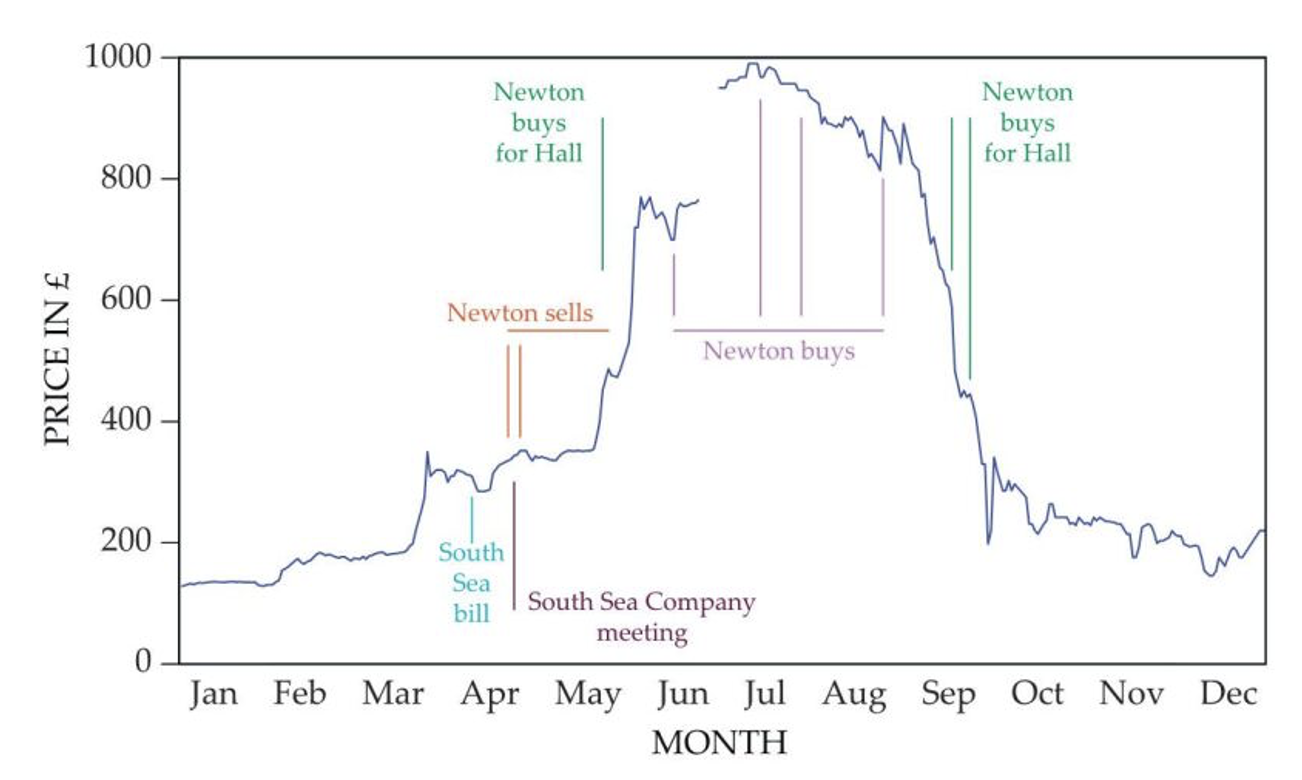
When the South Sea shares began their now infamous rise in the early 1720s, and at almost the age of 80, Newton was an early investor. Sensing that the market was overheating, he liquidated his South Seas holdings in April 1720 and walked away with a profit of around £20,000 – a huge fortune at the time. At an average inflation rate of 2.16 percent over 305 years, that £20,000 in 1720 has the equivalent purchasing power (excluding land) of £13.5 million today. With British land rising at an average of 5.7 percent, a £20,000 stake in British land would be worth £440 million today; the point was that Newton’s gain was significant.
Figure 1. Newton’s voyage on the South Seas
Source: “Newton’s Financial Misadventures in the South Sea Bubble”, The Royal Society Journal of the History of Science, Volume 73, Number 1 (March 2019).
Figure 1 illustrates the South Sea Trading Company share price, adjusted for dividends. The horizontal lines indicate estimated date ranges for trades, and the vertical lines indicate documented trades and trade instruction dates. ‘Newton purchases for Hall’ are transactions on behalf of the Hall Estate, for which Isaac Newton was executor.
If the story had ended with Newton winning, Newton would be remembered as a financial sage. But the bubble continued to inflate.
A sophisticated propaganda campaign – allegedly driven by the company – followed the passing of the South Sea Act. The publication of an abundance of pamphlets and newspaper articles attracted more than 80 percent of British investors at the time and resulted in an anonymous article in the newspaper. Flying Mail who used complex but flawed quantitative reasoning to promise infinite returns. A letter from a leading private banker of London, written in June 1720, advised: ‘If the rest of the world is angry, we must in some measure imitate them.’
The stock price shot up. Importantly, however, the managers of the South Sea companies never presented a business plan to the public explaining how they would generate substantial returns for their shareholders. Instead, the logic of the time was essentially a Ponzi scheme: the higher the stock price, the more money the company had, and therefore the more the shares were supposedly worth. Sounds a bit like current Nasdaq-listed Bitcoin Treasury company Strategy Inc (MSTR).
Between April and June 1720, and after he was sold, Newton watched from the sidelines as friends and colleagues became fabulously wealthy. Unfortunately, the psychological pressure of greed’s best friend – the “Fear Of Missing Out” (FOMO) – proved too strong to resist, even for the intellectual dean of physics.
In mid-June 1720, just as the mania was reaching its peak, Newton liquidated his investments in government bonds and poured virtually his entire fortune back into South Sea shares.
The severity of the crash
The collapse was as rapid as it was brutal. In September 1720, the market realized that the company’s profit expectations were mathematically impossible. The stock price plummeted. In October, shares were worth less than a quarter of their peak value.
Newton didn’t sell on time. By mid-1721 he had lost his initial profits of £20,000 plus a significant portion of his original capital. While he died a wealthy man in 1727 (with an estate worth about £30,000), the South Seas episode wiped out a huge percentage of his net worth.
Why did he fail?
It’s easy to dismiss Newton’s actions as simple greed, but an analysis of the Bank of England archives suggests a more nuanced psychological failure.
Newton was swept up in a powerful one groupthinkwhich was easier to indulge in at the time because financial sophistication in early modern society was low and financial institutions and products were relatively new.
Furthermore, it is possible that Newton’s professional brilliance may have worked against him, leading to hubris. As Master of the Mint, Newton was perhaps the most financially literate scientist in history at the time. He understood currencies, alloys and debts. Yet he failed to discover the structural flaws of the South Seas plan because the environment had shifted from economics to mass psychology.
A lesson for all ages
The story of Newton’s foray into stock trading in the South Seas is often concluded with a famous quote: “I can calculate the movements of celestial bodies, but not the madness of people.”
Whether fictional or not, the sentiment remains true. Newton’s financial disaster illustrates that intelligence is not a shield against market irrationality. When information is scarce or plentiful, but misinformation is rampant, herd mentality can overpower the sharpest minds.

He is also the author of the best-selling investing guide to the stock market, Value.able – how to value and buy the best stocks for less than they are worth.
Roger regularly appears on television and radio, and in the press, including ABC radio and TV, The Australian and Ausbiz. View upcoming media appearances.
This post was contributed by a representative of Montgomery Investment Management Pty Limited (AFSL No. 354564). The main purpose of this message is to provide factual information and not advice about financial products. Furthermore, the information provided is not intended as a recommendation or opinion about any financial product. However, any comments and statements of opinion should contain general advice only, prepared without taking into account your personal objectives, financial circumstances or needs. Therefore, before acting on any information provided, you should always consider its suitability in the light of your personal objectives, financial circumstances and needs and, if necessary, seek independent advice from a financial advisor before making any decision. Personal advice is expressly excluded in this message.
#Calculus #Madness #Part