

The third edition of the Las Vegas Grand Prix will once again be the coldest race of the Formula 1 season, with a night race in November with temperatures around 50 degrees. That presents a unique challenge for all teams, so who better to tell us about the quirks than the technical director of the team that scored a one-two here last year: Mercedes’ Andrew Shovlin.
“Las Vegas is difficult. This is a track where you take the low downforce Monza package and you kind of walk on it. And actually we’re at quite a high altitude here [2,000 feet -Ed.]which means you lose even more downforce because you have thin air.
“It is very difficult for the drivers to control the car with the low downforce. But with the length of the straights there is no option to use a big wing because you would lose so much in the straight line. You would never come back.”
“It’s a challenging street circuit. It’s very, very fast. The walls are very close to you. You have to use the entire available circuit. Mistakes are punished. But the drivers just do the usual: build up as the grip improves.”
“Besides just the downforce level here, if you have the tire temperature, you have grip. That’s the most important thing. It’s not like a normal track where you really feel the differences in the wing level. The most important thing here is: can you get the tires in the window? And if you have that and someone else doesn’t, you can end up being a second faster.”
When cornering at low speed, the car should drive low. Sam Bagnall/Getty Images
“We have a number of choices available to us at wing level. Our approach has been not to create unnecessary differences for 2024, so that determines where we start with the car.
“You have to take into account that the track will have little grip to start, so you have to reposition the car to get more stability compared to where you would expect during qualifying. And there are many options available.
“But once we see what problems we’re dealing with: are we getting the tires warm enough? Are they too hot? Is there a balance between oversteer or understeer? Are we grinding the tires? Once we know the answers to those, we can look at the specific solutions to those problems.”
“You have to drive the car low because of the low-speed corners, so you want the car to be as close to the ground as possible at the apex. So on the straights you end up on the road. But for a street circuit it’s actually quite smooth. There are some noticeable bumps, but overall it’s quite smooth and you can get the car quite low.”
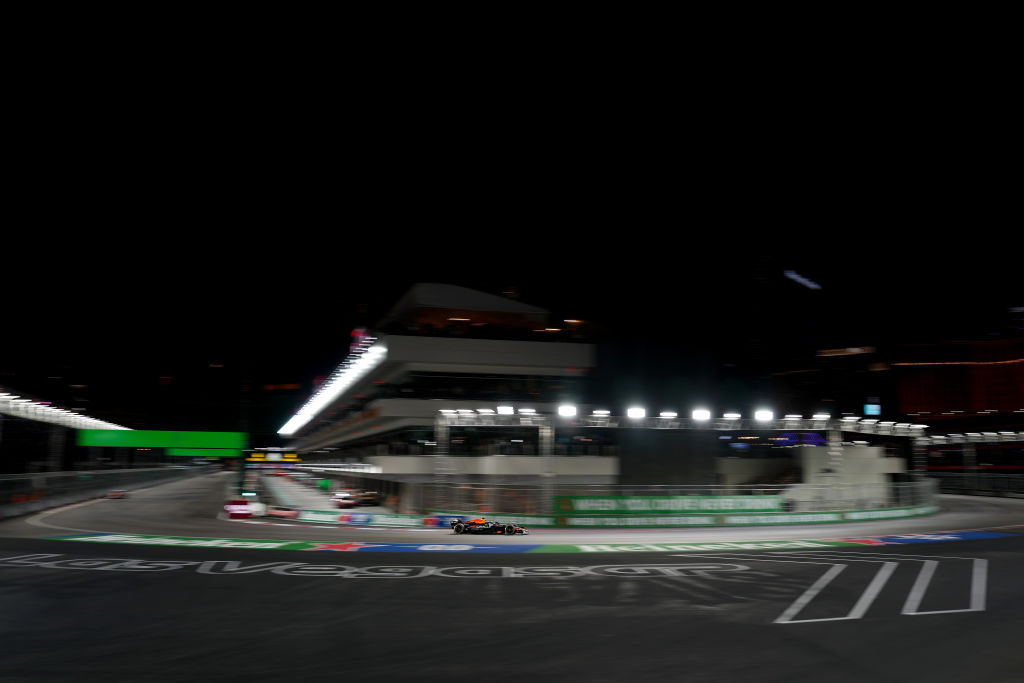
Although it is a street circuit, the surface is relatively smooth, although there are still many tire wearing elements at play. Alex Bierens de Haan/Getty Images
“You’ve got some really big stops like Turn 14. It’s about the biggest brake call you’ve had on the whole calendar. But honestly, on this lap the most important thing is how you got the temperature at the start of the lap.
“It’s quite a busy opening scene. And if you don’t have grip there, you lock the front or you slide. So the key thing is, can you build that temperature on the outgoing lap? And it’s one of those tracks where if the lap starts well, it normally ends well, because in a normal qualifying lap you’re actually trying to keep the tires cool. If the driver has a puncture, the temperature will increase, which will then punish him with less grip. This is actually one of the few few circuits [where] you don’t have to worry about that. So the drivers can let the car slide around a bit – it doesn’t cost them as much as on almost any other circuit.
“You have to look at the temperature of the tires in different ways. You have the biggest part, you need to build that temperature to soften the rubber so that it generates grip. And that’s one of the things you do on the last lap.”
“But then the surface is much more volatile than that. And as soon as you hit the brakes, you start to build up the surface temperature because you’re going to slide. As you go into the apex, as you get more power, more and more of that surface temperature builds up. And that’s what really drops on the straights.”
“So one of the challenges here is actually that when the drivers hit the brakes, the tires are too cold to generate good grip. And on that first hit you could end up: the grip is a little bit low, it’s easier to lock the front; they won’t get that nice feeling of the rear of the car being stuck.”
“But you have to trust that when you enter the braking phase, the temperature will rise and the tire will start to get grip. That’s one of the things they have to get used to in free practice, is how that grip is created.”
“You very often see a different performance order here. It is difficult to compare it with others because we only experience these temperatures during winter testing in Barcelona, and that is also a completely different circuit.
“If you were to ignore the ambient temperature and the track temperature, it wouldn’t be that different from Baku or maybe Montreal. However, that puts the tires in a region where we never race at any other track on the calendar.”
“That’s what makes it so unusual, apart from the fact that it’s quite a special place. When you saw where they were trying to organize a race you thought it was almost impossible to build a logical track here. But actually it’s a nice track – it offers good racing opportunities and hopefully it will do the same on Saturday night.”
AT A GLANCE:
Race distance: 50 laps/192.6 miles
Pole time 2024: 1m32.312s (George Russell, Mercedes)
2024 winner: George Russell, Mercedes
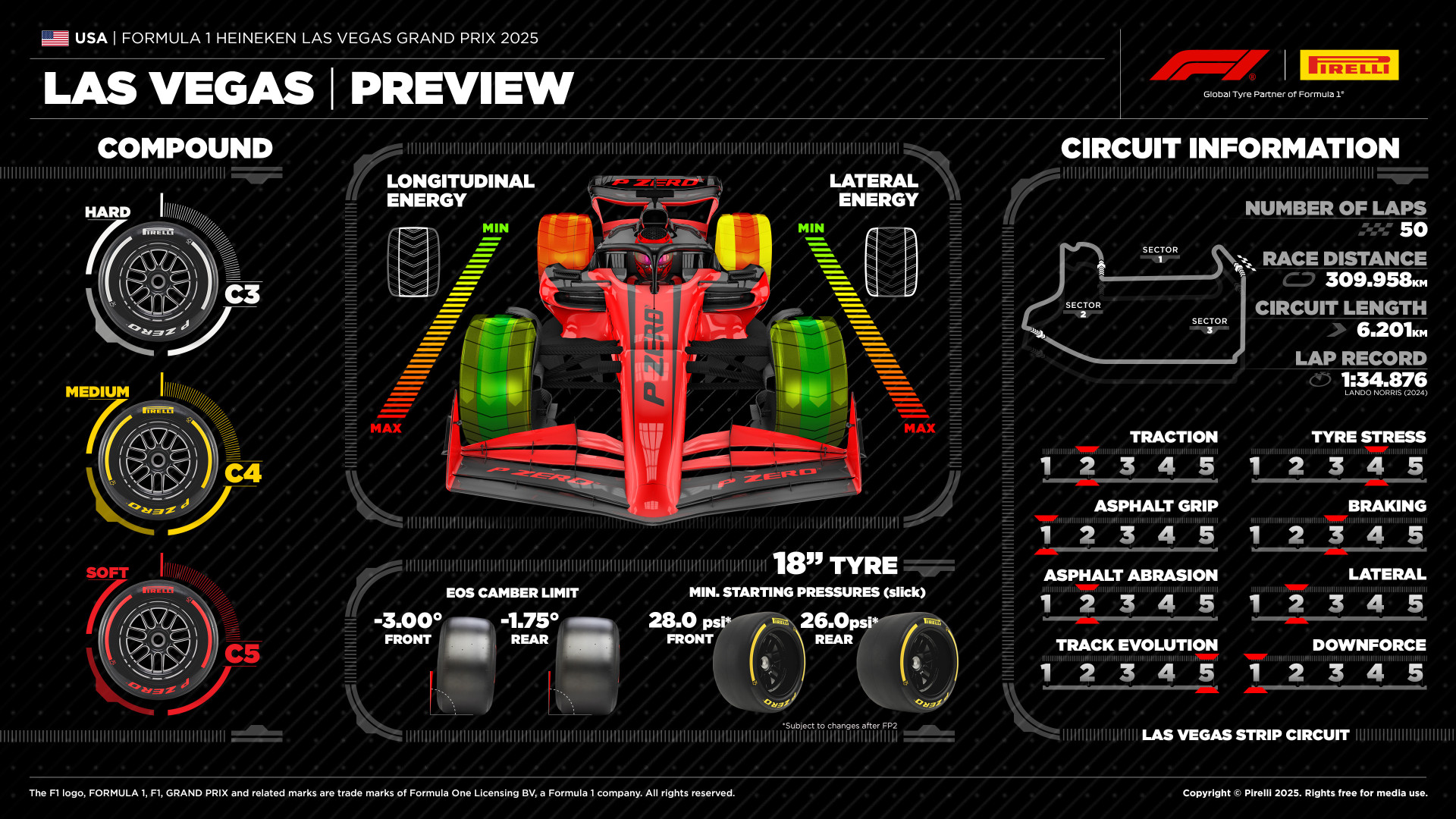
Before each Grand Prix, Pirelli provides teams with race strategy scenarios that are theoretically fastest, based on the specific tire compounds available that weekend. This is determined by extensive calculations that take into account numerous tire-related factors.
This approach requires a different methodology than that of the teams, even though the objectives are similar. All data is processed by proprietary software designed to identify the optimal strategies for one car on the track, with the aim of completing the race in the shortest time possible.
The first information to be analyzed concerns the performance difference between the connections, as identified in pre-event analysis performed by the modeling and simulation group. This is then added to historical tire degradation data from previous years at the same track, along with data from the same compounds already used in previous races during the current season.
An important parameter in the calculations is service life, the maximum number of laps a tire can complete before its performance drops to a level where replacement is preferable. These elements, together with other factors, make it possible to estimate lap times for each compound and, by also taking into account variations in fuel load, to identify the ideal periods for tire changes.
A key factor, which the teams consider very important when determining a one- or two-stop strategy, is the time it takes for the car to leave the pit lane, carry out the tire change and re-enter the track. This varies from circuit to circuit. Analytics are updated throughout the race weekend, with data from track sessions and what Pirelli engineers have learned from the product.
The teams, who have more data about their own cars, often use the so-called Monte Carlo method. This also takes into account random variables such as traffic, the likelihood of the safety car being deployed and how easy it is to overtake on each circuit, especially in the DRS zones.
HEINEKEN LAS VEGAS GRAND PRIX WEEKEND SCHEDULE (all times ET):
Thursday November 20
7:25 PM – 8:30 PM – Free practice 1, ESPNEWS
10:55 PM – 12:00 AM – Free practice 2, ESPN2
Friday November 21
7:25 PM – 8:30 PM – Free practice 3, ESPNEWS
10:55 PM – 12:00 AM – Qualifying, ESPN2
Saturday November 22
10:55 PM – 1:00 AM – Las Vegas Grand Prix (50 laps or 120 minutes), ESPN
#Setting #car #Las #Vegas #RACER